Christian purpose of fasting or self-denial

Today’s quote about fasting:

16 Lent--week 2 - fasting--Foster

There are several good reasons why Christians might fast or practice some form of self-denial. One reason is found in these words from Richard Foster, reminding us that when we fast, we are to replace the time and energy we spend on one thing (i.e., preparing and eating food) with something of even greater value.

This makes me think of Jesus’ 40 days in the desert. During his desert time, Jesus wasn’t doing active ministry or working in the carpenter shop or even visiting family. Jesus was practicing a kind of self-denial in order to  have some time alone for prayer.  It’s not that ministry, work, family togetherness are bad–they are good things. However, Jesus knew he needed some time to deepen his relationship with God in prayer.

So, when we fast or “give up” something for Lent, it is good to replace it with something even better. If we give up chocolate, we can replace it with fruit or vegetables. If we give up social media, we replace it with prayer or acts of kindness. If we give up a meal, we give the money we would have spent on the food to agencies who feed the hungry.

Until next time, Amen! 


Fasting, priorities, and time use

[P.S. FULL DISCLOSURE: I’m eating a chocolate donut while writing about fasting!]

15 Lent--week 2--fasting--Hoste (click on image to enlarge)

I am not very good at fasting–so sometimes I think about other ways to “give up” something in order to have time for the really important things in life. For example, there is nothing wrong with relaxing with a little “screen time” (TV, social media, YouTube, etc.), but most of us would agree, it’s easy to get roped into spending an hour or two with our “screens” than what we originally intended. So sometimes I have given up some television time during Lent–and I find I suddenly have more time on my hands.

It’s not that what we are viewing is wrong (hopefully not), but rather that some of us (myself included) slip into habits involving increasing screen time–and without realizing it, we are saying things like:

  • “I don’t have time to read the bible”
  • “I don’t have time to go to church”
  • “I don’t have time for exercise”
  • “I don’t have time to read a book to my child”
  • “I don’t have time to volunteer”

We live in a time when people are working very hard to make ends meet–I’m not saying it’s easy to find time. Neither am I saying that anyone should feel they have to “earn” God’s love or feel guilty about things (such as TV) that are basically a part of life in our times.

However, it is good during Lent to ponder how we use our time. We humans are limited creatures–we have a limited number of hours in the day, and a limited number of years in our lives. Lent is a good time for us to examine:

  • What are my priorities?
  • What is most important in my life?
  • Is there anything I might want to leave behind in order to do something else of greater value?

Lent is a good time for experimenting with this sort of thing. It gives us a time frame in which to try out something new and see how it works. Some of my past Lenten experiments were of great help to me–and others didn’t work out so well. However, even the ones that “failed” were good learning experiences for me.

God be with you in your Lenten journey.

Until next time,  Amen! 

Prayer, Fasting, and Almsgiving

Today I’m reflecting on this quote about fasting:

14 Lent--week 2--fasting--Wallis (click on image to enlarge)

Fasting and prayer go hand in hand. As others have pointed out, “fasting without prayer is simply starvation.”

In the Christian faith tradition, prayer, fasting and almsgiving are a united trio –or ought to be.  For many, this trio of spiritual practices is an emphasized theme during Lent. When people fasted, time was saved in food preparation–and that time could be spent in prayer. The food they saved was given to the hungry. (Monks actually made extra loaves of bread to give to the poor during Lent.)

Thought to ponder:
How do you practice this “spiritual trio” during Lent?

Until next time, Amen! 


Connection between fasting and prayer

Thought for today…about fasting and prayer (my underline):

14 Lent--week 2--fasting--Wallis(click on image to enlarge)

I’m thinking it’s not that God “needs” our fasting, but perhaps the fasting, along with prayer during the fasting period, makes us more dedicated to our prayer intention or paying attention to God. Perhaps the fasting process could be used in such a way to remind us to pay attention to God.

I’m pretty horrible at fasting. I’m wondering if any of you have found fasting and prayer to work together well. What are your thoughts? Experiences?

Until next time, Amen! 


The True Spirit of Fasting

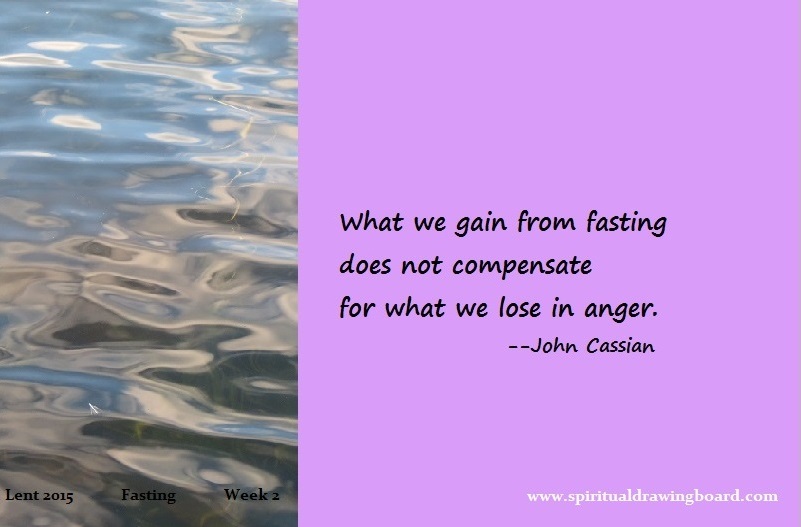
Today’s quote focuses on our attitude and how we conduct ourselves while fasting:

13 Lent--week 2--fasting--Cassian

I’m thinking Cassian was reminding the monks that their spiritual practice of fasting wasn’t really of value if they were hurting one another with their actions. It sounds as if he is saying: “What good is your fasting if you are turning up your anger volume in the meantime?”

Put another way, our Lenten practices should help us to grow in the Spirit in such a way that the fruit is kindness, mercy, love, etc. towards our neighbor. As our love for God grows, our love of neighbor out to be growing as well.

At least, that’s my musings on this quote.  Any one have other ideas? I welcome your comments below.

Until next time, Amen! 


Lent and Fasting

This week, I’ll be posting quotes related to the Christian practice of fasting. Fasting can take on many forms (for example, some people fast from social media or television during Lent). When it comes to food, I’m the LAST person who can teach you anything about fasting! So keep in mind, I am definitely using these quotes to preach to myself, to reflect about the spiritual practice…to help myself grow while sharing with you.

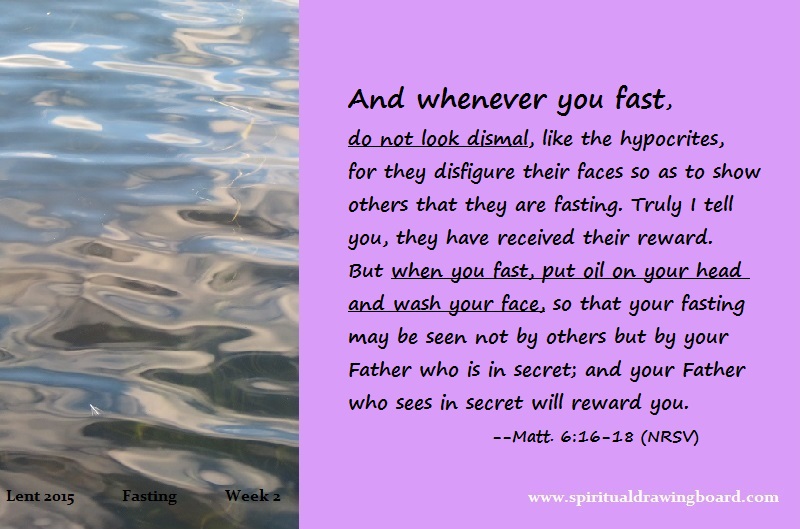
Today’s quote from Matthew 6 reminds us what kind of attitude we are supposed to have while fasting.

12 Lent--week 2--fasting--Matthew 6 (click on image to enlarge)

Whatever your Lenten practice, this has wisdom for how we are to conduct ourselves during this season of spiritual renewal. It’s a good reminder that we are not trying to “look better” or act “holier-than-thou” around others.

Until next time, Amen! 

Prayerful meditation–quote from J.I. Packer

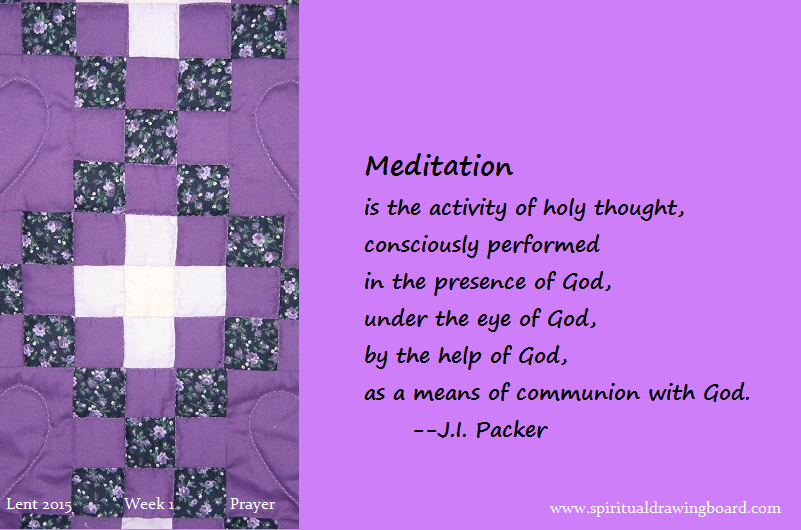
Thought for the day. . . about Christian meditation. . .

11 Lent--Week 1--Prayer--Packer

Christian forms of meditation aim at paying attention to God, or at least sitting quietly in the presence of God and allowing grace to work in the soul (whole person). This quote from J. I. Packer is “packed” with meaning for me (no pun intended!).

Until next time, Amen! 

Pray is the wing…and prayer is an eye

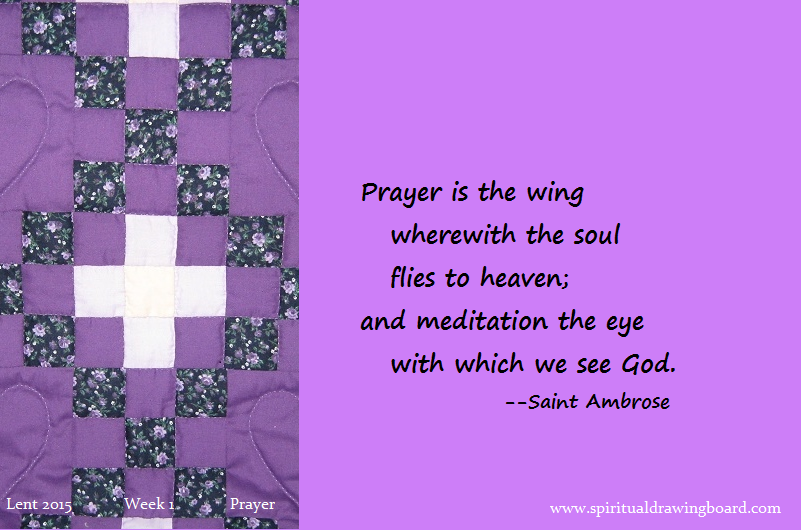
Here’s a thought for the day, about prayer:

10 Lent--Week 1--Prayer--Ambrose

Ambrose reminds us that prayer is a tool to bringing the soul into contact with the heavenly realm of God. Although God is always present (omnipresent), we are not always present and paying attention to God. When we pray, we are bringing ourselves into the presence of God.

Ambrose also speaks of Christian meditation as an “eye” with which we see God. To meditate on something, in this sense, is to ponder things in one’s heart in a prayerful manner. Some people meditate on a bible passage or particular truth of Christian belief (such as a portion of the Creed). Others meditate about the everyday events of their lives and how God is at work in those experiences, while writing in a journal, taking a walk, or sitting in a chapel. There are many diverse forms of Christian meditation (Christian “devotions” are a type of meditation).

Whatever way you like to pray, may God continue to bless you with the “wings” and “eyes” of prayer.

Until next time, Amen!


In our weakness God is strength

Today’s text is from 2 Corinthians 12:8-9.

09 Lent--Week 1--Prayer--Corinthians

We all have some weakness or other, some kind of ongoing suffering. It may be the physical condition that doesn’t go away, the struggle to overcome certain problems, or the various limitations in our abilities. As Christians, we believe that God loves us and showers grace on us despite these difficulties. We don’t have to be perfect in every way before God can love us.

In fact, the biblical writer above is reminding us that despite how things appear, God’s powerful love may actually be strongest when we are feeling very weak.

Don’t ask me to explain how this works, because it’s still a mystery to me. One thought I’ve had is that sometimes when I feel I just can’t manage something, I turn to God for help.  Perhaps this is part of the explanation, but I still don’t completely understand how all this works. However, I have come to believe this bible verse is  often true in my life.

Until next time, Amen! 


The Holy Spirit’s Work in Prayer

Sometimes we are tempted to stop praying because it “doesn’t seem like anything is happening.” That is, our prayer may feel boring, confusing, or useless. Sometimes these are just the normal phases of our own moods at work. It might be that God is inviting us to begin praying in a renewed or different way.( For example, some people pray while walking, write prayers in a journal, join a prayer group, meditate on bible passages, or like to pray in silence.)

These words of Evagrius, famous Christian of the 4th century, bring me comfort at those times when my prayer seems “boring” or “ineffective.”

08 Lent--Week 1--Prayer--Evagrius Ponticus (click on image to enlarge)

In the quotation above, Evagrius refers to some mysterious process happening inside us when we pray–some invisible action deep in our souls.  When someone prays, even if alone in his or her room, that person is not really alone. The Holy Spirit, the very presence of God in our midst, is with the praying soul.

When we open our hearts to God in prayer, the Holy Spirit is at work in our souls, in our whole persons, transforming us, like water slowly dripping on a rock. The Holy Spirit also fills us with the spirit of love and compassion for others during prayer time. As a result, this Spirit of Love also draws us more deeply into relationship with God and other people, a kind of communion with God and each other.

So, no matter how “futile” your prayer might feel, continue to pray. It’s important not to give up. If you think God is inviting you to a newer way of praying, seek out that new way–just so long as you keep praying. (Oftentimes, a spiritual director can help you seek out the way of praying that God is inviting you to at this point in your life.)

So, “keep on praying” . . . and until next time,  Amen!