Praying with “Migrant Mother” using Visio Divina

On the website Patheos, Presbyterian minister Tim Mooney writes about a prayer form called Visio Divina, a way of praying with sacred art or other images. Visio divina (“divine seeing”) models itself after lectio divina (“divine reading”), that time-honored Christian way of thoughtfully meditating on Scripture. (Read more about visio divina here.)

 Artwork and religious symbols often draw me into a quiet, reflective zone, so I decided to give visio divina a try and share my experience here at the Spiritual Drawing Board. Just so I wouldn’t have too many preconceived ideas, I looked for an image not usually found in churches, and decided upon Dorothea Lange’s 1936 photograph called “Migrant Mother.”

 Experiencing Visio Divina

As the article on visio divina recommended, I set aside 20-30 minutes for the process. After asking the Holy Spirit to guide my prayer, I spent a little time just observing the various parts of the picture:

  • The woman’s sleeve is tattered. She has no make-up and there are wrinkles near her eyes.
  • Why do the children hide their faces? Are they ashamed to be seen?
  • The baby on her lap is wrapped in an oversize garment and has dirt on his or her face.

 The woman looks to be 40-something, but I know from my reading that her name is Florence Owens Thompson, 32, married mother of seven children. In this photo, taken during the Great Depression, she is sitting in a three-sided lean-to canvas tent. (View other pictures taken that day here. )

These facts make me think about the economy of today and people who suffer around the world, especially the homeless, many of whom are children. I imagine the faces of other migrant women of various races and ethnicities. Would I feel the same empathy for each of them as I feel for the woman in the picture?

 After praying for the grace to love all people with equal intensity, I focus my attention back on the picture once again. The woman’s expression haunts me. She may be worried, but she is determined. I think she is going to do whatever it takes to feed her children. With her hand placed under her chin, she reminds me of Rodin’s bronze sculpture The Thinker. Yes, I decide, she is indeed a strong woman, a brave woman, dead set on caring for her hungry children.

 I wonder, did Mary, the mother of Jesus, ever look so strong and determined? She, too, was a “migrant mother,” on the move with Joseph, first traveling as a pregnant woman to Bethlehem, then fleeing to Egypt to save her child from death, and some years later to Nazareth. Did the Holy Family ever experience hunger pangs? Surely Mary must have felt this same fierce love and deep resolve to do whatever was necessary to care for her Child.  

 Why have I never seen this look of strength and determination on the face of Mary in statues or paintings? Wouldn’t Mary have been radically committed to do all in her power to fulfill God’s will? Wouldn’t her love of God have been strong? Are these characteristics of Mary portrayed in sacred art but I just didn’t notice?

 Come to think of it, wouldn’t God have the same type of parental concern for us? Could we imagine the Divine Face looking something like this woman, in terms of her strength and determination? Doesn’t God love us as much—no even more—than the very best of mothers?

Observing the Results

Sometimes we think of Scripture as comforting, but the Word of God also challenges us to become more like Christ. I think the prayer form visio divina has the same potential. After the above prayer time, I observed myself feeling less whiney about my own inconveniences and more grateful. I found myself intentionally smiling at people who look “different” from me. And, when writing this post, I recalled that the Hosea 13:8 compares God to a mother bear, who expresses fierceness if her cubs are threatened or taken away. 

Spiritual Aerobics –Try visio divina yourself, using whatever image or artwork you like. Many musuems have artwork available online. For visio divina directions, click here.

Skillful Speech–Part One: What Jesus Taught

 
For everything there is a season, and a time for every matter under heaven. . .
     a time to keep silence and a time to speak. . .
                        –Ecclesiastes 3:1, 7b (NRSV)


I sometimes find it difficult to know when to speak up and when to bite my tongue. It seems that controlling what one says is one of the hardest things to master.  

These days many people are examining the problem of vitriolic speech  in our culture, talk so inflammatory that it is comparable to throwing sulfuric acid in another’s face. Some claim that caustic speech in the media is harmless because

Fighting Hippos–Photo by Melissa Schalke–Dreamstime.com

it’s only “entertainment.” Others decry the loss of a more genteel way of expressing ourselves. People on both sides value the freedom to speak openly in a democracy.

Rather than focus on legal dimensions or proper etiquette, I would like to look how we use words from a spiritual perspective.

Twisting the truth is as ancient as Adam and Eve, who both used words to shift blame away from themselves: when caught in disobedience, Adam blamed Eve, and in turn, Eve blamed the snake. Although their words may have seemed logical at the time, they were not able to hide the truth from God. 

While there is nothing new about distorting the truth or using words in an attempt to manipulate others, what is new in our time the ease with which so many of us can spread our words around the globe within seconds. The sheer vastness of communication today makes it more important than ever before to raise questions about the words we choose, the tone in which we convey messages, and the truthfulness of messages that we receive and pass on to other people.


What did Jesus teach?

While Jesus was not afraid to tell religious leaders when they were wrong, I find no evidence that he derived any pleasure in correcting others. Jesus was a kind, compassionate person who wanted all to be brought into communion with his heavenly Father, even those commonly thought of as “enemies.”         

In the fifteenth chapter of Matthew, we read about Pharisees and scribes criticizing Jesus and his disciples for ignoring the religious ritual of hand-washing before eating. Jesus replies by drawing attention to the ways the religious leaders were using rationalizations to break commandments even more basic. He calls them hypocrites and quotes the prophet Isaiah:   

This people honors me with their lips,
   but their hearts are far from me;
in vain do they worship me,
     teaching human precepts as doctrines. 
 
                                 —Matthew 15:8-9, NRSV  
 

From this, we can see that what is important to Jesus is that our words are genuine and in accord with our actions. It is not acceptable to rationalize our evil deeds or merely say we believe in God. Attitudes and intentions deep within us are what matters.

Later in the same chapter, Jesus emphasizes the importance of what we say, again focusing on the motivations of the heart:

 Do you not see that whatever goes into the mouth enters the stomach, and goes out into the sewer? But what comes out of the mouth proceeds from the heart, and this is what defiles. For out of the heart come evil intentions, murder, adultery, fornication, theft, false witness, slander. These are what defile a person, but to eat with unwashed hands does not defile.

                                    –Matthew 15:17-20, NRSV

 While the leaders were focused on religious purity laws, Jesus was more concerned about the ideas coming out of one’s mouth. He even says some words defile us because they arise from evil intent within our hearts. (Even if we succeed at fooling the people around us with clever phraseology, God still sees our hidden motivation.)

So how we use words is indeed important to Christ. If you are like me, you fall short of these high standards, and I will remind you that God understands our human weakness and will forgive anything we are truly sorry for having said or done. However, that does not take away our responsibility to at least strive, with the help of the Spirit, to improve the ways we communicate with one another.

There are times when it is the path of wisdom to remain silent. There are other times when the Spirit prompts us to speak, sometimes about something that others do not want to hear. At those times it is especially important to speak the truth in a compassionate manner.

 For the words that come out of our mouths—or spill onto the internet—have the power to heal others or hurt them, to bring people together or to push them towards war, to build up the kingdom of God with love or divide God’s family with hate.  Which path will you and I choose? 

 NEXT TIME:  Part Two: Insights from Buddhism about “Right Speech”


Spiritual Aerobics

Spiritual Aerobics

1. Reflect on this saying: “If you don’t have something good to say, don’t say anything at all.” When is this saying true? Is there a time when it is not appropriate?

2. What does your upbringing or spiritual tradition teach about speaking the truth? Does it have teachings about gossip, slander, telling half-truths, etc.? If you don’t know, ask your religious leader, read the sacred texts, or search the web.

Making Choices: What’s the next step?

A journey of a thousand miles begins with a single step.
            Chinese Taoist philosopher Lao-Tzu
  

A number of years ago, while discussing an issue with my spiritual director, I suddenly burst out, “I wish God would just give me a recipe for my life.”           

To this, the saintly elder nun replied, “What kind of God would that be?”  

This answer caught me off guard, and since then I have pondered its meaning many times. Certainly God gives us various guidelines for the spiritual journey, but God also gives us the free will to choose the many ways in which we can express our love.  

Would I really wish that God decided everything for me? Wouldn’t that make me a puppet on a string or a computer that was just programmed to act in a predetermined manner?

 If one believes, with Saint John the Apostle, that God is love, or at least believes in living according to the ways of compassion, then it follows that we are given freedom in order to choose the many ways in which to express a healthy love for God, self, and one another.  

 What’s the next step? 

When I feel a little “stuck” in a project or indecisive about something, I consider a question I first heard about in a spiritual direction training course: What’s the next step?   

Retreat leader Pierre Wolff describes this method in his book Discernment: The Art of Choosing Well (Liguori, Revised edition, 2003, pages 27-30).  Focusing on just one step forward in love can help us keep from giving up a seemingly monumental project before we even begin. One step at a time also keeps us from expecting ourselves to have everything figured out and the decision completed within an unreasonable time frame.  

I also find that simply taking one simple step helps me keep from putting off something indefinitely. I can sort one pile of clutter rather than set myself up to clear out all the cobwebs of my house in a day (an unreasonable goal that is destined for failure). If I am feeling “stuck” in a writing project, I can ask myself, what is the one thing I could do today to move it along? If I’m experiencing a strained relationship, I can select one little way to reach out to the person with compassion.           

 A journey of a thousand miles. . .

“A journey of a thousand miles begins with a single step.” This wise saying is attributed to Lao-Tzu, a major spiritual figure in Taoism. (Some say that the saying originated with Confucius.)  

I believe that it is true that the little tasks we do, the little decisions to love, the day-to-day ways we treat each other, gradually add up to something tremendous, as Mother Teresa was fond of saying, “something beautiful for God.”

However, there is another meaning to this saying that is not readily apparent in the English translation. According to the website Quotationspage.com, the original Chinese proverb can also be translated into English in this way: “The journey of a thousand miles begins beneath one’s feet,” or “Even the longest journey must begin where you stand.” It is explained that this translation means that actions are best when they arise out of stillness.  

That means, when you are thinking about a choice, or doing some action, stop to think about it first. Take a walk alone to think it over, meditate, mull it over a bit in your journal, or spend some time praying about it. Listen to where the Spirit is moving in your heart.  

Hmmm… Isn’t that what Jesus did when he went out in the desert to pray, before beginning his public ministry, before selecting his ministry companions?  

Just for today, let us ask ourselves, with the attitude of compassion, what’s the next step?   

For reflection: What do you find helps you make good decisions?

The Breath Prayer Revisited

A simple way to pray everyday

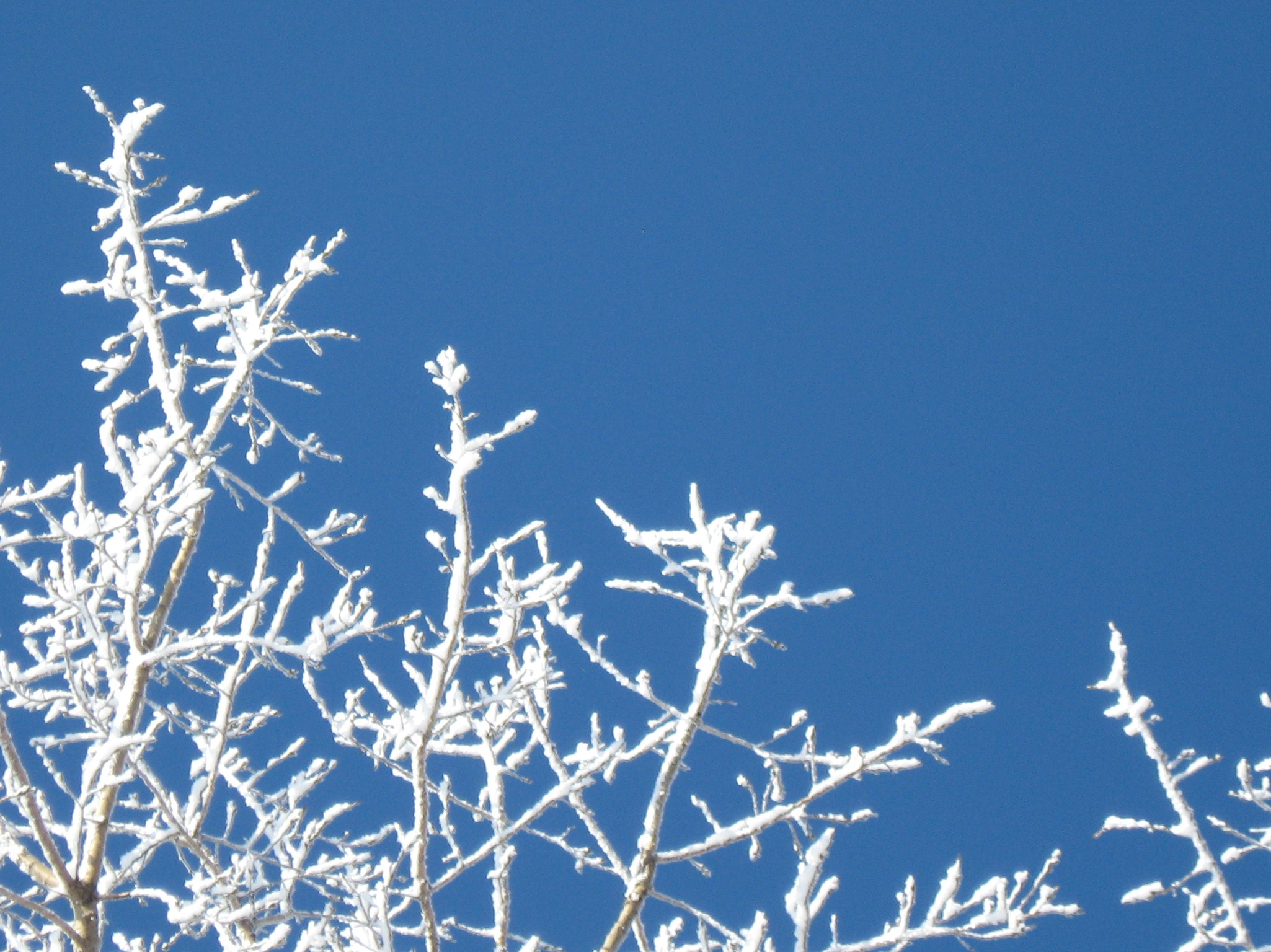
Blue sky with snowy branches in Eagan MN

A number of years ago, I published an article about the “breath prayer” a contemplative nun had taught me. Since then, I have found this way of praying to be such a blessing that I would like to share it with readers once again.

 There are many ways of meditating in relation to breathing, but this one is called the breath prayer because it only takes the space of one breath to say it.

 In the years since writing that article, I have found I like using the prayer of Jesus on the cross: “Father, into your hands I entrust my spirit” (Luke 23:46).  I can connect the first part of the sentence with inhaling and the second part with exhaling. (Do not hyperventilate. Prayer is not about creating “special effects”!)

 Over the years, I have developed a simplified version: “Your hands / my spirit.” This short version is like the code talk of lovers: God knows what I mean. Putting myself in God’s hands takes me out of my own self-focus of controlling, fixing, and do-do-doing, so that God can be in charge of the moment.

 Some Christians are concerned about using mantras or repetitive prayers, but I do not feel believe that is a problem in this case, unless you are counting up how many times you say the breath prayer and then expecting God to pay you in return for your effort.

 At any rate, there is no need to say the breath prayer a million times. After a while, you may find yourself drawn into a quiet space in the presence of God. At that point, by all means, let go of words. You may just feel like a little child resting in the warm glow of the loving arms of God. At that point, who needs words?


For more info, here is the original article  from 2003:

“Pray without ceasing,” writes Saint Paul in the First Letter to the Thessalonians (5:17).

“Isn’t that a sweet sentiment?!” I think to myself, somewhat sarcastically. How can the typical Christian pray always, even amidst rambunctious toddlers or ballistic office phones?

It is tempting to shrug our shoulders and leave all that endless praying stuff to the monks. However, I notice that St. Paul was not preaching to cloistered religious folk, but ordinary baptized believers like me.

Over the course of church history, to “pray without ceasing” has come to mean developing an ongoing awareness of God’s loving presence in every moment. Although we need specific “quality time” for prayer each day, we also gratefully recall the divine presence while washing dishes, meeting with a client, or repairing roof shingles.

A Carmelite nun I know (who wishes to remain anonymous) teaches visiting retreatants a way to encourage awareness of God’s presence through a method she calls the “breath prayer.” After forty-seven years as a nun, she has found the breath prayer to be a great help to people both inside and outside the cloister.

The breath prayer, Sister explains, is like the traditional “ejaculatory prayer,” because it is very short and can be used anytime and any place. However, when one prays the breath prayer, the words are said inwardly, slowly, and in unison with one’s breath. One recalls that we depend on breath for life, and it is the Creator who breathed life into us in the very beginning. God is closer to us than even our breath. If we do not breathe, our bodies die, Sister reminds us, and if we do not pray, we die spiritually.

To compose your own breath prayer, Sister suggests first selecting your favorite name for God (Spirit, Abba, etc.). Next, add a short phrase expressing your love or petition. “My God, I love you,” “Shepherd, guide me,” or “Jesus, help me to love like you” are three examples of breath prayers. Pray the first part of your prayer while inhaling and the second part while exhaling. (If you are tense—like me!—let the prayer slow you down. Do not overdo the breathing. Remember, the main point is to gently focus on God’s presence.) 

You can also use your favorite Scripture verse, in simplified form, for your breath prayer. For example, the words of Mary, “Behold, I am the handmaid of the Lord. May it be done to me according to your word” (Luke 1:38), can become the breath prayer: “Be / it done.” Jesus’ words, “Father, forgive them, they know not what they do” (Luke 23:34) becomes the breath prayer “Father / forgive them.”

After choosing your breath prayer, select some mental cues to remind you to pray during your average work day. For example, a teacher prays briefly every time the school bell rings. A dentist prays every time she washes her hands. Use your breath prayer when standing in line, downloading computer files, walking down the street, or even when feeling stressed or angry.

Over time, Sister says, the practice of the breath prayer prepares our hearts for other forms of prayer. Gradually, turning to God inwardly during daily tasks will become more and more natural, as natural as breathing itself.

Grandma’s Quilt

A thing of beauty is a joy for ever . . .   

                                                –John Keats, 19th century

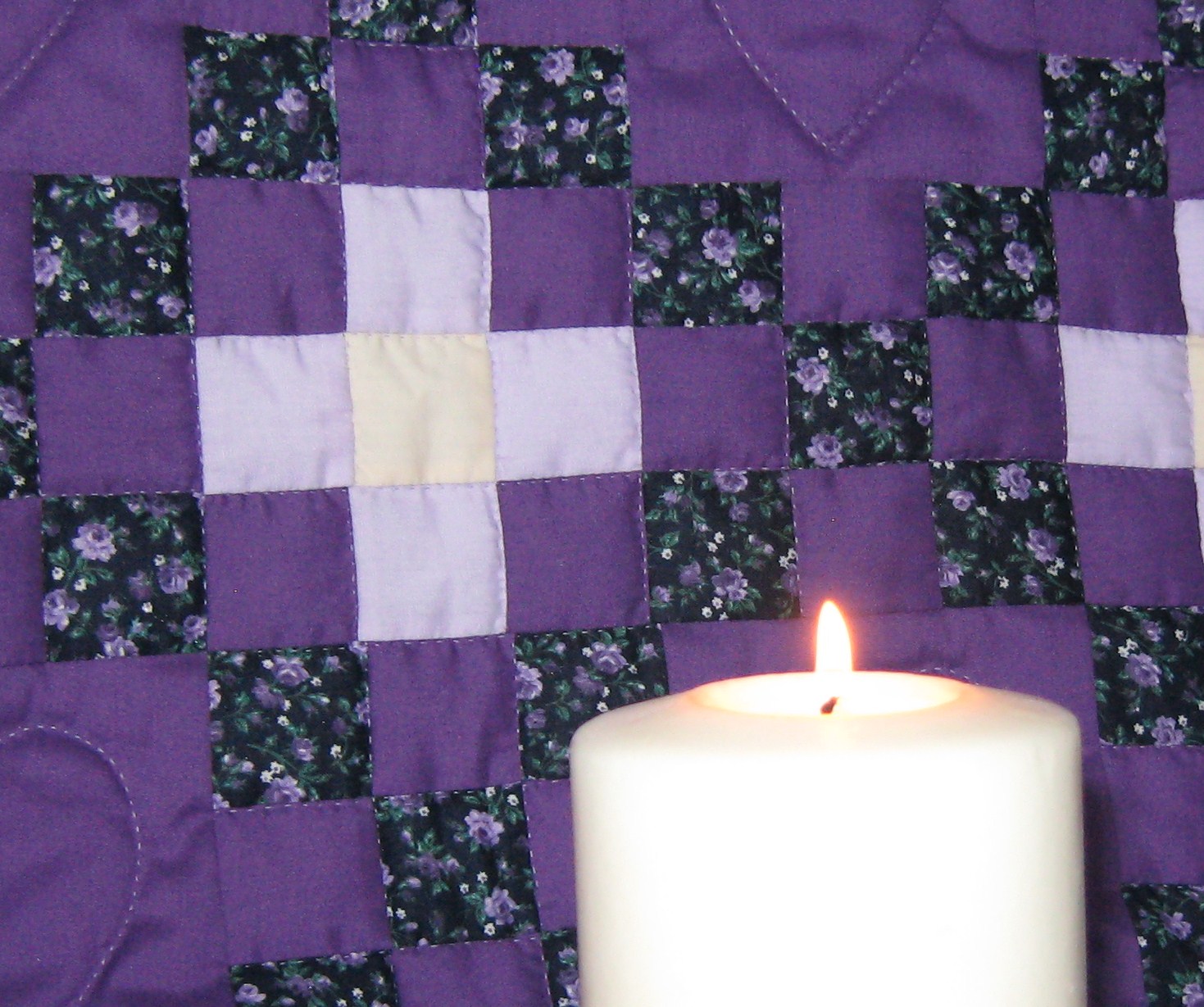
Amish Quilt from Minnesota

 The smallest things can make an impression on a child. I remember the first time I experienced the beauty of patchwork quilts. I was spending the night at Grandma’s house, and she covered me with one of her own quilt creations. As she explained the pieces, my eyes lit on fabric squares of the same cloth she had used to make my doll’s clothes. It seemed a kind of magic: the same fabric in both places? How did she do that?

 Quilts remind us that nature is not the only place that beauty can be found. People can use their God-given talents to co-create with God. One way this is expressed is in the way women arrange “little scraps” together to form something artistic, giving us a glimpse of spiritual beauty. When our eyes behold a striking pattern, we pause in delight, even if only for a second. This pause grants us a little rest from the busyness of life, an opportunity to whisper a prayer of thanks.

Juggling the many pieces of my life often feels helter-skelter and confused, but a quilt reminds me that God is sewing these elements together into a pattern. I just don’t see the bigger picture in the moment—a picture that is bigger and better than just I, me, mine. Continue reading “Grandma’s Quilt”

Sunrise over Eagan, Minnesota, USA

Every day God sends us beautiful images in the nature all around us, but I often miss these gifts because my mind is too occupied with planning, working, worrying, and a host of other things.

Sometimes, as I am writing, I pause in my work and look out the window. On the day I took this picture (see the header image above) the sun’s rays were painting a lovely work of art. I know from past experience that such a view is fragile and easily lost. I dropped everything, grabbed my camera, and now I have something that reminds me of the simple-yet-awesome works of God.

What you do not see in this picture is that I live in a very ordinary suburb (okay, it’s a nice suburb, but not really unusual as far as suburbs go) with very ordinary things going on beneath this sky: commuters are packing their cars and sleepy teens are trudging toward the bus stop. Houses form a haphazard pattern on what was once a huge area of farmland, a place where once the woods met the wild prairie lands.

These other things are not shown in the photo so that we might focus our hearts and minds on something other than our own doings for a moment: to observe the great beauty in this world, even in the midst of what can seem at times a real drag of work, day in, day out.

I believe God is immanently present to us, in our hearts, our work, our play, and our relationships. I also think that sometimes we need a sunrise like this to help us remember that God is also transcendent. The light in the sky reminds me that there is something beyond my own petty worries and obsessions. Whatever the sorrow and suffering in life—and there truly is a lot of that—God still loves us and wants to bring us to something better, something filled with love and beauty.

For reflection: Did you ever see a simple work of nature that warmed your heart, perhaps on the most ordinary of days?