Whom do you trust the most of all?

While reading Psalms this morning, this verse caught my eye:

Some trust in chariots and
some in horses,
but we trust in the name
of the Lord our God.   (Psalm 20:7)

Whom do you trust--light blue image--Julie McCarty--April 7 2014This psalm is written for those experiencing a time of great trouble, a time of stress and fear. (The first line is “May the Lord answer you in the day of trouble!”)  So I think that the chariots and horses are ways of defending the people, ways of keeping them safe in the time of attack.

The psalmist isn’t saying not to use chariots or horses, but rather that one’s ultimate trust, the One to actually worship and stake your whole life upon is God.

I wonder, if the psalmist wrote this for us today, living in our own culture and time, what would he or she write? There are many possible answers, but here’s one…  a bit of a stinging challenge to us all (Lent is a challenging time, isn’t it?!):

Some trust in private investment,
others in government programs,
but we trust in
the love and mercy of God.

That’s not to say we don’t need private investment or government programs. It’s that these things are not as important as placing all our faith in God.

Trusting in God doesn’t mean everything will “go my way”… That might be what some think, especially those who subscribe to the “gospel of prosperity,” but the God I believe in is much more mysterious and beyond my comprehension. God is not at my beck and call, like a servant waiting to answer my petty little whims.

For me, trusting in God means staking my whole life on the message of love and mercy that Christ taught.  It means being willing to go the extra mile or take the risk to try something new for the sake of others.

Trust means believing that, in the end, it doesn’t matter if I have wrinkles or the Vikings win or which political party has the majority in Congress. Trusting in God means believing that there is something more important and more valuable than any of these things–and that the love we practice here prepares us for the loving embrace of God in the next life.

And, yes, at times, we do this very poorly–but that’s no reflection on the truth of Christ’s message. The fact that we fail to follow through on parts of the gospel is one good reason for the season of Lent: to recognize our sins, faults, weaknesses, and ways we “miss the mark” in our relationship with God and others.

Trust means believing that despite these sins and failings of mine, Christ has overcome sin and evil–and that Christ will continue to overcome sin and evil both now and in the future.

Now it’s your turn:

How would you rewrite the psalm verse for today?
What is the Spirit of God leading you to think about today?

Lenten reflection--Some trust in -- by Julie -- April 7 2014

Feel free to share your answer in the comment section if you like.

May the good Lord bless you. . . Until next time, Amen!


Lenten reflection: Marc Chagall’s White Crucifixion

I haven’t had the opportunity to blog as often lately, but I thought some of you might like to revisit a reflection I wrote three years ago about Marc Chagall’s “White Crucifixion.” I really enjoy Chagall’s unique style, and the “White Crucifixion” is  an amazing work of art –and good for Christians to ponder as we draw closer to the special time of Holy Week.

The Holy Spirit works in mysterious ways: this post was brought back into my awareness when Pope Francis said “White Crucifixion” is his favorite work of art

White Crucifixion--oil painting by Marc Chagall, 1938
White Crucifixion–oil painting by Marc Chagall, 1938


I have found that reflecting on the “White Crucifixion” is a kind of visio divina— that is, a prayerful meditation on a work of art. It brings my mind and heart into the realm of paying attention to God. To read that post, visit April 2011 on this blog.

May the good Lord bless you with awareness of his loving presence in your life in the days ahead. . .

Until next time, Amen!

P. S.  If you enjoy this blog, look for “Spiritual Drawing Board by Julie McCarty” on Facebook. 


Trust in God–even in hard times (or poor weather)

Lately I’ve been working on lots of creative projects.  One is serving as coordinator for a Christian spirituality blog for Easter Lutheran Church.

At the same time, the weather has been pretty crazy this winter. I say winter, not spring, because yesterday we had serious snow swirling around and it’s currently 11 degrees F.   Again.

…and so it was, I enjoyed this post by Pastor Paul Harris about trust in God, no matter how wacky or trying things may be (for me, even poor weather–which is a much easier cross than others have):

May the God of all hope
fill you with joy and peace in believing,
so that you may abound in hope
by the power of the Holy Spirit.

 — Romans 15:13

In my late teens I had a great struggle with the Christian faith in which I had been raised.   After rejecting Christianity as both irrelevant and untrue, I found myself in a terrible disquiet of heart.  How could I live in a world without God; a world with neither moral nor spiritual guideposts?

After many turns and twists of mind and heart, I …

READ MORE at —>> www.easterprays.com  (March 24, 2014 entry)


Budding leaves--Trust in God--Julie McCarty


May the good Lord bless you with faith, trust, and perseverance.

Until next time, Amen!


Lenten Opportunity: E-mail book group about “Hearing God: Developing a Conversational Relationship with God”

Hearing God book cover

“Being close to God means communicating with him–telling him what is on our hearts in prayer and hearing and understanding what he is saying to us. It is this second half of our conversation with God that is so important but can also be so difficult. How do we hear his voice? How can we be sure that what we think we hear is not our own subconscious? What role does the Bible play? What if God says to us is not clear?”  — From the back cover of “Hearing God” by Dallas Willard. 

Lent begins today, and if you are still looking for some special way to observe the season, you might consider reading this book, “Hearing God: Developing a Conversational Relationship with God.”  As most of you reading this blog know, prayer is not just about chattering on and on to God. Prayer is also about listening to God, paying attention to the presence of God.

But precisely how do we do this “listening” when it comes to God? Is there something wrong with us if we don’t actually hear a voice with our ears or in our minds? Is there some other way of “listening”?

During Lent I am facilitating a “virtual” book study about “Hearing God” in a small group format using e-mail. A friend of mine from church did this last summer with a group of Christians using a different book, and I learned a great deal. It was very convenient because we just wrote our thoughts at whatever time of day we wanted. We shared with people from different parts of the country, too. Frankly for me it was both challenging as a Christian (it was that kind of book) and JUST PLAIN FUN. 

I already have a couple of people who want to discuss “Hearing God” in this way. If we have enough people (we need a few more to make it work), we will start the group process around next Wednesday, March 12. You can buy the book on Amazon or Christian Books or other places. There is even a Kindle version and audio version. (I will be using the 2012 updated version–and I’m also hoping to watch the related DVD’s.)

Amish Quilt Please  join this group only if you have an open heart to learning about this important topic. People who join us should be prepared to be honest but polite, respectful of other people’s feelings and ideas.

Will you join us? If interested, please send me your first and last name and e-mail address by March 10.  I am not charging a fee for this–just buy the book, and have fun reading and pondering the ways of God.

Contact me via e-mail at juliemccarty (at)  usfamily  (dot)  com  —OR– send a message to my Facebook page called “Spiritual Drawing Board by Julie McCarty.”

Whatever your spiritual practices this Lent, may the good Lord bless you.

Until next time,  Amen!  
Psalm 1–Delight in pondering the ways of God

If your town is like mine, it has been a very cold, icy, snowy winter. This week my hubby is shoveling snow–off the roof!  (We have to prevent “ice dams” that could cause water to seep inside the house.)

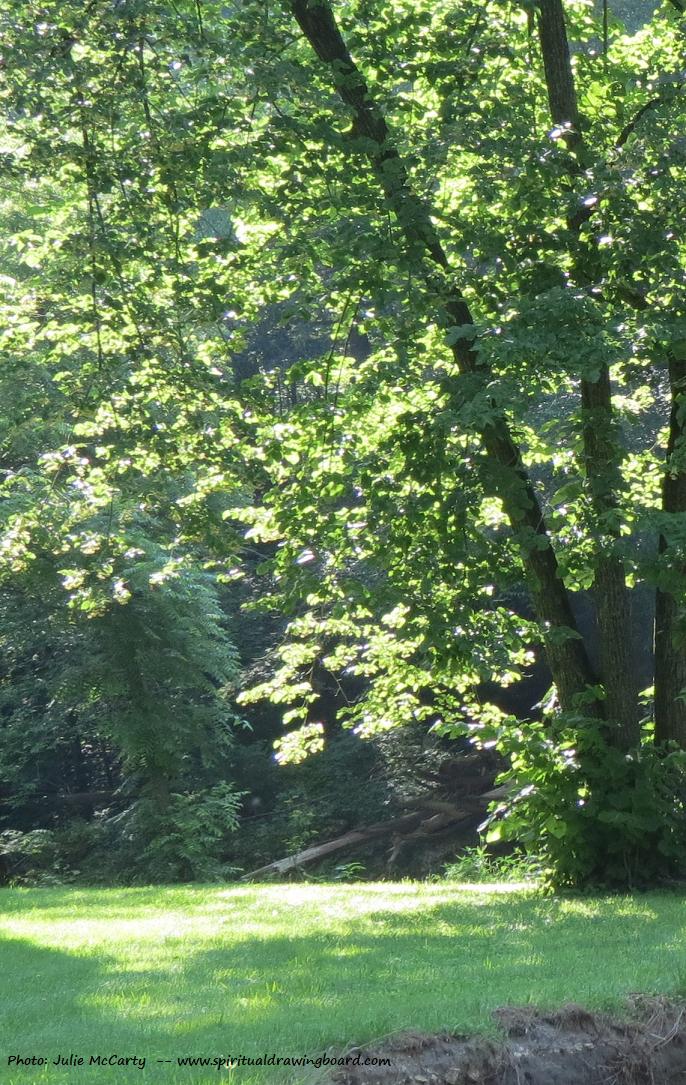
At times like this, it’s nourishing to feast one’s eyes on the green in this picture:

Tree beside stream--photo by Julie McCarty

(click on photo to enlarge)

I was reminded of this photo while reading Psalm 1 this morning (sorry, the margins aren’t what I wanted):

Happy are those
who do not follow the advice of the wicked,
or take the path that sinners tread,
or sit in the seat of scoffers;
but their delight is in the law of the LORD,
and on his law they meditate day and night.
They are like trees
        planted by streams of water,
        which yield their fruit in its season. . .  (NRSV)

In my prayer journal, I have found it sometimes helps to paraphrase or adapt bible verses for our day and age. When I put something in my own words, it forces me to think about it more deeply. (As a straight paraphrase, one would stick to the text, considering what the author intended. As a prayerful meditation, one can be a little creative.) 

In my case, I reworked the words for my own Christ-centered beliefs. I have respect for the psalms just as they were written, and I know that not everyone will agree with how I have rephrased it. However, that’s one nice thing about a prayer journal: you can explore ideas without worrying so much about what others might think.

Green tree--photo by Julie McCartyHere’s how I adapted this passage:

Blessed is she who delights
in the way of Christ,
pondering it day and night.
She is like a tree
planted beside a stream,
drinking in the waters of the Spirit,
bearing fruit, with God’s help,
in due time.  

I encourage you to try this way of praying. Study a bible passage and then rewrite it in your own words–just for yourself. Seek to really listen to God’s word–and apply it to your own life.

Whatever way you like to pray, may the good Lord bless you this day, with the nutritious waters of the divine Spirit–and the renewed hope that spring is just around the corner.

Until next time, Amen! 
God’s frost artwork, “through a glass dimly”, and our future

[Note: I began this draft last week, and the weather is quite similar today. That’s Minnesota for ya!]

For now we see through a glass, indistinctly,
but then, we will see clearly, face to face.
Now I know somewhat,
Then I will know completely–
so much that I will even know myself
as I am known.
(paraphrase of 1 Cor. 13:12)

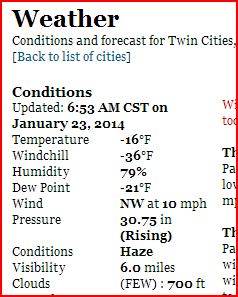
It’s January in Minnesota, and today’s weather dipped into the dangerously cold zone, so frigid that school was called off because children would likely get frostbitten just waiting for the school bus.

Capture--Jan 23 2014 weather on MPR

I’ve been keyboarding away on my computer since early morning hours, by the light of the half-moon, when suddenly I noticed the sun was up and forming this pattern on the drapery:

Through a glass dimly--photo by Julie McCarty

When I pulled back the curtains, here’s what I saw:

God's Artwork--Ice Crystals--photo by Julie McCarty--Eagan MN

(window plus storm window–click to enlarge)

For a time, I just took in the beauty of the ice crystals sparkling in the sunlight, and then grabbed my camera. I call this “God’s Artwork”:

Frosty ice art on window pane--photo Julie McCarty

(Click on photos to enlarge.)

After taking many photos, I noticed a rainbow effect in the sky parallel to the sun, and began to search for a “sun dog.”  I didn’t get to see the sun dog because I went nearly half blind trying to look for it in all the glare. (No wonder St. Paul fell to the ground after seeing the Light of Christ in a vision. I felt fairly disoriented while I waited for my eyes to readjust.)

Here is a “sun dog” photo I took in December:

Sun dog--Dec 6 2013--Julie McCarty - Even Smaller Copy--with sig

We often think of Christ as the “Light” of God who came into the world. Early Christians sometimes compared God the Father to the sun, and Christ as the divine ray of sunlight sent to earth to bring us new life.

My experience of seeing shadows of ice crystals through the curtain — a sort of “veil”–and then seeing the beauty of the frost directly, and finally the sun beyond (practically blinding me–I’m still not really “seeing” the sun), reminds me that there is much to know about God, and much to experience of God’s presence. Even the most Spirit-charged experiences in this life are nothing compared to what we can expect in the next life.

In Chapter 13 of First Corinthians, Paul writes about this pattern of spiritual growth: “When I was a child, I spoke as a child, I understood as a child, I thought as a child; but when I became a man, I put away childish things” (vs. 11)  Then he turns to his belief about the future:

For now we see in a mirror [or glass], dimly, but then face to face. Now I know in part, but then I shall know just as I also am known.  (vs. 12)

Paul is reminding us that there is so much more to come. Even if we have come to Christ, prayed, studied the bible, attended worship services,  and experienced the power of the Spirit in various spiritual gifts, there is still more for us to discover about God–and experience one day in God’s presence in heaven.

Thank you God --Gods artwork--frost on window--photo Julie McCartyNow, we see the light of God, as through a veil, or in a glass dimly; one day we will see and know  and experience God face to face.

I think that is Good News.

Until next time, Amen! 

My Christmas wish for you–from Julie

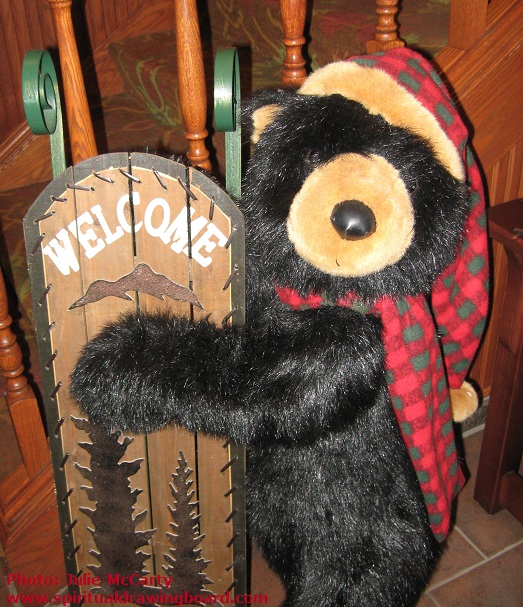
Christmas bear--photo Julie McCarty--Eagan MNChristmas/New Year message

Dear readers:

Thank you so much for your encouragement and support over the past couple of years. I’m looking forward to more blogging and writing in 2014!

I want to wish each of you a very happy holiday season. Whatever your religious beliefs (or lack of them), you are welcome here. My heart prays and wishes all sorts of good gifts for each and everyone one of you–especially the kinds of inward blessings only God can give.

Below is a quote I found that expresses my wish for you this Christmas & New Year 2014. Most of the readers of this blog are Christ-followers, and I hope that those of you who are not Christians will understand that I am not trying in any way to trample on your personal beliefs. If you believe in the Divine One or Transcendent Being, perhaps you can translate the message below into your own religious imagery or spiritual language.

So, here it is:

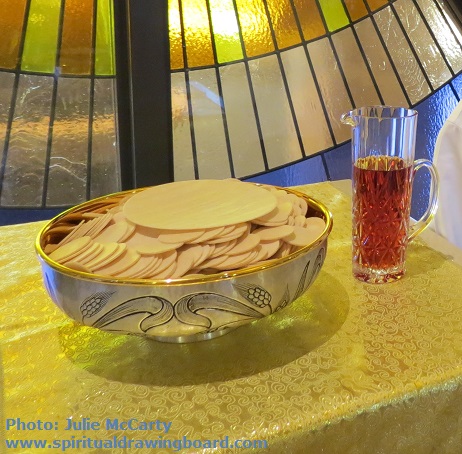
What shall I wish you for Christmas? I think the best Christmas wish is that some holy and lovely thought may come to your heart with your Christmas Communion, and make its home with you and stay to strengthen you and help you to “walk forty days and forty nights” like the heavenly bread of Elias. God only knows the bread to give [God’s] creatures, and when [God] says one word it makes the impossible possible and the unlovely lovely, and the unmeaning become a revelation. (Janet Erskine Stuart*)

Communion bread and wine--photo Julie McCarty

May God bless YOU with whatever “bread” you need most.

Until next time, Amen!

*Note: Quote seen in “People’s Companion to the Breviary,” vol. 1 (Carmelites of Indianapolis, 1997)–from “Life and Letters of Janet Erskine Stuart” by Maud Monahan.

100th post: Pondering Advent and Spiritual Hypothermia

Post it note--100th blog postWordPress tells me that this is the 100th post on Spiritual Drawing Board blog.  Wow. I had no idea.

Numbers like 100 form a sort of milestone, giving one pause to ponder

  • how did the past blogging go (such as, did I forget to write Part 2 of the post defining “Christian contemplative”?)
  • where one is at present with blogging (I’ve been so busy I’m forgetting to post very often — yikes!)
  • where will one be in the future with blogging (Do I want to continue? — yes!)

This time of year, with its emphasis on new beginnings (Advent=new church year, Christmas=new life in baby Jesus, New Year of 2014), is a good time to ponder our own lives past, present, and future in similar fashion:

  • In the past, how has God invited me to live and how have I responded?
  • What is God trying to communicate to me today?
  • What would God like for me in the future?

[I think here of the brilliance of Charles Dicken’s A Christmas Carol:  Scrooge was forced to ponder the effect of his actions on others in the past and present, and what might result in the future if he remained on that path.] 

If you try this spiritual reflection for yourself and find yourself regretting things of the past or frustrated with the present, please do not berate yourself or lose hope. Classic spiritual writers agree that self-knowledge is the beginning of wisdom. Use what you learn about yourself as an opportunity to make fresh choices for the future.

In the following 2-minute Advent reflection video, Pastor Paul Harris explores what he calls “spiritual hypothermia,” a condition of feeling disoriented, lost, confused, guilty, or spiritually weak.  He reminds us we are not alone, and offers a way to cry out to God for help.


(If you don’t see the video, copy and paste this YouTube link into your browser: http://www.youtube.com/watch?v=Snr2v8YrAQo )

When we feel we are having a case of “spiritual hypothermia,” we can cry out to God in the words of Psalm 80:

Restore us, O God of hosts;
let your face shine, that we may be saved.

          (Psalm 80:7, NRSV)

To paraphrase that, writing a similar prayer in my own words:

Bring us back to life, O Loving, Unseen God!
Let the radiant light and heat of your presence
Shine down on us, that we might not die in our sins
and mistakes of the past, but rather we might
live the compassionate, holy life Christ revealed

Until next time, Amen! 

Grateful, with a Chance of Grump

Note from Julie: I’ve been busy this past month with teaching and other commitments, so it is with a grateful heart that I share this guest post with Spiritual Drawing Board readers. Thank you, writer Autumn Lubin! 

It’s a foggy day at the end of October. Thickly plush, the fog envelopes the world like a soft, silky blanket. When I was little, someone told me that fog is how God hugs us. That may be why I find fog so comforting. Wrapped up in the blanket of God, I say a prayer of gratitude for all the physical reminders God places around our world to remind us we are loved.

Foggy hillsides--photo Julie McCarty

(click on photo to enlarge)

Most of the time, I find the prayer of gratitude an easy one to send up. So, so much has been given to me in this world. How could I not be grateful for it all? Well, God made us in this quirky human form, that even when we are surrounded by a bounty of gifts of people, riches, experiences, nature and love, we will find the one thing that is missing or not quite right. That place where curmudgeon and envy live in our souls and snatches away the gratitude, replacing it with a lump of grumpy dissatisfaction.

I’ve been working on prayer that leads me from my lump of grump and back to gratitude. A favorite quote reminds me that being grateful is the only true response.

“You cannot be grateful and bitter. You cannot be grateful and unhappy. You cannot be grateful and without hope. You cannot be grateful and unloving. So just be grateful.” –(Author Unknown)

In Timothy 4:4 – 5, we read:

“For everything created by God is good, and nothing is to be rejected if it is received with thanksgiving, for it is made holy by the word of God and prayer.”

I pray for these words to enter deeply and become the blood that pumps my heart. Breathe in heaven, breathe out gratitude.

I’ve come to find that gratitude is an intentional place in us. It doesn’t just spring from us. It requires sight and insight. It requires a desire to appreciate all of what is ours, that which we love and that we dislike very intensely and everything in between. It demands something I call painful gratitude – finding the gift in even that which hurts, angers, humiliates, makes us cry and saying a prayer of thanks. Not every gift we are given is one we recognize or understand its value or purpose. But as I was taught as a child, you say thank you even if don’t like it, don’t want it, don’t know what it is or already have it. With a smile.

The sun has set now and the darkness has vanquished the fog from my vision. But I know it remains outside my window. Gently blanketing my home, I lean back in God’s love and say thank you. Thank you for it all. I will remember to take each and every gift with grace and want for nothing more. This is what I pray. And then I pray for the grace I’ll need to honor my promise because I know some other day, maybe tomorrow, I will find myself again with a lump of grump obstructing my view of gratitude.

How do you practice gratitude?

How do you find you way back when your lump of grump is getting in your way?

~~~

Autumn is a writer, educator and a non-profit consultant. More importantly, she is a wife, mom, grandma, cousin, friend, neighbor and owned by a dog and two cats. You can reach her at amlubin@gmail.com.

Planting Spiritual Seeds

We often think of spring as the season of planting. When the snow melts, little green shoots begin popping out of the ground. Farmers sow their fields and suburban growers visit the garden center.

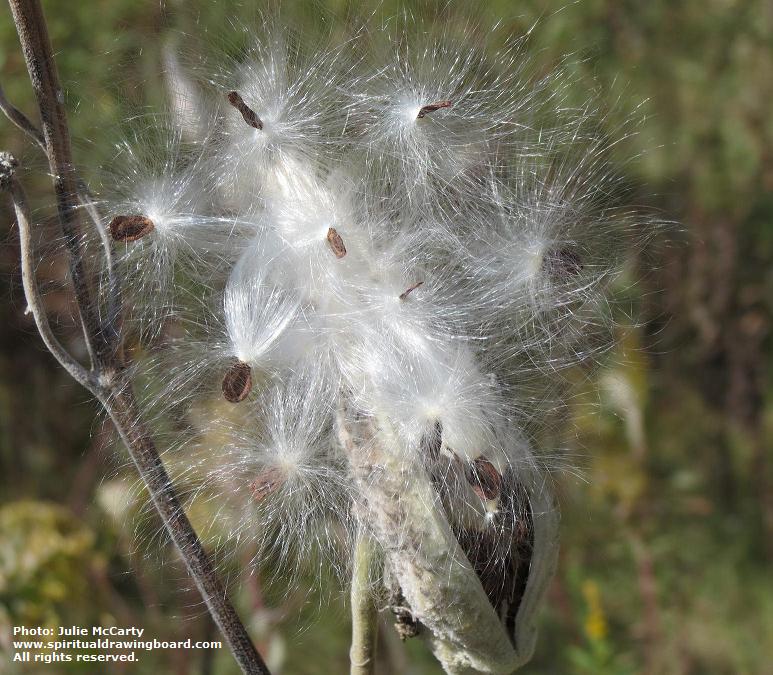
However, if wild plants could talk, many of them would tell a different story. In nature, autumn is the time when seeds are sown. The fruit of the plant matures, and whatever is not eaten by animals, falls to the ground. Other seeds are carried away by the wind or attached to animal fur for relocation.  (In my neighborhood, squirrels are dashing about, digging holes everywhere in our lawn, storing food for the winter–and some of those seed nuts will emerge as plants come spring.)

Milkweed in autumn 2 -- photo by Julie McCarty

At this point in autumn, the seeds appear tiny and lifeless–they seem to be “dead.” Gradually, colorful dancing leaves come to rest on them, and snow blankets them in for the winter months. They disappear from view.

Dead and buried, the seeds wait. . .  And wait . . .   And wait some more. . . .

 If we did not know better, we might think the seeds were dead and gone forever, buried beneath the howling winds and snowy skies. 

But the seeds are not dead, they are merely “gone to sleep.”  Months later–many months in Minnesota!–the melting snow and warming sun will nurture these tiny, inanimate objects into life again.

Jesus used the image of planting seeds as a way to talk about spiritual principles and the kingdom of God (for example, in Matthew 13). Spreading the good news of God’s love and mercy is a lot like planting seeds. Serving others, listening with compassion, offering encouragement or comfort, building a safe and nurturing home for our children, doing our jobs in an ethical manner, praying for those who suffer, and inviting others to worship with us on Sunday are all ways we “scatter the seeds” of Christ’s kingdom of love.

At times, these spiritual seeds may appear to have no effect– but we ought not to lose heart. After all, seeds lie dormant in the winter, waiting for the warmth of springtime.  Some seeds we plant now may even mature in future generations, long after we are gone.  We do not really understand how or when all this sprouting of spiritual seeds happens–that is all in God’s hands.

For discussion or reflection:

  • What spiritual seeds do you think God is sowing within your soul at this stage of your life?
  • What spiritual seeds do you think God wants to plant in others through you today?  this week?   this autumn?

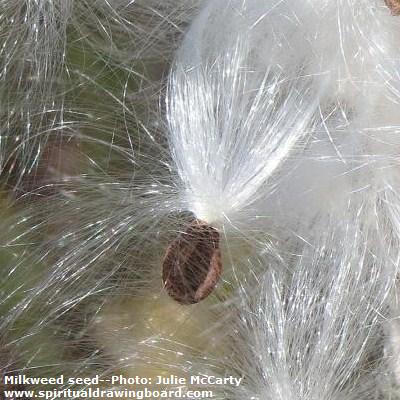
Single milkweed seed 2--photo Julie McCartyThink about it. Pray about it.

I will.

Until next time, Amen!