The Advent/Christmas season is a blessed time for all, but sometimes it can be a painful time for those who experience separation from loved ones (as, for example, in time of war) or death of close friends or relatives.
When Mary said yes to the angel Gabriel (see last post), it was surely an exciting and joyous time, even if there was the terrifying side of being chosen as mother of the Son of God. It is right to celebrate the joyous event of the Incarnation, but sometimes we forget the high price Mary paid to follow through on her commitment to God.
In her obedience to God, Mary almost lost Joseph. Surely some people ridiculed her for having a child out-of-wedlock, perhaps even more so if she tried to explain about the angel’s involvement. Later, she and Joseph would face the labor of birthing in Bethlehem, away from familiar surroundings. They would have to flee as political refugees to a foreign land to save their child from death. One day, Mary would see her beloved child put to death on the cross.
Saying “yes” to God carries the great joy of new life and resurrection, but sometimes we Americans forget what Dietrich Bonhoeffer called the “cost of discipleship.” Following Christ is not always easy.
Below is a 3-minute prayer break, a mini-time-out from the busyness of holiday preparations. The song “Say Yes” by Bob Franke (name rhymes with Yankee) reminds us to stay true to Christ even when the going gets tough. (Thanks to Barbara Keffer for sending it to me! And, of course, thanks to Bob Franke for such an inspiring song.)
If you are receiving this message via e-mail, the YouTube video may not appear. You can find it by visiting YouTube and typing in the search window these words: say yes by bob franke . It’s worth the effort.
May God grant you a peace-filled Christmas and bless you in 2012!
“Greetings, favored one! The Lord is with you. . . Do not be afraid, Mary, for you have found favor with God. And now, you will conceive in your womb and bear a son, and you will name him Jesus.” –The angel Gabriel to Mary, in Luke 1:28, 30-31.
If you’ve ever been on crutches, you know that carrying things is a challenge. I broke my leg a few weeks ago, and find myself stuffing cans of pop into my sweater pockets, shuffling dishes along the countertop, and sliding books along the floor using my crutch as a hockey stick (apologies to librarians!). Objects tucked into my waistband tumbled to the floor so many times I wished I was a kangaroo with a built-in giant pocket.
In the midst of this, Advent began and I found myself thinking about the mystery of the Incarnation. It would not have mattered if Mary had used crutches: the baby Jesus was growing deep within her womb and naturally went with her everywhere she went.
Theotokos--detail from the Virgin of the Sign Icon
In the Eastern Christian Church, the mother of Jesus is often called Theotokos, a Greek title that means “God-Bearer.” Mary carried Christ, the second person of the Holy Trinity, within her being in a literal sense, by the power of the Holy Spirit. Early church fathers observed that while Christ was truly divine, his truly human side grew out of Mary’s flesh and blood.
That a woman of 2,000 years ago carried Christ within her, feeding him from her very body through the umbilical cord, is reason enough to be filled with awe and wonder. However, this amazing spiritual truth does not end there. For Mary, as premiere disciple, is a model or “spiritual type” of what we are also called to do. We are to carry Christ within our hearts and souls, to “give birth” by bringing his words of mercy and his compassionate presence to all those we encounter.
In this manner, the words of the angel Gabriel are also addressed to each one of us: “Greetings, favored one!” (“Hail, Mary, full of grace!”). Each one of us, and all of us together, are “favored” by God, shown by the superabundant love of Christ by his dying for the whole world. As a result, we, too, are favored, that is, graced by God, and chosen to bring the Christ our Light into the world.
May God bless you this Advent and Christmas season–and may the Spirit empower you more and more each day to “give birth” to Christ in the world.
Until next time, Amen!
Enjoy these spiritual reflections? Please spread the word by telling your friends.
O give thanks to the Lord, for he is good;
his steadfast love endures forever! –Psalm 118:1 (NRSV)
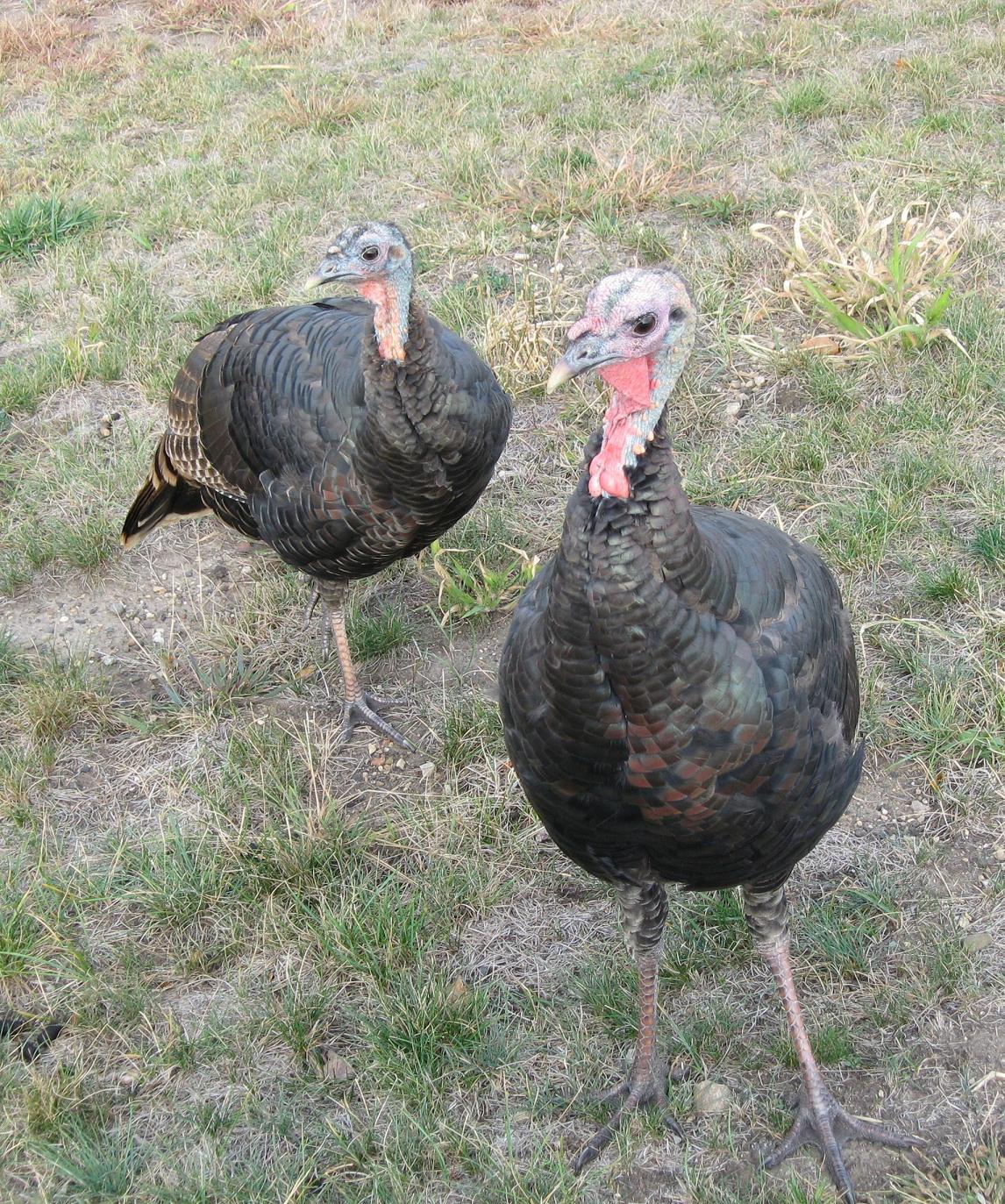
Wild turkeys in a nearby suburb--photo by Julie McCarty 2011
When I am feeling a little blue or worried in the middle of the night, I sometimes stop the negative thoughts by attempting to list 25 things for which I am grateful. The list can be wild or seemingly insignificant–whatever occurs to me at the time. I am thankful for a lush tomato from the garden, the color lavender, the scent of bread baking; for specific people/relationships in my life; for time alone with God and time together with others to celebrate. By the time I list 25 things, whatever was bothering me seems a less significant.
The above verse from Psalm 118 reminds me that one thing to be grateful for is the way God loves us no matter what. We sin, we hurt ourselves or others, we make mistakes–and yet, God’s love is ever-present, ever-faithful, ever-merciful.
In the original Hebrew of Psalm 118, the word for “steadfast love” is checed (pronounced kheh’ – sed ). Checed or hesed, as it is sometimes written in English, is translated various ways depending upon the bible translation and the particular context of the bible verse. Sometimes it reads like this:
O give thanks to the Lord; for [he is] good:
because his mercy [endureth] for ever. –Psalm 118:1 (KJV–my underline)
Or, this:
Give thanks to the Lord, for He is good:
For His lovingkindness is everlasting. –Psalm 118:1 (NASB–my underline)
Checed can be translated all of these ways. God is good, and God’s faithful love, kindness, and mercy are all everlasting.*
Thanksgiving is a time of offering prayers of thanks for many things. Most often, we thank God for the food on the table, a roof over our heads, our family and friends, our health, our jobs. These are all good prayers of thanks.
But the bible verse above makes me wonder: when have I ever thanked God for his love? Have I told God I appreciate his presence in my life? Have I expressed thanksgiving for the good Lord’s compassion, his kindness, his mercy and forgiveness?
Thank you, God, for your blessings this Thanksgiving–and thank you even more for the gift of Yourself, given to us through the sacraments, the Word of Scripture, the beauty of nature and other people, and your Spirit deep within our hearts.
Until next time, Blessed Thanksgiving!
* Note: Information on checed was found in the Blue Letter Bible online using the bible verse and Hebrew lexicon.
Also note: You can now print off these reflections, email them to others, Facebook or Twitter, using new features of WordPress at the Spiritual Drawing Boardshown at the end of each post. (If you have trouble with printing using your server–as I did–try using Google Chrome or Mozilla Firefox servers.)
Amen, I say to you, whatever you did for one of these least brothers of mine, you did for me. –Matthew 25:40 (NAB)
Many of you have been praying for my dad, who lives in Arizona and is struggling with Burkitt’s lymphoma, a cancer of the blood. I am so grateful for your prayers!
"Bobski" (my dad earlier this year)
Since May, Dad (called “Bobski” by his friends) has been doing an intense regimen of chemo that involves long stays in the hospital in Arizona, where he lives.
This past week, my husband and I spent time visiting Dad and other family members. It felt so good to put my hand in his and think back to the days when I was his “little girl.”
I firmly believe that God does not target people for suffering, but rather hopes that seeing others suffer, we will do something to show our love for others and make the world a better place. My dad certainly does not deserve this suffering of Burkitt’s lymphoma any more than anyone else does. If I could, I would remove Dad’s current pains, just as he would have removed my illnesses as I was growing up, if it had been in his power.
But God can bring about something good out of our suffering. In this situation, my family has created a team to participate in the Leukemia and Lymphoma Society’s “Light the Night Walk” on this coming Saturday. Light the Night Walk is a walkathon to raise money to provide free information and family support groups to those affected by these diseases, life saving research to end blood cancers, and other similar services to families affected by leukemia and lymphoma. We are not able to prevent my dad’s condition, but we can work together with the hope of helping others or maybe even one day preventing these diseases.
If you would like to make a donation to the Leukemia and Lymphoma Society in Dad’s honor, you can support “Bobski’s Team” by clicking here. (You should see the same picture of Dad as in this blog post.)
Until next time, thank you for your prayers and support–and Amen!
Rising very early before dawn, [Jesus] left and went off to a deserted place, where he prayed. (Mark 1:35)
St. Elizabeth–Spinning to make clothes for the poor–Marianne Stokes
In my Catholic upbringing, I got the impression that the only path to sainthood would be priesthood for men and religious life (becoming a nun) for women. I rarely heard about married women saints, and when I did, they were described to me as holy because of becoming nuns or founding convents after their husbands died.
Because of this, I have a special place in my heart for St. Elizabeth of Hungary, the medieval wife and mother who didn’t merely “tolerate” marriage (after all, the marriage was arranged by one’s parents) but rather genuinely liked her husband.
In her short lifespan of 24 years, Elizabeth integrated many callings: queen, wife, mother, woman of prayer, personal service to the poor and sick, etc. Elizabeth’s example appeals to people of many walks of life for many reasons, but I like to think of her as the patroness of “juggling:”
When I feel overwhelmed with balancing the pieces of my life, I think of St. Elizabeth of Hungary, the thirteenth-century queen who could be called “the patroness of juggling.” This young woman not only devoted herself to raising her children and spending time with her husband Ludwig (whom she adored), but she also attended church frequently, managed the castle while Ludwig was away on extended business, developed a rich prayer life, and personally ministered to the poor and sick of the kingdom (something the elite found rather revolting).
Apparently Elizabeth couldn’t find enough prayer time to satisfy her, so she instructed her maid to sneak into the royal bedroom each night, reach under the bed covers, and pull on her toes to wake her. Elizabeth would slip away without disturbing Ludwig’s sleep to pray in secret. This clever plan worked well for a time, until one night, when the servant girl reached between the sheets, the king suddenly bolted upright in bed. Apparently she had found the wrong toes.
Jesus, too, often had to find ways of stealing away from his busy ministry to catch his breath. [In Mark 1:35-39], it appears that the disciples do not know where he has gone. When they find him, Peter sounds exasperated: “Where have you been? Everyone is looking for you!” It’s as if he thinks Jesus is missing a photo-op and the chance to work the crowd. But Jesus knows his priorities: his work must be grounded in a healthy, personal relationship with his heavenly Father.
When we feel pulled in many directions, unsure which task to do next, whether to say yes or no to this or that, or how much time to devote to prayer, we can take heart that others before us (including Jesus!) certainly faced similar human challenges–yet ultimately found their true Christian fulfillment.
St. Elizabeth of Hungary’s feast day is Nov. 17. For more about her read here or view a slide show here .
For he who is acquainted with our inmost hearts and knows the secrets of our minds knows when each one of us is ready to respond fully. –St. John Chrysostom*
click on image to enlarge
I was surprised the other day when this lovely bird sitting by the grassy path did not fly away as I approached. He (she?) even allowed me to stand only a few feet away, taking photos.
I don’t know if it was the closeness or the filtered sunlight, but the bird appeared to me the most exquisite, beautiful living thing. (I would later find out it was an ordinary fledgling robin!)
From the bird’s behavior, I thought it was either sick or wounded–indeed, it was no longer living when I passed by it on my return trek. I was saddened, but grateful that in its vulnerable state, I had been able to see the details of its gorgeous feathers.
This experience made me think how God wants to be close to us, but often we fly away, just out of reach. God is always with us, of course, but sometimes we just don’t want to get too up-close-and-personal with God.
I am not sure why this is. We may be afraid because of having been exposed to harsh, wrathful images of God when we were young. Perhaps we are afraid God will ask us to change our ways or take on a new calling. Maybe we are just too busy to spend time with God.
I think for some of us, it is when we are most vulnerable, like the little bird, that we allow God to come close. When we are suffering prolonged illness, failing relationships, job loss, or grieving, we may cry out to God in our anguish. In our vulnerability, God determines we are ready to receive spiritual growth, new callings, or deeper experiences of being loved.
St. John Chrysostom, an early church father known for his preaching, observed that God uses our vulnerability to draw us to himself. Chrysostom writes that Jesus did not call Matthew at the same time he called Peter and John because Christ knew Matthew was not yet prepared to accept the calling. He notes that others, too, like Paul, were called at various times because it was only when they were finally vulnerable they could really respond fully to the good news. (I wonder, did Paul’s vulnerability cause him to fall off the horse, or did the great fall cause his vulnerability? Ha ha ha ha…)
God knows the best timing for spiritual growth in each unique person. As Chrysostom explains:
click on image to enlarge
For he who is acquainted with our inmost hearts and knows the secrets of our minds knows when each one of us is ready to respond fully. Therefore he did not call them [the apostles] all together at the beginning, when Matthew was still in a hardened condition. Rather, only after countless miracles, after his fame was spread abroad, did he call Matthew. He knew Matthew had been softened for full responsiveness. *
When we have an attitude of openness and “holy vulnerability” before the Lord, we can really listen to what the Spirit desires for our lives. This attitude of vulnerability does not mean cowering in our shoes or belittling ourselves, but rather being open to whatever God has in store for us. Holy vulnerability allows God to draw close, like the little bird allowed me to share in his last few moments of life.
Until next time, Amen!
~~~~~~~~~~
*Quotes and concepts based upon St. John Chrysostom’s The Gospel of Matthew, Homily 30.1, quoted in Give Us This Day (Sept 2011, pp. 219-220). Give Us This Day is a new monthly publication from Liturgical Press centered around the Roman Catholic lectionary (daily Mass readings) with morning and evening prayer. I highly recommend this insightful and convenient daily prayer guide. For more info click here.
Maple tree--photo by Julie McCarty--click to enlarge
Be still and know that I am God. . . –Psalm 46:10
For many years, I have been attempting to live a contemplative lifestyle that is often puzzling to others, even to professional church leaders. This way of life is grounded in my calling to follow Christ, but has often been difficult to explain in “sound bite” definitions, because this vocation does not fit easily into the Catholic or Protestant paradigms many of us were taught.
In addition, I can hardly begin to describe whatever-this-is that God desires for my life (at least I believe God wills this!), when the contemplative quest is so very difficult for me to grasp myself. So mysterious does all this seem that many times I have tried to keep this calling hidden, feeling others might not understand. (Many of you already know this about me–it is only I who think I need to “come out” of the contemplative closet!)
What I have discovered, ever so gradually over the course of my life, is that I am what could be called a Christian contemplative (also known in some circles as a lay contemplative, or, in my case, a married contemplative). A Christian contemplative is a person wholeheartedly attempting to follow Christ in a concrete way that emphasizes “be-ing” over “do-ing” in their day-to-day attitudes, work, and prayerful lifestyle. Although living “in the world,” a Christian contemplative focuses his or her life more intensely on spiritual values and practices that are often thought of as belonging to monks, such as silence, solitude, Christian meditation, biblical study, simplicity, and digging deep into one’s own soul, searching for the Holy Spirit or ongoing presence of Christ within.
This idea of living monastic values in the midst of the world is, in some ways, new, and in other ways, ancient. Many Western Christians assume a strict delineation between monastic living and those “in the world,” and, indeed there are significant differences between the two ways. For example, as a married lay woman, I am not celibate and I do not live in a monastery setting. On the other hand, monastic values, such as silence, almsgiving, humility, and treating others as brothers and sisters in Christ, are ancient practices found among biblical figures who were family men and women, living “in the world.”
Two books that really helped me understand this lay contemplative calling and how to begin to put it into practice are listed below:
The Lay Contemplative: Testimonies, Perspectives, Resources edited by Virginia Manss and Mary Frohlich with Foreword by Tilden Edwards (St. Anthony Messenger Press)
Ordinary People as Monks and Mystics by Marsha Sinetar (Paulist Press — I see there is a new edition of this since I last read it.)
I found these books unique because they describe the experiences of other people who are also searching for a quieter, more contemplative lifestyle outside monastery walls.
This is not to say that the contemplative lifestyle is necessarily “better” than those who are called to a more “active” service- or ministerial-oriented lifestyle. However, I think it would be good for those who lead the church to have a grasp on this often misunderstood Christian path.
click to enlarge
If you feel drawn to a more contemplative lifestyle and would like to share your experiences, or perhaps just want to ask questions, join the conversation! Feel free to post your thoughts, or use the contact tab to write to me privately if you wish.
More to come on this topic in a future post…
Until next time, Amen!
P.S. Yes, it is always okay with me to forward this post to your friends via e-mail. –Julie
…for as all die in Adam, so all will be made alive in Christ. –I Corinthians 15:22.
All will be made alive in Christ? All? All might end up in heaven? Or just Catholics? Or just Protestants? Or just Missouri Synod Lutherans? Or maybe just baptized believers? Or maybe “good people” of any spirituality? Or just those who do good things? Or those who give enough money to charity? Or those who believe the right things?
Rob Bell brings up questions like these and many others in the book we’re reading in my church group, Love Wins: A Book about Heaven, Hell and the Fate of Every Person Who Ever Lived (HarperOne, 2011). In case you haven’t heard about this book, here’s a preview video (if you are reading this in your email, the YouTube preview is on my blog):
Bell raises important questions about heaven and hell that many Christians secretly wonder about but are afraid to ask. He particularly challenges the types of church-goers who seem to relish the thought of some people being sent to hell. They consider themselves “saved” and righteous, but anyone outside their select group “condemned.” They seem to worship a God who is loving one moment and wrathful the next.
Reading Bell’s book is one thoughtful way to consider how we view Christ-followers of “other groups” (denominations, political parties, that “other choir” at church, etc.), those of other religious groups (Hindus, Buddhists, Muslims, etc.), the “merely spiritual,” or those of no particular philosophical or faith adherence. Do we treat them will equal dignity and compassion? Or, as Rob Bell points out, do some of us secretly rejoice to picture certain people in hell? Would Christ our Lord rejoice to see someone be cast into hell? Bell asks, Is this “good news”?
Christians of other centuries have also wrestled with these questions. In the article “Dare We Hope For the Salvation of All?” Greek Orthodox theologian, Bishop Kallistos Ware examines how Origen, St. Gregory of Nyssa, and St. Isaac the Syrian considered the salvation of all people and the restoration of all things in Christ. He also draws material from a variety of others, including Julian of Norwich, C.S. Lewis, and St. Silouan of Mount Athos. (Theology Digest 45:4 (1998); also reprinted in The Inner Kingdom, Vol. 1, pages 193-215).
Like Bell, Bishop Ware is trying to remain true to the immense love of God, while also upholding human free will. My favorite story in the article was about a conversation between St. Silouan and a hermit. St. Silouan was so convinced that hell might not be a forever situation that he actually prayed “for the dead suffering in the hell of separation from God. . . [Saint Silouan] could not bear to think that anyone would languish in ‘outer darkness.'”
When the hermit criticized St. Silouan for this, the holy man said, “Tell me, supposing you went to paradise, and there looked down and saw somebody burning in hell-fire–would you feel happy?”
The hermit responded that it would be the condemned person’s own fault.
The holy St. Silouan replied, “love could not bear that…we must pray for all.”
(Quotes above from Saint Silouan the Athonite by Archimandrite Sophrony, quoted in The Inner Kingdom, page 194).
For Eastern Christians, heaven is less a “me and Jesus” and more of a mystical communion of persons. God is “communal” in the sense that God’s oneness is Trinitarian–and to truly mirror God and be taken into the glory of heaven, the multitude of saints (all God’s beloved people) would need to be included in order for the joy to be complete.
The best way to explain this is to consider that the definition of hell for Russian Christians is two people, tied to each other but back to back. They are with each other but not really one. The opposite of that, heaven, is “face-to-face”: face-to-face intimacy and union not only with God, but with each other.
Saint Silouan didn’t think he could be completely happy in heaven until every last person was there, “face-to-face,” dwelling in glory with God and each other, including every single person.
Since the last blog post, I’ve been thinking: What have I learned in the period since the tragic terrorist attack of September 11, 2001? Is there anything good in my life that was brought about by something that was otherwise an evil deed?
(I don’t believe God causes evil, but that sometimes, when you look back over a long period of time, you can find something good that God brought out of an otherwise bad/evil situation.)
In reflecting on this question, the thing that surprised me most is how much I’ve learned about Islam, that is, people called Muslims. It’s not that I even know that much about Islam, but before 9-11, I knew nothing about it. Absolutely nothing. If it hadn’t been for 9-11, I doubt I would have ever wondered about this major world religion and its devout believers.
Looking over the past decade, I discover that I’ve read a number of books I never would have thought to read otherwise–and a number by Muslim authors:
Reading Lolita in Tehran: A Memoir in Books, by Asar Nafisi;
The Kite-Runner, by Khaled Hosseini;
A Thousand Splendid Suns, also by Khaled Hosseini;
The Trouble with Islam Today: A Muslim’s Call for Reform in Her Faith, by Irshad Manji;
Things I’ve Been Silent About: Memories of a Prodigal Daughter, also by Asar Nafisi);
The Faith Club: A Muslim, A Christian, A Jew –Three Women Search for Understanding, by Ranya Idilby, Suzanne Oliver and Priscilla Warner;
These books do not represent all sides of the Muslim world–they just happen to be the ones I read. As I said, I didn’t exactly plan it that way. I just observe this when looking over the past decade.
These books gave me windows into other people’s worlds, realms that were completely unknown to me. Reading stories or the personal experiences of others was far more engaging than merely reading theological textbooks (although those have their place). My reactions to various parts of these books covered the full gamut of human emotions: sometimes I was laughing or crying, sometimes feeling shock, anger, outrage, or empathy–and always, always, I learned something.
This doesn’t take away the evil or tragic dimension of what happened on 9-11–and particularly not for those who lost loved ones–but for someone like me it shows that God can bless us in unexpected ways.
Until next time, Amen!
Spiritual Aerobics
1. Can you think of a time in your life when God brought something good out of something that was in other ways a bad situation?
2. Is there something positive you can do today about a situation that is otherwise sad, trying, frightening, or painful for yourself or someone else?
But to you who hear I say,
love your enemies,
do good to those who hate you,
bless those who curse you,
pray for those who mistreat you. –Words of Jesus recorded in Luke 6:27-28.
The tenth anniversary of 9-11 will soon be upon us, and I wonder: What I have learned in those ten years? Have I overcome my fears and anger? Have I become more compassionate towards those who are “different” from me?
While thinking about this, I thought it might be worth revisiting a column I wrote at the time of the first anniversary of 9-11, published in The Catholic Spirit and a few other newspapers around the country.
Back then I was pondering the meaning of Jesus’ command to love your enemies, and the context was the ongoing threat of terrorist attacks. Today when I reread it, I think about how so many Americans have turned against each other in their extreme enthusiasm for their favorite political agendas. At times it seems hostility has become the national pastime.
Being kind to those who hurt us is no easy task, and I certainly struggle with “love your enemies” myself. Nevertheless, if we call ourselves Christ-followers (Christians), then we must strive, with the help of the Holy Spirit, to practice all that Jesus taught.
Here’s that original article:
Praying for Enemies on the Anniversary of 9-11
As the one-year [now 10-year] anniversary of the tragic events of September eleventh approaches, I am pondering the meaning of Christ’s command to “love your enemies, and pray for those who persecute you” (Matthew 5:44). Just what did Christ mean? Should I pray for terrorists?
A priest I know did just that during a time of shared prayer at church. Some people questioned what he meant by praying for terrorists. Was he condoning their acts of violence and murder? Did he want terrorists to “win” the war?
Praying for one’s enemies does not mean that we agree with their ideas or support evil. Praying for enemies does not mean staying in an abusive relationship. It certainly does not mean that we eliminate praying for the poor, the oppressed, and victims of violence.
Therese of Lisieux at age 15
A startling example of praying for “society’s enemy” is found in the autobiography of St. Thérèse of Lisieux. When she was a teenager, Thérèse heard about a notorious murderer named Pranzini, whose story made headline news. While waiting on death row, Pranzini showed no signs of repentance. Because Thérèse felt a great longing to prevent sinners from suffering the pains of hell, she prayed ardently that God would forgive Pranzini, granting him eternal happiness in heaven. On the day following his execution, Thérèse read in the newspaper that “Pranzini had mounted the scaffold without confessing and was ready to thrust his head beneath the guillotine’s blade when he suddenly turned, seized the crucifix offered him by the priest, and thrice kissed the Sacred Wounds.” Thérèse tells us that she felt such joy over this news that tears came to her eyes.
I find it difficult to pray for mildly irritating people, let alone violent criminals. However, someone taught me a method that helps. Setting aside your own agenda (that’s the hard part!), simply ask God to grant this person a pleasant day, peace, joy, etc. If you like, envision the blessings like a gentle rain showering upon this person.
When I pray this way for someone everyday for a month, I often notice a change in myself. Sometimes I begin to see this “enemy” in a slightly better light. I listen to him or her more at meetings.
Some wounds in life—like childhood sexual abuse—are so painful that we cannot do this type of prayer exercise. In these cases, we can pour out our troubles to the Lord, ask for God’s help, seek necessary professional help, and give ourselves time for the healing process. God understands.
Nevertheless, Christ calls us to deepen our love for others by praying for someone we dislike. Why do such a distasteful thing? Jesus explains that because God gives the blessing of sun and rain to all people—both saints and sinners—we must do the same. We ask God to grant our enemies the same love and mercy that God has given us.
Jesus also reminds us that being kind to people we like is not really so special or virtuous. (Even terrorists are kind to people they like!) The Lord Jesus forgave his executioners and the repentant thief during his own crushing agony on the cross. This same Lord promises that when we love our enemies, we will truly become children of God.







 thers was far more engaging than merely reading theological textbooks (although those have their place). My reactions to various parts of these books covered the full gamut of human emotions: sometimes I was laughing or crying, sometimes feeling shock, anger, outrage, or empathy–and always, always, I learned something.


 Spiritual Drawing Board