The Risen Lord Enters Our Hell

The tombs also were opened, and many bodies of the saints who had fallen asleep were raised. After his resurrection they came out of the tombs and entered the holy city and appeared to many.  –Matthew 27:52-53.

When you think of Christ’s resurrection, what do you imagine? Do you think of Jesus bursting out of the tomb, his cape flying behind him like Superman? Do you think of Jesus disguised as the gardener who surprises Mary Magdalene? Jesus magically appearing behind locked doors? Walking with the disciples on the road to Emmaus?  

If you were raised in an Eastern Christian church, you might have another image, an even more prominent image, strongly planted in your mind. You might immediately think of the “Anastasis” (Greek for “resurrection”), an icon or image of Christ breaking down the doors of hell (hades, the place of the dead), in order to free Adam and Eve and others from their spiritual prison.

Below is an ancient fresco of this image, painted in the Church of St. Chora in Constantinople. Christ is pulling Adam and Even out of their tombs. He is standing on the gates of hell, which he has broken open. Other saints and prophets of the Old Testament are also witnessing and participating in this remarkable event.

Anastasis--photo by Neil Harrison--Dreamstime.com

(Click on photo to enlarge. Photo: copyright Neil Harrison — Dreamstime.com) 

It is JESUS who goes the extra mile, to pull up Adam and Eve out of the grave. Never mind that Adam and Eve had deliberately sinned. Never mind that they didn’t “deserve” salvation. Never mind that they weren’t baptised Christian. Never mind that they lived before him in time and place.

Jesus’ love overcomes every obstacle. Even the doors of hell cannot hold Christ back. And that applies to our current lives as well. Christ enters the places we feel are our own personal “hells” in order to bring us new life.

In Praying with Icons, Jim Forest reminds us that the Anastasis Icon serves as a reminder that Christ wants to free us from all that enslaves us, especially perhaps, our fears:

The icon of Christ’s Descent into Hell can be linked with an ongoing prayer not to live a fear-centered life. We live in what is often a terrifying world. Being fearful seems to be a reasonable state to be in — fear of violent crime, fear of job loss, fear of failure, fear of illness, fear for the well-being of people we love, fear of collapse of our pollution-burdened environment, fear of war, and finally fear of death. A great deal of what we see and hear seems to have no other function than to push us deeper into a state of dread. . . .

We can easily get ourselves into a paralyzing state of fear that is truly hellish. The icon reminds us that Christ can enter not just some other hell but the hell we happen to be in, grab us by the hands, and lift us out of our tombs.

There is much that can frighten us in our everyday experiences. Christ does not prevent us from ever suffering–but Christ does promise to be there with us, through the power of the Holy Spirit dwelling within and among us, come what may.

Until next time, Amen!

Winner of Les Miserables Giveaway

LESMHE-008_2D-BD_ORING_01_R4 - Copy--smaller--…And the winner is… Ryan C. of Columbus, Ohio.  Congratulations!

Ryan C. wins the Les Miserables DVD from the giveaway drawing we recently held here on the Spiritual Drawing Board blog. Thanks to my hubby Terry for drawing the name out of a hat.

Thanks to all of you who participated.  
May your week be filled with sunshine!
(Here in Minnesota, we are shoveling snow. LOL.)  

Until next time, Amen!

The Prayer of Agony

If you are feeling a little blue, or overwhelmed, you might enjoy this post I just wrote for “Easter Prays,” the spirituality/prayer blog for Easter Lutheran Church (ELCA) in Eagan, Minnesota:

Jesus said, “Abba, Father, for you all things are possible; remove this cup from me; yet not what I want but what you want.” (Mark 14:36)

Amish Quilt

In our culture, it can be tempting to think that Jesus’ life was always easy. After all, he was the Son of God. We tend to think because Jesus had miraculous powers, public popularity, and immense wisdom, that he must have been happy all the time.

However, the gospels paint a picture of a man who also experienced others’ rejection, family misunderstandings, ministry fatigue, and grief.

       READ THE REST–>>  http://www.easterprays.wordpress.com/

Giveaway: Les Misérables (Blu-Ray + DVD + Digital Copy + Ultraviolet)

Les Miserables Announcing the Spiritual Drawing Board Blog Giveaway of Les Misérables, four ways to watch, all in one box–you choose DVD, Blu-Ray, Digital, or Ultraviolet. Names will be put in a hat and one person will be drawn at random as the winner. (Details below.*)

Three ways to enter: To enter the drawing, send Julie your e-mail one of three ways:

1. Enter your e-mail address in the upper right box where it says “follow this blog.” (If you have already done that in the past, do #2 or #3 below.) –OR–

2. Write a comment somewhere on this blog. (If you write something really plain like “hi,” I may think it’s spam and you won’t be included in the contest. Simple is fine, but please be genuine, civil, and true to yourself. Others will not see your e-mail address.) –OR–

3.  Send your real name and e-mail address to my e-mail:  juliemccarty (at) usfamily (dot) net  — Please put “Les Mis” in the subject line and indicate you want to enter this contest.

Deadline to enter is end of the day Easter, March 31, 2013 (11:59 PM Central Daylight Time). Winner will be announced in early April. 

Best wishes to all, and Happy Easter!

*More details: Only one entry per person. You must be over 18 to win. You must be U.S. citizen to win (sorry to my other friends, I don’t know the laws in every other country). At the time of winning, the winner will need to provide his or her mailing address to receive the price. Thanks to Allied Faith & Family for their assistance with this giveaway.

Les Misérables: Who do you belong to?

Les Miserables This past weekend I enjoyed Les Misérables, the 2012 movie fresh out on DVD. As most of you know, Victor Hugo’s story is swimming with meaningful themes. One could explore how Les Misérables focuses on the power of truth, redemptive suffering, compassion for the poor, devotion to God, forgiveness, letter of the law vs. spirit of the law, or a host of other spiritual themes. 

One theme that caught my attention this weekend is this: Who do you belong to?  That is to say, who are you, in your deepest, truest person?  (Who am I?)

To understand what I mean, watch for how Jean Valjean struggles with these questions throughout the movie. At the beginning of the story, Jean Valjean has been in prison for 19 years, a sentence that began because of stealing a loaf of bread to feed starving family members. From the perspective of Javert, the ruthless prison overseer, Valjean is nothing but a stinking criminal, a “dangerous man,” whose only name is his prison number: 2-4-6-0-1.

And, unfortunately, the prison experience has indeed made Valjean’s heart embittered and filled with hatred. He has come to the conclusion that an “eye for an eye and a tooth for a tooth” is the way to live. Upon his release, he is given identification papers which label him for life as a criminal.

Finding it impossible to find an honest living with the label “dangerous man,” Valjean likely would have remained forever in his angry 24601 identity, if not for a churchman’s simple, yet bold act of mercy. This freely given kindness pierces the bitter armor of Valjean, who comes face to face with the realization of who he has become, a man of hate and revenge.

Standing on the threshold of new possibilities, Valjean must decide if he will continue to live the life of “24601,” or become a person who values his soul, the way the kind bishop viewed him.  Valjean sings “my life he claimed for God above” and “my soul belongs to God.”

Valjean vows to become a different person, and he truly does reform his life. However, that is not the end of wrestling with “who am I?” and how to live the moral, spiritual life. (Would that life were that easy!) He will have to ask these questions again and again, throughout the rest of the story.

( Taste test the movie at  http://www.lesmiserablesfilm.com/  .)

This week, Holy Week 2013, is a good time for each of us to ask, “Who am I?” Do I see myself as ultimately belonging to God? If so, how does that belonging to God influence the choices I make, here and now?

Easter Church--Hill focal pointJesus stayed true to the person God intended him to be. He did a lot of good upon the earth, but in the end, the world made him pay the price for following his divine calling. We who call ourselves Christians will also, at times, find ourselves paying the price for following Jesus. It is the way of things. Jesus reminds us:

I have said this to you, so that in me you may have peace. In the world you face persecution. But take courage; I have conquered the world!   (John 16:33)

We journey this week with Jesus, to the cross, knowing that our lives will not be free from crosses. But we can trust in the promises of Christ, knowing that death does not have the final say. In Christ’s death there is also Christ’s resurrection–and the promise of new life for us as well.

Violet Gravatar of Julie McCartyUntil next time, Amen! 

P.S. Giveaway coming soon: Watch for upcoming giveaway of a brand new, free DVD of Les Misérables here on Spiritual Drawing Board blog or Facebook page “Spiritual Drawing Board by Julie McCarty.”

Coming Soon: Giveaway of Les Miserables (new DVD)

Les Miserables Coming soon:

This blog will be having a contest to win a brand new copy of Les Miserables,  just released yesterday on DVD / Blu-Ray / Digital Copy.

Entering will be easy.

Details will be posted in the near future.
Stay tuned!

P.S. I love this movie!

Experiencing God’s Artwork at Lake Superior

Praise God, sun and moon,
Praise God, all you shining stars!
Praise God, you highest heavens,
   and you waters above the heavens!
Praise the Lord from the earth,
   you sea monsters and all deeps,
fire and hail, snow and frost, 
   stormy wind fulfilling God’s command! *

Minnesotans have many ways of dealing with long winters, and one of them is to bundle up, get out of the house, and just ENJOY the weather. There is skiing, sledding, ice skating, snowshoeing, ice fishing, snowmobiling, and pond hockey. 

On a recent weekend, my husband Terry and I drove north to Duluth for a long weekend, with the hope of doing a little outdoor activity. We brought all our gear for winter hiking and our cameras to practice our new hobby, nature photography. On a bright sunny day, we headed out for a drive along the lake shore.

A Lake Superior Morning

Little did we realize the awesome sight we were about to see. While hiking in a state park overlooking the frozen Lake Superior, we heard a sound we could not  comprehend. It reminded us a little of rain, but not quite.

Following the unusual sound, we hiked about a quarter-mile, up a little hill and along an icy cliff. Peering carefully over the edge, we saw it:  large, clear ice pieces, shaped like panes of glass, floating and bumping against the rocky shoreline. Some pieces were even piled against the shore, their jagged edges pointing to the sky.

(click to enlarge)

You can see and hear this sparkling ice for yourself, by clicking on this video Terry posted on YouTube, “North Shore Superior – March 2013”:

I often feel God’s presence in a special way in nature. It’s not that I hear words or see a vision. The beauty of God’s creation sometimes exhilarates me, and other times hushes my soul. I feel awe walking in the midst of God’s creation. I delight in the vast beauty of places such as Lake Superior. 

And that awe or delight is often a prayer without words–at least that’s how I experience it. It feels like a special type of prayer that glorifies God deep within.  

Ice like glass panes--Lake Superior

It’s not so easy to explain this kind of prayer in words. But perhaps if you have experienced a similar feeling in the great outdoors, you will understand.

Until next time, Amen!

*From Psalm 148:3-4, 7-8.

Where’s the fruit? Guest post by Barbara Keffer

sacredgroundspirit's avatarsacredgroundspirit

Fig TreeIn the past, I would read the parable of the fig tree that we hear this year on the third Sunday in Lent, and feel shame.

What have I accomplished with my life? When I measure with the values of our culture, not much.

As a child, I was told that I would accomplish big things in the world.  I could do or be anything I wanted.  I thought I would be a chemist and devote my life to science. I took in the high expectations people had for me, and excelled in school in high school and college. But then, as faith became more important to me, I found myself making choices that led more to experiences of vulnerability, and sometimes insecurity rather than accomplishment as I saw it.  Parenting, taking in foster teenagers, working as a spiritual director or therapist, took me to the edges of what I…

View original post 594 more words

Holden Evening Prayer

Last night, I attended the Wednesday Lenten evening prayer service at Easter Lutheran Church in Eagan (“on the Hill” location). The music we sang is called the Holden Evening Prayer, music written by composer Marty Haugen. (The name comes from Holden Village, a Lutheran retreat center in Washington State, where Marty Haugen was musician-in-residence when he composed the music.)

The Holden Evening Prayer music can be sung anytime, but is especially appropriate during Lent, when praying is a special focus. The candles were lovely in the dark winter night, the music was soothing, and the short message by the pastor was inspiring–a great boost for the middle of the work week. If you’re not much of a singer, don’t worry. It’s pretty simple music, and I’m convinced that even if you just sit and listen,  your soul will soak up the beauty of prayer.

Want to hear a sample? Here’s one of many clips from YouTube of the Holden Evening Prayer. This one was filmed at University Lutheran Church of the Epiphany (ELCA) in St. Cloud, MN (with a child singing one of the leads!):

After the service last night, I felt so relaxed. That’s the kind of music it was–very consoling and calming.

Whatever you do this Lent, keep on prayin’

What kind of crosses are you carrying?

Today’s reflection in Liturgical Press’ Give Us This Day explores the kinds of crosses we carry–some of which are really not the cross God wills for us to have to endure. Benedictine sister Macrina Wiederkehr writes:

Many of the crosses we choose to carry are not redeeming. To name just a few: living with resentment, withholding forgiveness, needing to be in control, being unwilling to learn from others, selfishly demanding my own way, remaining imprisoned in addictive ways of living.*

Many times we don’t even realize we are carrying these types of crosses. When it comes to light that “we are carrying a cross of our creation–carved out of our own foolishness,”*  we can see it as a sign of spiritual growth. Some of the suffering in our life is not sent by God, but rather a result of our own attitudes or a natural result of our sinful choices.

On the other hand, the author also observes that some crosses we carry may have spiritual value. These crosses mysteriously participate in the redemptive work of Jesus Christ. What made Christ’s suffering redemptive was not the pain or agony, but that he bore the suffering out of his great love for us.

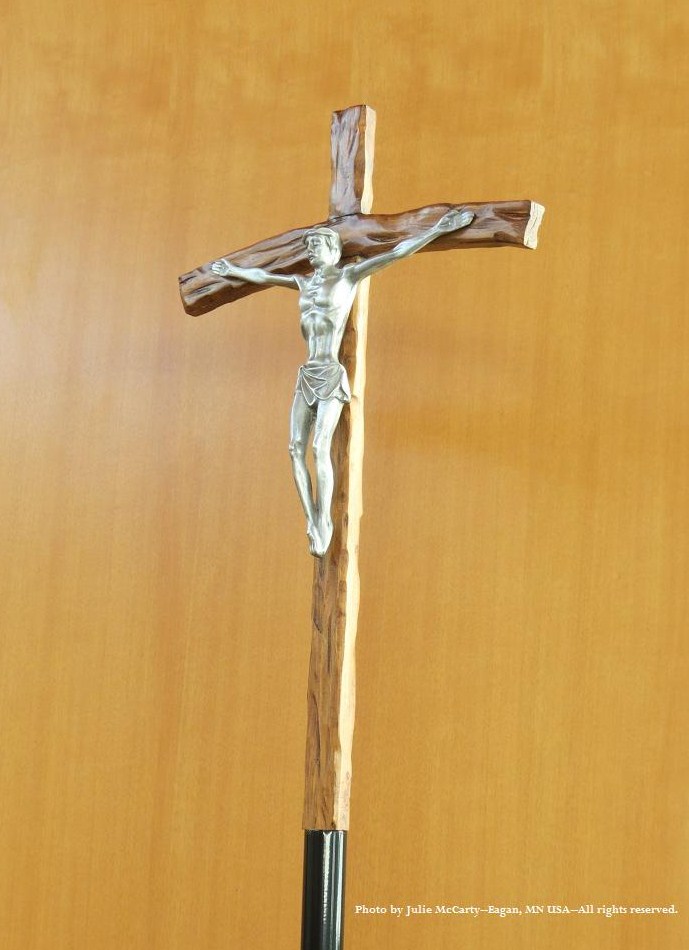
Cruicifix--photo by Julie McCarty--Eagan MN USA. All rights reservedLent is the perfect time to ponder this question: What kind of crosses am I carrying? If you are like me, some of your personal suffering is really a result of choices you’ve made, or perhaps the attitudes you have. If I enter into a situation like a lion about to pounce, then it is likely I’m going to bring about more suffering on myself (and others!). On the other hand, if I enter a complex situation with the mind and heart of Christ, I may still suffer for speaking the truth, but what I say will be spoken with love, for the ultimate good of others.

Love sometimes involves being willing to suffer for another person’s sake, and that is the kind of suffering that mysteriously participates in the work of Christ on earth today. We may give up something we want to provide for our children. Perhaps we sacrifice a relaxing evening at home in order to pack food boxes for the hungry. We may take an unpopular stand on the job because of our commitment to Christ’s ethics of love and suffer as a result. When I think of these examples, crosses born out of love for another, I think of the words of Jesus:

If any want to become my followers, let them deny themselves and take up their cross and follow me. (Matt. 16:24)

I like to paraphrase it this way:

Jesus says to us today:

If you want to be my disciple, to call yourself a Christian (“Christ-follower”), then you must be willing to set aside your self-centered self, take up your own cross, and come, follow me.

The next time you are talking a walk, journaling, praying at church, or just driving alone in your car, think about this:  What crosses are you carrying? Which ones are endured because of love and which are really due to your own self-centered choices? Would you like to lay some of them down at the foot of the Cross of Christ? Tell God in your own words whatever you think about the crosses in your life–the good, the bad, and the ugly. Don’t be afraid to be honest with God no matter what. As they say, “God’s a big man–he can take it!” 

Until next time, Amen!

* From page 153 of Feb. 2013 issue of Give Us This Day (Liturgical Press), quoted from Sr. Macrina Wiederkehr’s book Abide.