During week 1 of Lent, I will be sharing some thoughts on prayer…

Until next time, Amen!

During week 1 of Lent, I will be sharing some thoughts on prayer…
Until next time, Amen!
Blessed 4th day of Lent!
 (click on image to enlarge)
After what I wrote yesterday, you might think: but how can I be cheerful when I am feeling so sad or upset? Didn’t you just say that Jesus had feelings of agony, distress, anger, grief, etc.?
My guess is that the person writing this proverb knew full well that a range of emotions is completely normal. After all, the Scripture is filled with emotion, and much of it poured out to God in prayer (take look at the book of Psalms!). I am a firm believer that we have a right to be honest about our feelings.
However, when we bring an overall attitude of cheerfulness to others, it spreads like a positive kind of energy flow. Some of the studies I’ve read say even using your “smiling muscles” on your face brings a change in the way your brain and body are experiencing the moment. Certainly when we smile at another person, it often brings a smile to their face and a pleasant feeling going forward into their day. We have the ability to spread joy–or at least comfort in the midst of sorrow.
The “bones” in the bible often refer to the deepest essence of a person…as in “I feel it deep down in my bones” or “deep in the marrow of my bones”… So I think the writer Proverbs 17:22 is reminding us that if we feed our spirits constantly with “downers” (for example, feeding ourselves on the media so much that we are constantly afraid or anxious–and spreading that fear to others), then we risk harming ourselves at the deeper level of who we are at core.
What do you think? I welcome your comments below.
When Jesus went off to pray in the desert, it was time of growth, prayer, waiting, and, yes, temptation. We, too, have desert times in life.
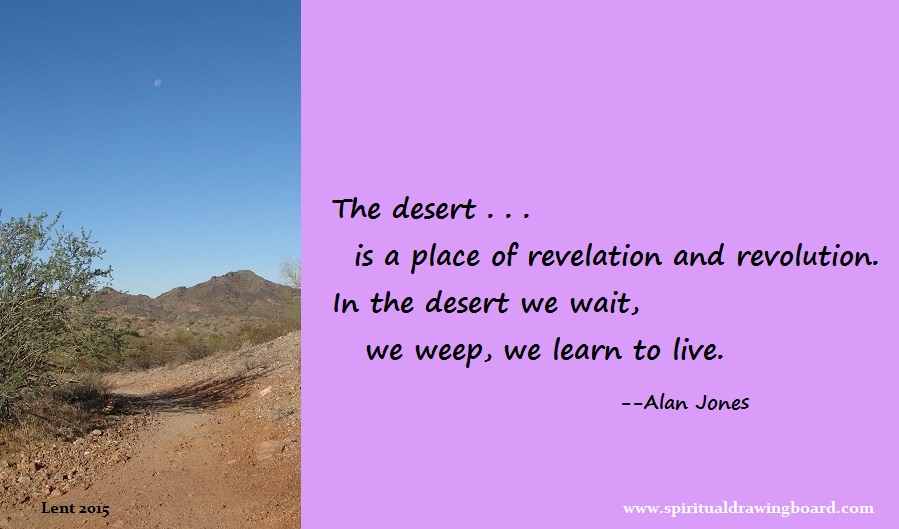
To be truly human, is to experience the highs and lows of feelings, to have times of joy and times of sorrow. Although Jesus was divine, he freely entered into these seasons and challenges of being human. If Jesus experienced these oh-so-human dimensions of life, it is only natural that his followers also have their desert times of waiting, weeping, and learning.
Will you pray with me?
Lord Jesus, when life feels overwhelming, help me to remember that you, too, had times of stress, confusion, agony, and grief. Grant me patience with the challenges of life, and when faced with difficult decisions, give me the wisdom I need to make the best choice.
Until next time, Amen!
Continuing the thought of Jesus going into the desert for 40 days. . .
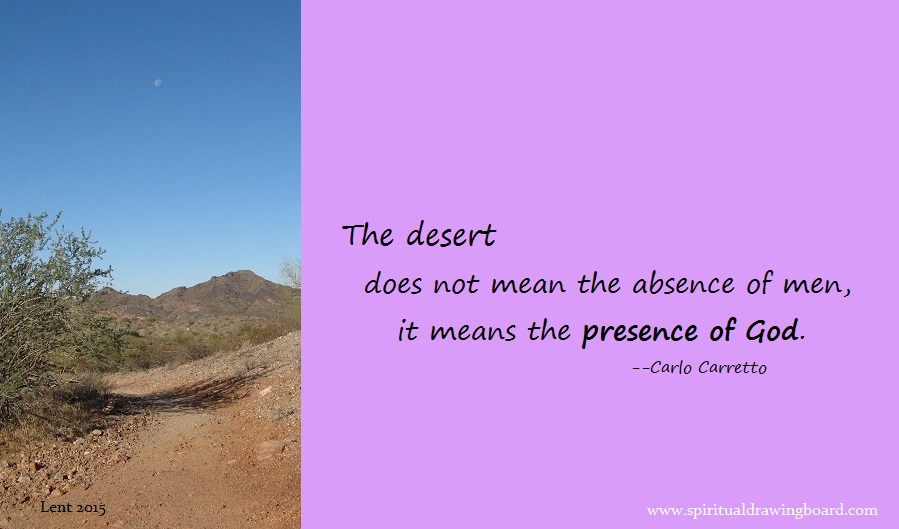
(click on image to enlarge)
Blessed Day 2 of Lent!
May your Lenten season be blessed… Here’s a gift for you:

(click on image to enlarge)
More quotes and images to ponder coming your way, one per day during Lent…
Until next time, Amen!
Lent begins tomorrow, and I’ve been working on creating images with quotations to nurture our Lenten journeys together. I will be posting them here, and also on my public Facebook page called Spiritual Drawing Board by Julie McCarty .

I hope you will find these images to be nourishing food for the Lenten journey and something positive and/or meaningful you can share in social media with your friends.
I will also be posting the images here so you can receive all of them in your e-mail (you have signed up to “follow” this blog in your e-mail haven’t you?). If you follow on Facebook, make sure you visit Spiritual Drawing Board page often or you won’t see all the posts. (The current delivery rate of posts on public FB pages is only about 2%.)
Whatever plans you have for Lent, may the good Lord bless you. Let’s pray for each other during this special time of preparation for the celebration of Easter.
Until next time, Amen!
While reading Psalms this morning, this verse caught my eye:
Some trust in chariots and
some in horses,
but we trust in the name
of the Lord our God. (Psalm 20:7)
 This psalm is written for those experiencing a time of great trouble, a time of stress and fear. (The first line is “May the Lord answer you in the day of trouble!”) So I think that the chariots and horses are ways of defending the people, ways of keeping them safe in the time of attack.
The psalmist isn’t saying not to use chariots or horses, but rather that one’s ultimate trust, the One to actually worship and stake your whole life upon is God.
I wonder, if the psalmist wrote this for us today, living in our own culture and time, what would he or she write? There are many possible answers, but here’s one… a bit of a stinging challenge to us all (Lent is a challenging time, isn’t it?!):
Some trust in private investment,
others in government programs,
but we trust in
the love and mercy of God.
That’s not to say we don’t need private investment or government programs. It’s that these things are not as important as placing all our faith in God.
Trusting in God doesn’t mean everything will “go my way”… That might be what some think, especially those who subscribe to the “gospel of prosperity,” but the God I believe in is much more mysterious and beyond my comprehension. God is not at my beck and call, like a servant waiting to answer my petty little whims.
For me, trusting in God means staking my whole life on the message of love and mercy that Christ taught. It means being willing to go the extra mile or take the risk to try something new for the sake of others.
Trust means believing that, in the end, it doesn’t matter if I have wrinkles or the Vikings win or which political party has the majority in Congress. Trusting in God means believing that there is something more important and more valuable than any of these things–and that the love we practice here prepares us for the loving embrace of God in the next life.
And, yes, at times, we do this very poorly–but that’s no reflection on the truth of Christ’s message. The fact that we fail to follow through on parts of the gospel is one good reason for the season of Lent: to recognize our sins, faults, weaknesses, and ways we “miss the mark” in our relationship with God and others.
Trust means believing that despite these sins and failings of mine, Christ has overcome sin and evil–and that Christ will continue to overcome sin and evil both now and in the future.
Now it’s your turn:
How would you rewrite the psalm verse for today?
What is the Spirit of God leading you to think about today?

Feel free to share your answer in the comment section if you like.
May the good Lord bless you. . . Until next time, Amen!

“Being close to God means communicating with him–telling him what is on our hearts in prayer and hearing and understanding what he is saying to us. It is this second half of our conversation with God that is so important but can also be so difficult. How do we hear his voice? How can we be sure that what we think we hear is not our own subconscious? What role does the Bible play? What if God says to us is not clear?” — From the back cover of “Hearing God” by Dallas Willard.
Lent begins today, and if you are still looking for some special way to observe the season, you might consider reading this book, “Hearing God: Developing a Conversational Relationship with God.” As most of you reading this blog know, prayer is not just about chattering on and on to God. Prayer is also about listening to God, paying attention to the presence of God.
But precisely how do we do this “listening” when it comes to God? Is there something wrong with us if we don’t actually hear a voice with our ears or in our minds? Is there some other way of “listening”?
During Lent I am facilitating a “virtual” book study about “Hearing God” in a small group format using e-mail. A friend of mine from church did this last summer with a group of Christians using a different book, and I learned a great deal. It was very convenient because we just wrote our thoughts at whatever time of day we wanted. We shared with people from different parts of the country, too. Frankly for me it was both challenging as a Christian (it was that kind of book) and JUST PLAIN FUN.
I already have a couple of people who want to discuss “Hearing God” in this way. If we have enough people (we need a few more to make it work), we will start the group process around next Wednesday, March 12. You can buy the book on Amazon or Christian Books or other places. There is even a Kindle version and audio version. (I will be using the 2012 updated version–and I’m also hoping to watch the related DVD’s.)
 Please join this group only if you have an open heart to learning about this important topic. People who join us should be prepared to be honest but polite, respectful of other people’s feelings and ideas.
Will you join us? If interested, please send me your first and last name and e-mail address by March 10. I am not charging a fee for this–just buy the book, and have fun reading and pondering the ways of God.
Contact me via e-mail at juliemccarty (at) usfamily (dot) com —OR– send a message to my Facebook page called “Spiritual Drawing Board by Julie McCarty.”
Whatever your spiritual practices this Lent, may the good Lord bless you.
Until next time, Amen!
If you are feeling a little blue, or overwhelmed, you might enjoy this post I just wrote for “Easter Prays,” the spirituality/prayer blog for Easter Lutheran Church (ELCA) in Eagan, Minnesota:
Jesus said, “Abba, Father, for you all things are possible; remove this cup from me; yet not what I want but what you want.” (Mark 14:36)

In our culture, it can be tempting to think that Jesus’ life was always easy. After all, he was the Son of God. We tend to think because Jesus had miraculous powers, public popularity, and immense wisdom, that he must have been happy all the time.
However, the gospels paint a picture of a man who also experienced others’ rejection, family misunderstandings, ministry fatigue, and grief.
READ THE REST–>> http://www.easterprays.wordpress.com/
Last night, I attended the Wednesday Lenten evening prayer service at Easter Lutheran Church in Eagan (“on the Hill” location). The music we sang is called the Holden Evening Prayer, music written by composer Marty Haugen. (The name comes from Holden Village, a Lutheran retreat center in Washington State, where Marty Haugen was musician-in-residence when he composed the music.)
The Holden Evening Prayer music can be sung anytime, but is especially appropriate during Lent, when praying is a special focus. The candles were lovely in the dark winter night, the music was soothing, and the short message by the pastor was inspiring–a great boost for the middle of the work week. If you’re not much of a singer, don’t worry. It’s pretty simple music, and I’m convinced that even if you just sit and listen, your soul will soak up the beauty of prayer.
Want to hear a sample? Here’s one of many clips from YouTube of the Holden Evening Prayer. This one was filmed at University Lutheran Church of the Epiphany (ELCA) in St. Cloud, MN (with a child singing one of the leads!):
After the service last night, I felt so relaxed. That’s the kind of music it was–very consoling and calming.
Whatever you do this Lent, keep on prayin’ …
 Spiritual Drawing Board