
The Jesus Prayer

“Jesus Christ, Son of God, have mercy on me, a sinner.”

As I mentioned last time, I’m  involved in a small faith group this summer which is exploring various ways to pray. We are using the book Creating a Life with God: The Call of Ancient Prayer Practices by Daniel Wolpert (Upper Room Books).

"Christ the Pantocrator--Jesus Creator of All" --Icon by Marian Zidaru 2002--photo by JAMThis week I finished reading the chapter that focuses on the Jesus Prayer.  This ancient way of praying reminds us of God’s presence through praying the words the blind man shouted out to Jesus as he passed by: “Jesus, Son of David, have mercy on me!” (Mark 10:47)

The exact wording of this prayer can vary. Some pray, “Jesus, Son of God, have mercy on me, a sinner” or other similar words. I once met a nun who simply prays two words in a slow, meditative fashion, sometimes in rhythm with her breath, “Jesus, mercy.”

This way of praying is not done in order to earn salvation or win God’s favor by repetitive prayer. The short prayer is used to draw one’s attention to God’s love, mercy, and presence in our lives, whether we are eating, sleeping, working, or sitting in church praying. Praying in this way draws our hearts and minds away from trivial, passing things, and into the realm of God’s presence, seeking to follow the instruction of First Thessalonians to “pray without ceasing” (5:17).

While reading Wolpert’s book, I was touched by the way he described praying the Jesus Prayer in the wee hours of the night:

One of the best times for me to pray the Jesus Prayer is at night when I cannot sleep. Rather than tossing and turning and getting upset that I am still awake, I simply begin to pray the Jesus Prayer. Remember that the pilgrim was told to pray the prayer even in his sleep! Often I do fall asleep right away. The times when sleep comes more slowly are wonderful periods of prayer. In the deep silence of the night, I can lift my heart and mind to my Creator—a soft voice ringing out into the infinite.

“Jesus Christ, Son of God, have mercy on me.” 

I, too, on occasion have prayed this prayer in the middle of the night. I like to do the short form, in time with gentle, slow breathing: “Jesus” (while gently inhaling) and “mercy” (while gently exhaling).  It’s like inhaling the presence of God and asking for God’s love and mercy all at once…mercy for my sins, mercy for the one who has hurt me, mercy for the sick and suffering, mercy for the broken and hurting world all around us.

If you think that this prayer practice is nothing but sweetness and light, think again: it is not always so. During an interview I did one time for an article on the Jesus Prayer, an Orthodox priest told me the this prayer form “is no picnic.” He explained that if one is serious about the Jesus Prayer, practicing it in the context of truly following Christ, Christ the Pantocrator -- Jesus Creator of All -- Detail --2002 Icon by Marian Zidaru -- photo by JAMthe prayer gradually leads a person to recognize his or her own impurities of word, thought, and deed that previously went unnoticed. This awareness of our own sins and imperfections leads us into a gradually deepening conversion process.

The Jesus Prayer, this priest observed, “is an effective tool in the very difficult work of gaining control of one’s mind in order to center it on the constant remembrance of divine beauty and awakening it to the eternal realities of the Spirit.” The process makes it possible for us to become “servants of divine Compassion, students of the Lord, studying how to die to ego, so that we might be reborn as children of the Spirit.”

“Jesus Christ, Son of God, have mercy on me, a sinner.”

Until next time, Amen!
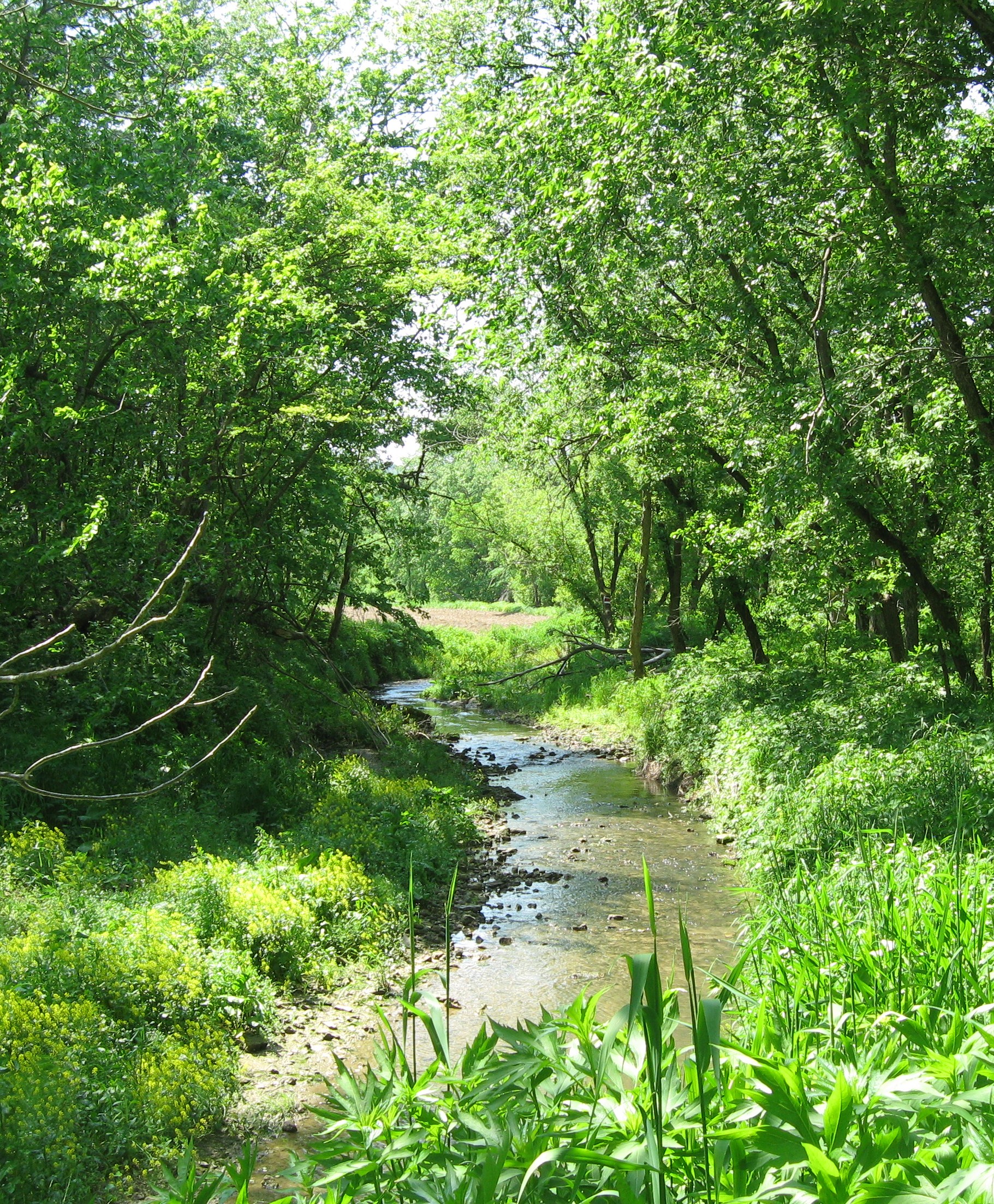
Living Water, Holy Spirit, and Solitude at an Iowa Stream

On the last day of the festival, the great day, while Jesus was standing there, he cried out, “Let anyone who is thirsty come to me, and let the one who believes in me drink. As the scripture has said, ‘Out of of the believer’s heart shall flow rivers of living water.'” Now he said this about the Spirit which believers in him were to receive; for as yet there was no Spirit, because Jesus was not yet glorified.  (John 7:37-39)

Wolf Creek--photo by Julie McCarty--Note: click on photo to enlarge

Flowing water fascinates me. When I was a little girl, my best friend had a house with a creek flowing near her house, and we would play for hours within and around the water.

Jesus tells us that he is the living water that satisfies all our deepest longings. The Spirit is flowing in Christ, flowing through him to everyone around him.

What surprises me when I read this passage today is the part about the water of the Spirit flowing out of those who believe in Christ. In all the times I heard this passage proclaimed at church, I never noticed that part. Here’s what the footnote in my bible says:

Jesus is the true water of life, who turns the symbol into reality. . . Believers become channels of life to others, through Christ’s Spirit given at Pentecost after he was glorified (crucified, risen, ascended).    –From the Oxford Annotated Bible, NRSV.

Not only was Christ both human and divine, his human side was a channel of the Holy Spirit–and we, too, are called to be channels of the Holy Spirit, flowing out to give to others in abundance.

Today I am offering you a gift that relates to this meditation: a 2 minute escape from your present work into the environment of a flowing, modern day stream named Wolf Creek. This is a very short video I took on a recent trip to our favorite country getaway in the rolling hills of northeastern Iowa, the “Morning Mist Cabin” owned by Larry and Jo Thein. (Thanks to them for letting us share it, and thanks to my husband Terry for his techie expertise in getting it setup on YouTube.)

As you watch this video, you might want to just enjoy the ability to getaway for a moment from the busyness of daily life, taking in the sights and sounds of God’s creation in nature. You might consider Jesus, the Living Water, and how the Spirit is the water that flows through you to others. Or maybe you just want to wait and see what the Spirit might inspire in you this day.

Note: You can enlarge the picture using the little box with four arrows in the bottom right of the picture to enhance the experience of “getting away from it all,” but just be aware that the picture won’t be as sharp. Move your mouse to see how to reduce it again. 

Until next time, Amen! 

Living Stones, Spiritual Milk, and Soul Growth

Come to him [Christ], a living stone, though rejected by mortals yet chosen and precious in God’s sight, and like living stones, let yourself be built into a spiritual house, to be a holy priesthood, to offer spiritual sacrifices acceptable to God through Jesus Christ.  — 1 Peter 2:4-5.

This week I have been pondering this verse, taken from the First Letter of Peter, which will be proclaimed this Sunday at many Christian churches throughout the world.

Peter—whose name means “rock”– calls Christ a living stone, and later in the passage, a cornerstone, the important foundation for the beginning of a building. He also calls us living stones that God is building into a spiritual house or temple. Although each one of us is uniquely gifted, each one of us has our identity and space in the building, our relationship to each other. Individually, we are loved by God, but together we form something even better and bigger than ourselves, the “spiritual house” God is building.

Having been raised Catholic, I can’t help but notice that Peter, the Rock, whom many call the first pope, doesn’t say anything about popes, cardinals, bishops, or other hierarchy in this reading. All are “rocks,” built together upon the Cornerstone, Christ. Peter calls all of us together a holy priesthood, whose purpose is to offer spiritual sacrifices to God.

But what is meant by living stones?

Unlike inanimate matter, Peter doesn’t want us to just “sit there,” motionless. We are to be strong, like rocks, in our faith in God, no matter what the weather brings, but we are also to be alive, growing, moving, and changing more and more each day into the image of Christ.

Churches who use the Revised Common Lectionary this Sunday, will hear the words of Peter just prior to these verses, and I think it’s worth looking at how these verses illuminate what the writer meant by “living” stones. Just before he writes about the living stones, Peter writes:

 Like newborn infants, long for the pure, spiritual milk, so that by it you may grow into salvation—if indeed you have tasted that the Lord is good.  (1 Peter 2:2-3)

At first I didn’t think there was any connection between this verse on drinking spiritual milk and the living stones. However, the original text would not have had paragraph indentations and periods at the end of sentences. The writer was flowing from one thought to the next.

Peter exhorts us to long for spiritual milk from God (food like Eucharist?), so that we can keep growing in the Lord. We forget to consider that in biblical times there was no packaged infant formula. The only way an infant was fed was directly from the mother’s body (or a “wet nurse”). The original hearers would have imaged a mother feeding her baby when they heard this verse and perhaps thought of God as feeding them directly from himself in the Eucharistic feast. (I am not the first person to think of this. See May 5th post.)

Although we must be strong in faith, like rocks, we are also to be fluid, moving, and growing, like a newborn baby. God is both the builder who is creating a strong church community and the mother who is feeding us directly with God’s self. (I think of Eucharist here, but I suppose additionally, in a mystical sense, the Spirit feeds us in the depths of our hearts as well.)

If you stop to think about it, these are amazing ideas: a God who is constantly supporting us, feeding us, building us up, not only individually, but together, in interdependent relationships.

O God, Sacred Builder and Divine Nurturer, help us to be strong as rocks in our faith in You, and as innocent and reliant upon You as a newborn baby is upon his or her mother.

Until next time, Amen!

Jesus said, “Peace be with you.”

When it was evening on that day, the first day of the week, and the doors of the house where the disciples had met were locked for fear of the Jews [the leaders who handed Jesus over to the Romans] , Jesus came and stood among them and said, “Peace be with you.” (John 20:19)

After Jesus was crucified, his disciples were in hiding, afraid of what might happen next. If Jesus, their beloved rabbi and leader, the one with all those miraculous spiritual powers, had been tortured and killed, it could happen to them.  

I imagine they were confused, crushed with disappointment, and experiencing the intense emotions of grieving. How could this happen? All those miracles, their belief in Jesus as the Messiah, the Anointed one of God–all that goodness destroyed by the Romans who put him to death! And their own religious leaders, who had also condemned Jesus of blasphemy. Would they also turn on Jesus’ disciples?

Surely they had feelings of remorse and guilt. After all, they had run away when their friend needed them most. They had given in to fear, even though their Lord had told them repeatedly, “Do not be afraid.” What kind of followers were they, insisting to Jesus’ face that they would stand by him, even to the death, and then, instead, immediately fleeing when the going got tough? Peter, “first among equals” or the “prime” apostle, even lied when questioned about his association with Jesus.

When the Risen Lord appears to this disloyal group for the first time after his death, what does he say? If he were a married person, talking to his or her spouse, he might have said, “Told you so! I knew you would leave me when things got rough.”

If Jesus were a politician, he might have fired the disciples from their managerial posts. If Jesus were like certain religious leaders, he might have assigned the apostles a penance, banned them from teaching, or withheld communion. After all, most the apostles abandoned Jesus after he was arrested. (We only hear of John, Jesus’ mother, and other women followers standing by Jesus as he suffered on the cross.)

But the Lord Jesus is not like us sinners. He is not self-centered or self-righteous. In relationships, Jesus does not grab at power over others. He has no need to be a superstar, dictator, or spiritual bully.

When he reappears to them after his death, the first words Jesus says to them are “Peace be with you.” This peace is the inner peace that only God can give. It is not a peace based on owning a lot of material possessions, being wealthy, having a sexy appearance, belonging to the winning political group, or even forming the perfect liturgical translation. Christ’s peace is a gift of the Spirit, given freely with love.

The peace that Christ is offered them–and offers us–is not only peace within each soul, but also peace among people, creating spiritual networks of loving relationships. The Greek word in this passage of John’s gospel is not merely about the absence of disturbance or conflict. It is a word that probably is from the root word that means “to join.” Christ desires that we be joined together in relationships of love. The peace Christ wants is one of harmony among people, which is what he prayed for just prior to his death, that all may be one, not one in physical appearance, worship style, culture, or dogma, but one in the Spirit, one in the Lord.

When Christ wishes the disciples peace, he is offering it to them without strings  attached. The Risen Lord loves all people, sinners or so-called religious. If we would be his followers, we must do the same.

Until next time, Amen!


Note: Many thanks to my hubby, Terry McCarty, for the photographs in this post. He took them this past month at the Como Park Conservatory in Saint Paul, Minnesota. Copyright 2011, Terry McCarty. All rights reserved.

Holy Week: Meditating on Marc Chagall’s White Crucifixion

White Crucifixion–1938 oil painting by Marc Chagall (click on picture to enlarge)   (more details at end of post) 


 As you probably know, this week is the celebration of Jewish Passover and Christian Holy Week. Because of this, I wanted to do something special, so I hunted online for a work of art to use for visio divina (meditating with art, see Feb. 24, 2011 post). As a Christian, I was looking for an image of Christ on the cross, and ended up being drawn to a 20th century painting called White Crucifixion by the famous Russian and Jewish artist Marc Chagall.

People have highly individualized reactions to art and I want to state up front that this post is not a historic analysis, an art critic’s review, or even a theological examination of the White Crucifixion. This post is simply my own personal feelings, thoughts, and prayer reactions after spending several days pondering the work. I respect that there are many ways to view the White Crucifixion, and I believe the artist himself would be the first to acknowledge that.

Many of Chagall’s paintings could be described as lively, romantic, humorous, imaginative, and filled with brilliant colors, but the White Crucifixion is largely drained of color. Chagall painted it in 1938 while living in Paris, in response to the horrifying events of Kristallnacht,  the “Night of Broken Glass,” when Jewish homes, businesses, and synagogues throughout Germany were systematically vandalized or destroyed, and thousands of Jewish men were carted off to concentration camps.

In White Crucifixion, Chagall arranges various scenes of this Jewish suffering around the crucifix, much like an altar screen adorned with biblical scenes around the perimeter. In the upper left, Russian soldiers turn Jewish homes upside down and set them ablaze. In the upper right, Nazi soldiers throw sacred objects from a burning synagogue out into the streets.

Below, a Jewish man is fleeing with a bag of belongings on his back, while another stands ready to sprint away, the sacred Torah firmly clasped in his arms. A woman holds her child in a protective stance; an old bearded man stands with a sign around his neck, his hands open, as if to ask “Why?”; refugees on an overloaded boat look as if about to die of hunger; a sacred scroll in the lower left corner is rolling on the ground, about to disappear from our sight; and the ghosts of Jewish rabbis and ancestors float above the scene, some covering their eyes or looking away—the sight is too horrendous to behold.

In the middle of all this, a Jewish man hangs on a cross, his only clothes a simple head covering and a tallith, a Jewish prayer shawl, to hide his nakedness. The words above him identify him as “King of the Jews.” With his hands and feet nailed to the cross he cannot move to stop the chaos and suffering all around him. He, too, suffers with all those others suffering. He bows his head in silence, as if in prayer or mourning. A light shines from above, while silent candles (a menorah turned sideways?) hold vigil at the base of the cross.

If the picture makes you feel uncomfortable, as it did me, I suggest you stay with that feeling for awhile. I did. I pondered the many evil things people have done, supposedly in the name of Christianity or other religions. I thought of all the times we think of Jesus as a blue-eyed, blond-haired little baby in a manger and how wrong it is that so often Christians have stripped Jesus of his Jewish heritage—and, much worse, committed heinous crimes against his younger, modern-day nieces and nephews.

The White Crucifixion reminds me that the observance of Good Friday ought not only to be about remembering the sacrifice of Christ, but also of the suffering that is going on all around the world today. Even as you read this, someone somewhere is being tortured, unjustly imprisoned, raped, kidnapped, enslaved, or murdered. Do we pray for these unseen, silent victims?

This Good Friday, let those of us who dare to call ourselves Christians take a good hard look at how we treat people who are seemingly “different.” Let us meditate long on the words Jesus said: “. . . love your enemies, do good to those who hate you. . .” (Luke 6:27) May we respect life in all its forms, treating every human with the same dignity we would treat Christ.  After all, it was Jesus who said [in the words of the song based on Matt. 25:40], “Whatsoever you do to the least of my brothers, that you do unto me.”


Notes:  Image of the painting above was copied from Wikipedia under the creative commons agreement. To view a larger image, visit the Art Institute of Chicago website, http://www.artic.edu/aic/collections/artwork/59426.

Other resources consulted: Marc Chagall and the Lost Jewish World by Benjamin Harshav (Rizzoli); Chagall by Jacob Baal-Teshuva (Taschen); and Marc Chagall by Jonathon Wilson (Nextbook-Schoken).

The Veil Torn in Two–Removing Obstacles in the Spiritual Life

After the long winter, it was good to see the ground again, even if the grass was flat and brown. One recent Saturday, when the only snow left was a couple of mountains near our driveway, my husband Terry spread the snow out across the lawn to speed up the melting. He said he wanted the exercise of shoveling and, after all, it felt good to get outside in the fresh spring air.

Secretly, I thought it wasn’t necessary, but I understood well the desire to be done with winter. Besides, I knew there were flower bulbs underneath that giant snow pile by the mailbox, and I thought perhaps we might see some blossoms a little bit sooner if the thick veil of snow was removed.

We were in for a big surprise: the very next morning, little shoots were peeking out of the soil. I still can’t get over it. How can a bulb that is several inches beneath the surface, and just the day before also beneath a couple feet of snow, push its way to the surface in less than 24 hours?

This experience made me think of the many obstacles, like mountains of snow, that sometimes block spiritual growth or the deepening of our relationship with God. We may have certain behaviors in our lives that are sinful, or bad habits that keep us from our maximum potential. Soft addictions (see my March 24 post) may keep us occupied in ways that prevent us from having the time for more productive activities or more attentive prayer lives.

But it is not God’s desire that anything keep us apart from the divine presence. In upcoming days, Christians throughout the world will be meditating on the suffering, death and resurrection of Jesus Christ. We read in Matthew’s gospel that at the moment when Jesus released his spirit and died upon the cross

 . . . the curtain of the temple was torn in two, from top to bottom. The earth shook, and the rocks were split. The tombs also were opened, and many bodies of the saints who had fallen asleep were raised(Matthew 27:51-52).

This curtain was the veil that hung between the general worship space of the temple and the Holy of Holies, the place where the Ark of the Covenant with the Ten Commandments was kept. The Holy of Holies was the place in which God dwelt in a special way–so special that only the High Priest could enter this sacred room, and then only on one day each year, on the Day of Atonement.

Some Scripture commentators write that the tearing of the veil of the temple at the time of Jesus’ death symbolizes the end of the Old Covenant and the beginning of the New Covenant. Another interpretation–the one I like best–is that Christ’s sacrificial death transformed the way we humans relate to God. Christ removes the obstacles between God and us.

Christ is our high priest whose own sacrifice “tears the veil away,” making it possible for us to approach God directly in prayer. Christ removes the many obstacles in our lives that keep us from growing in love and service.

The more these obstacles are removed, the more the light of God will shine on us, so that each of us will grow into creations as beautiful as the flowers that bloom in spring.

Until next time, Amen!

P.S. If you are receiving this in e-mail subscription, it is always allowable to forward it to a friend. –Julie McCarty, author of the Spiritual Drawing Board, https://spiritualdrawingboard.wordpress.com