Feast of the Transfiguration

Today is the Feast of Christ’s Transfiguration:

Jesus took Peter, John and James and went up a mountain to pray. While he was praying his face changed in appearance and his clothing became dazzling white. (Read more in Luke 9:28b-36)

 Transfiguration photo 2--by Julie McCarty --Spiritual Drawing Board

Until next time, Amen!

P.S. Yes, it’s okay to share these posts with friends. See also Facebook page “Spiritual Drawing Board By Julie McCarty” for more social media sharing.

Gray hair, wisdom, and following Christ

My child, from your youth choose discipline;
and when you have gray hair you will find wisdom.
–Sirach 6:18

Gray hair connected with wisdom?

I don’t dye my graying hair, so I experienced a kind of delight in this reading this verse today in Give Us This Day (Liturgical Press). I don’t consider hair coloring to be sinful or anything–so please don’t be offended if you, well, improve your hair color. I just find it freeing and natural to be true to who I really am before God, by letting my hair “be itself,” the color God gave me. (My husband likes it that way, too.)

Of course this bible verse isn’t really about gray hair, but rather the search for wisdom– genuine wisdom, not just memorizing facts or getting a passing grade in school. Youth can be extremely insightful about certain things, but there is a special wisdom that some people receive through lived experience and years of spiritual attentiveness.

Being of an older age is no guarantee that one will be wise, of course. The book of Sirach (Ecclesiasticus) tells us that if you want to have wisdom in later years, you need to have discipline in your life. Our culture often thinks of discipline as punishment, but that is not what is meant here. Sirach is talking about self-control, dedication, and hard work, like a farmer who works at plowing and planting a field, and then must wait for the harvest.

Growing corn plants--photo by Julie McCarty

If you are like me, you have self-control in some ways but not in others. I can finish a college course, but waste time on Facebook when I should be writing. I can eat a healthy breakfast yet pig out in the evening. I can control cussing in public only to say something hurtful to a friend. You get the idea.

The roots of the words discipline and disciple are connected with learning. A professor teaches an academic discipline, such as chemistry. One who is learning from a spiritual master or guru is called his follower or disciple. The followers of Jesus were not called disciples just because they walked down the road with him, but because they were his spiritual apprentices, learning Christ’s spiritual teachings.

To be a disciple (follower) of Jesus Christ in our own day is to follow his spiritual teachings. Occasionally I get the feeling that some who call themselves Christian in this country are losing sight of this fact. Yes, our profession of belief in Christ might be the minimal requirements, on our death-bed, for God to take us to heaven out of his infinite mercy and love (like the good thief on the cross).  Yes, it is true we cannot “earn” our salvation by our own good works.

Good Shepherd stained glass window--photo by Julie McCartyHowever, if we are really disciples of Christ, that is, believers in the “Jesus way,” then we will seek to live as he taught us. That takes courage, self-control, effort, and many gifts of grace and the Holy Spirit. Jesus taught us that not everyone who cries out “Lord, Lord” (believing in God) will be saved, but rather those who actually do the will of God (see Matt. 7:21).

I want to be that kind of follower of Jesus, someone who not only intellectually believes in Christ or goes to church on Sunday, but also one who lives her life according to the teachings of Christ. Yes, I am a sinner. I cannot live as Christ taught without the help of grace and the Holy Spirit. But I have to do what I can, put forth a little effort to truly love God with my whole heart, mind, soul, and body, and to love others as myself.

For me, living that way would be the Ultimate Wisdom.

Until next time, Amen!

The Risen Lord Enters Our Hell

The tombs also were opened, and many bodies of the saints who had fallen asleep were raised. After his resurrection they came out of the tombs and entered the holy city and appeared to many.  –Matthew 27:52-53.

When you think of Christ’s resurrection, what do you imagine? Do you think of Jesus bursting out of the tomb, his cape flying behind him like Superman? Do you think of Jesus disguised as the gardener who surprises Mary Magdalene? Jesus magically appearing behind locked doors? Walking with the disciples on the road to Emmaus?  

If you were raised in an Eastern Christian church, you might have another image, an even more prominent image, strongly planted in your mind. You might immediately think of the “Anastasis” (Greek for “resurrection”), an icon or image of Christ breaking down the doors of hell (hades, the place of the dead), in order to free Adam and Eve and others from their spiritual prison.

Below is an ancient fresco of this image, painted in the Church of St. Chora in Constantinople. Christ is pulling Adam and Even out of their tombs. He is standing on the gates of hell, which he has broken open. Other saints and prophets of the Old Testament are also witnessing and participating in this remarkable event.

Anastasis--photo by Neil Harrison--Dreamstime.com

(Click on photo to enlarge. Photo: copyright Neil Harrison — Dreamstime.com) 

It is JESUS who goes the extra mile, to pull up Adam and Eve out of the grave. Never mind that Adam and Eve had deliberately sinned. Never mind that they didn’t “deserve” salvation. Never mind that they weren’t baptised Christian. Never mind that they lived before him in time and place.

Jesus’ love overcomes every obstacle. Even the doors of hell cannot hold Christ back. And that applies to our current lives as well. Christ enters the places we feel are our own personal “hells” in order to bring us new life.

In Praying with Icons, Jim Forest reminds us that the Anastasis Icon serves as a reminder that Christ wants to free us from all that enslaves us, especially perhaps, our fears:

The icon of Christ’s Descent into Hell can be linked with an ongoing prayer not to live a fear-centered life. We live in what is often a terrifying world. Being fearful seems to be a reasonable state to be in — fear of violent crime, fear of job loss, fear of failure, fear of illness, fear for the well-being of people we love, fear of collapse of our pollution-burdened environment, fear of war, and finally fear of death. A great deal of what we see and hear seems to have no other function than to push us deeper into a state of dread. . . .

We can easily get ourselves into a paralyzing state of fear that is truly hellish. The icon reminds us that Christ can enter not just some other hell but the hell we happen to be in, grab us by the hands, and lift us out of our tombs.

There is much that can frighten us in our everyday experiences. Christ does not prevent us from ever suffering–but Christ does promise to be there with us, through the power of the Holy Spirit dwelling within and among us, come what may.

Until next time, Amen!

Les Misérables: Who do you belong to?

Les Miserables This past weekend I enjoyed Les Misérables, the 2012 movie fresh out on DVD. As most of you know, Victor Hugo’s story is swimming with meaningful themes. One could explore how Les Misérables focuses on the power of truth, redemptive suffering, compassion for the poor, devotion to God, forgiveness, letter of the law vs. spirit of the law, or a host of other spiritual themes. 

One theme that caught my attention this weekend is this: Who do you belong to?  That is to say, who are you, in your deepest, truest person?  (Who am I?)

To understand what I mean, watch for how Jean Valjean struggles with these questions throughout the movie. At the beginning of the story, Jean Valjean has been in prison for 19 years, a sentence that began because of stealing a loaf of bread to feed starving family members. From the perspective of Javert, the ruthless prison overseer, Valjean is nothing but a stinking criminal, a “dangerous man,” whose only name is his prison number: 2-4-6-0-1.

And, unfortunately, the prison experience has indeed made Valjean’s heart embittered and filled with hatred. He has come to the conclusion that an “eye for an eye and a tooth for a tooth” is the way to live. Upon his release, he is given identification papers which label him for life as a criminal.

Finding it impossible to find an honest living with the label “dangerous man,” Valjean likely would have remained forever in his angry 24601 identity, if not for a churchman’s simple, yet bold act of mercy. This freely given kindness pierces the bitter armor of Valjean, who comes face to face with the realization of who he has become, a man of hate and revenge.

Standing on the threshold of new possibilities, Valjean must decide if he will continue to live the life of “24601,” or become a person who values his soul, the way the kind bishop viewed him.  Valjean sings “my life he claimed for God above” and “my soul belongs to God.”

Valjean vows to become a different person, and he truly does reform his life. However, that is not the end of wrestling with “who am I?” and how to live the moral, spiritual life. (Would that life were that easy!) He will have to ask these questions again and again, throughout the rest of the story.

( Taste test the movie at  http://www.lesmiserablesfilm.com/  .)

This week, Holy Week 2013, is a good time for each of us to ask, “Who am I?” Do I see myself as ultimately belonging to God? If so, how does that belonging to God influence the choices I make, here and now?

Easter Church--Hill focal pointJesus stayed true to the person God intended him to be. He did a lot of good upon the earth, but in the end, the world made him pay the price for following his divine calling. We who call ourselves Christians will also, at times, find ourselves paying the price for following Jesus. It is the way of things. Jesus reminds us:

I have said this to you, so that in me you may have peace. In the world you face persecution. But take courage; I have conquered the world!   (John 16:33)

We journey this week with Jesus, to the cross, knowing that our lives will not be free from crosses. But we can trust in the promises of Christ, knowing that death does not have the final say. In Christ’s death there is also Christ’s resurrection–and the promise of new life for us as well.

Violet Gravatar of Julie McCartyUntil next time, Amen! 

P.S. Giveaway coming soon: Watch for upcoming giveaway of a brand new, free DVD of Les Misérables here on Spiritual Drawing Board blog or Facebook page “Spiritual Drawing Board by Julie McCarty.”

What kind of crosses are you carrying?

Today’s reflection in Liturgical Press’ Give Us This Day explores the kinds of crosses we carry–some of which are really not the cross God wills for us to have to endure. Benedictine sister Macrina Wiederkehr writes:

Many of the crosses we choose to carry are not redeeming. To name just a few: living with resentment, withholding forgiveness, needing to be in control, being unwilling to learn from others, selfishly demanding my own way, remaining imprisoned in addictive ways of living.*

Many times we don’t even realize we are carrying these types of crosses. When it comes to light that “we are carrying a cross of our creation–carved out of our own foolishness,”*  we can see it as a sign of spiritual growth. Some of the suffering in our life is not sent by God, but rather a result of our own attitudes or a natural result of our sinful choices.

On the other hand, the author also observes that some crosses we carry may have spiritual value. These crosses mysteriously participate in the redemptive work of Jesus Christ. What made Christ’s suffering redemptive was not the pain or agony, but that he bore the suffering out of his great love for us.

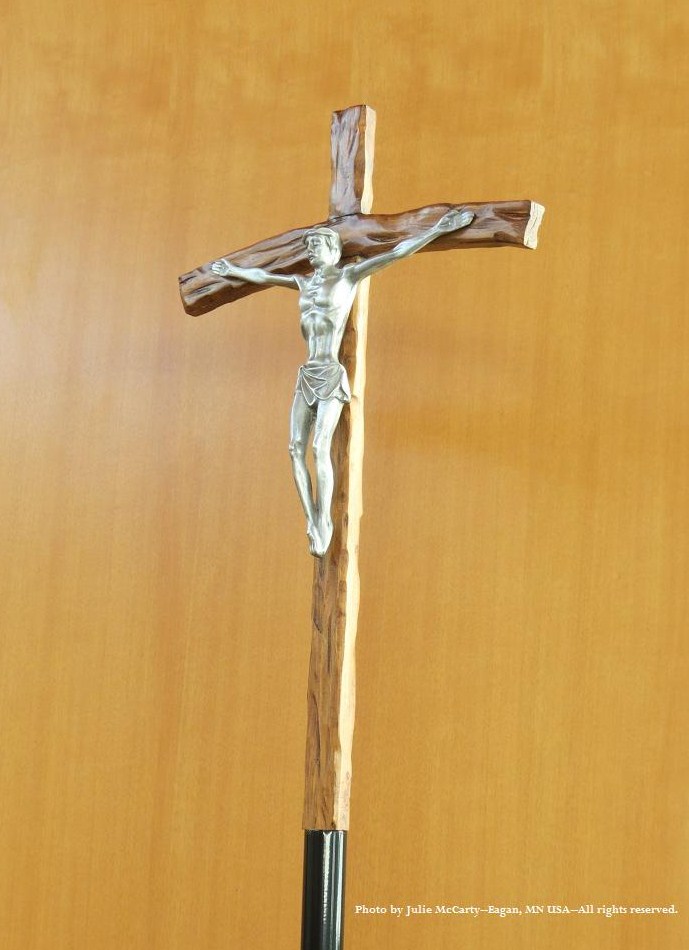
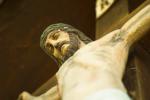
Cruicifix--photo by Julie McCarty--Eagan MN USA. All rights reservedLent is the perfect time to ponder this question: What kind of crosses am I carrying? If you are like me, some of your personal suffering is really a result of choices you’ve made, or perhaps the attitudes you have. If I enter into a situation like a lion about to pounce, then it is likely I’m going to bring about more suffering on myself (and others!). On the other hand, if I enter a complex situation with the mind and heart of Christ, I may still suffer for speaking the truth, but what I say will be spoken with love, for the ultimate good of others.

Love sometimes involves being willing to suffer for another person’s sake, and that is the kind of suffering that mysteriously participates in the work of Christ on earth today. We may give up something we want to provide for our children. Perhaps we sacrifice a relaxing evening at home in order to pack food boxes for the hungry. We may take an unpopular stand on the job because of our commitment to Christ’s ethics of love and suffer as a result. When I think of these examples, crosses born out of love for another, I think of the words of Jesus:

If any want to become my followers, let them deny themselves and take up their cross and follow me. (Matt. 16:24)

I like to paraphrase it this way:

Jesus says to us today:

If you want to be my disciple, to call yourself a Christian (“Christ-follower”), then you must be willing to set aside your self-centered self, take up your own cross, and come, follow me.

The next time you are talking a walk, journaling, praying at church, or just driving alone in your car, think about this:  What crosses are you carrying? Which ones are endured because of love and which are really due to your own self-centered choices? Would you like to lay some of them down at the foot of the Cross of Christ? Tell God in your own words whatever you think about the crosses in your life–the good, the bad, and the ugly. Don’t be afraid to be honest with God no matter what. As they say, “God’s a big man–he can take it!” 

Until next time, Amen!

* From page 153 of Feb. 2013 issue of Give Us This Day (Liturgical Press), quoted from Sr. Macrina Wiederkehr’s book Abide.

Visual Meditation: Attending the Mystery of the Incarnation at Christmas

How do you picture the birth of Christ? Do you think of a little Nativity scene like the one sold in stores, Mary kneeling in adoration beside the Baby Jesus, with the protective Joseph standing with staff in hand? Are there angels, shepherds, and wise men? Who or what do they represent? A historical moment or an ongoing spiritual mystery?

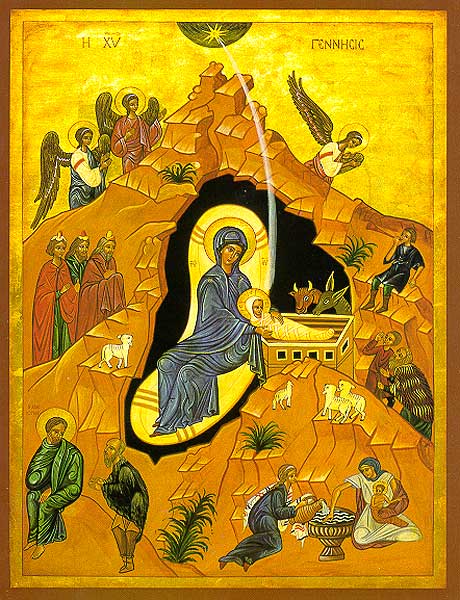
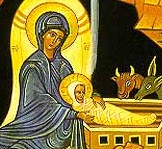
For people of Eastern Christian heritage, Christ’s Nativity is recalled using a highly symbolic picture, called a sacred icon. (“Icon” is the Greek word for “image.”) This image is created in such a way to act as a sacramental window into deeper spiritual truths. The icon below is a modern example of a Nativity icon.

Image of The Nativity by Sr. Marie Paul, O.S.B.; © Monastère des Bénédictines du Mont des Oliviers and Editions CHOISIR, Genève. The Printery House, Conception, Missouri, exclusive U.S. agent. www.printeryhouse.org –Shown with permission.
Image of The Nativity by Sr. Marie Paul, O.S.B.; © Monastère des Bénédictines du Mont des Oliviers and Editions CHOISIR, Genève. The Printery House, Conception, Missouri, exclusive U.S. agent. http://www.printeryhouse.org –Shown with permission.

Religious icons are not only beautiful works of art, but more importantly, created as a instrument for pondering the mystery of God’s presence in our lives. One meditates on the works of God by beholding the various truths represented in the icon and “pondering all these things” in one’s heart.

In the icon above, the various bible stories surrounding the birth of the Messiah are portrayed around the central figure of Mary and the Christ Child. Many events are portrayed, but each little picture relates to what is at the center, the birth of Christ. In this manner, we are reminded that, as Christians, Christ is to be the center focus of our lives.

Most of us can readily pick out the three wise men, angels, and shepherds in this icon. But if you go a little deeper, you will see the wise men are of differing ages, proving that God’s wisdom can dwell in people of any age. Two angels have their hands in the ancient open position of prayer, their “job” being to glorify God (something we are also to do). The other angel is descending from the heavens, to bring the good news of Christ’s birth to shepherds on earth (bringing good news of Christ to others is something we are to do, too!).

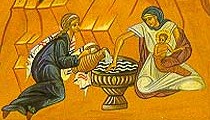
Nativity icon from Printery House --M08 - Cropped Copy--MidwivesIn the lower righthand corner, midwives wash the newborn Babe, wrapping him in swaddling clothes, the strips of cloth used for ordinary newborns of the time. This story of the midwives, told ancient written sources, reminds us that Christ was not only divine, but also truly human. (The direct line from the star at the top reminds us of Christ’s divine nature, and that he came to dwell in Mary by the power of the Holy Spirit.)

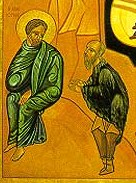
Nativity icon from Printery House --M08 - Cropped Copy--JosephJoseph’s posture, with his back to Mary & the child, startles me.  Orthodox theologian Leonid Ouspensky explains that the figure next to Joseph is the devil disguised as a shepherd, who is tempting Joseph to doubt in the miracle of Virgin Birth. (Remember how Joseph doubted Mary’s word about the angel at first?) Despite this, his halo reminds us that he was a holy man, redeemed by Christ and loved by God.

Returning to the central focus of the icon, Mary gives birth to the Christ Child, placing him in a manger box that also symbolizes the church and tomb.  Christ is born in a dark cave–he enters into the “darkness” of this world in order to overcome sin, evil, and death. (The golden light in icons is a symbol for God, the unapproachable Light, who nevertheless choses to enter into our earthly reality.)

With so much suffering in the world, the Nativity icon reminds us that no matter who we are–wise scholars or simple shepherds, young virgins or doubting Josephs–Christ comes to free us from sin, to re-create us into adopted sons and daughters of God. No matter what we have done or failed to do in the past, God reaches out to us now, in this and every moment, with unfailing divine love.

Nativity icon from Printery House --M08 - Cropped Copy--Mother & Child

This is reason for Christmas joy.

Until next time, Amen!

Note: Many thanks to The Printery House for help with information and the image for this blog post. Read more or purchase this icon at www.printeryhouse.org (click here)

Jesus, Barabbas, and Mob Mentality

But they all cried out together, “Away with this man and release to us Barabbas”—a man who had been thrown into prison for an insurrection started in the city, and for murder. Pilate addressed them once more, desiring to release Jesus; but they shouted out, “Crucify, crucify him!”    —Luke 23:18-21.

When I was young, my church began to read the story of Christ’s passion in group format on Palm Sunday. At first, I thought it was rather exciting to be included in reading the gospel aloud—that is, until I realized that we were given the part of the angry mob that chose Barabbas over Jesus.  I hated saying the words, “Crucify him!” In my child’s mind, I thought, I certainly don’t want Jesus on that cross. Why do I have to read this?

Today, when I read this bible passage I think to myself how often I have indeed chosen “Barabbas” over Jesus over the course of my life–not literally of course, but in terms of the many times I have chosen something over or against the ways of Christ.

When we ignore the cries of the poor, we choose “Barabbas” over Jesus. When we refuse to own up to our responsibility for our actions, we choose Barabbas. When we prefer lording over others instead of servant-leadership, we choose Barabbas. When we allow any group, be it a political group, workplace team, media, or social group, push us to act against the teachings of Christ, we choose Barabbas. At times, we may become part of the angry mob of a nation that turns against Jesus, calling for his crucifixion.

Holy Week is a good time to remember that we are all sinners—we all fall short in many ways. It is a good time to ask God for forgiveness, with a humble heart, recognizing our need for the Holy Spirit to guide us in the future. We can trust that Jesus, who willingly suffered on the cross for our salvation, will lead us into newer, better ways of living.

Will you pray with me? . . . .  Lord, help us to be more aware of our sins and failings– and to truly repent of them. I especially ask your forgiveness for …  Please forgive all our sins and help us to trust in your mercy. Pour out your Spirit upon us, so that no matter what the angry mob says or does, we might live more like Jesus. Amen.

 Yes, until next time, Amen.

Theotokos–Carrying Christ our Light

 “Greetings,  favored one! The Lord is with you. . . Do not be afraid, Mary, for you have found favor with God. And now, you will conceive in your womb and bear a son, and you will name him Jesus.” –The angel Gabriel to Mary, in Luke 1:28, 30-31.

If you’ve ever been on crutches, you know that carrying things is a challenge. I broke my leg a few weeks ago, and find myself stuffing cans of pop into my sweater pockets, shuffling dishes along the countertop, and sliding books along the floor using my crutch as a hockey stick (apologies to librarians!). Objects tucked into my waistband tumbled to the floor so many times I wished I was a kangaroo with a built-in giant pocket.

In the midst of this, Advent began and I found myself thinking about the mystery of the Incarnation. It would not have mattered if Mary had used crutches: the baby Jesus was growing deep within her womb and naturally went with her everywhere she went.

Theotokos--detail from the Virgin of the Sign Icon

In the Eastern Christian Church, the mother of Jesus is often called Theotokos, a Greek title that means “God-Bearer.” Mary carried Christ, the second person of the Holy Trinity, within her being in a literal sense, by the power of the Holy Spirit. Early church fathers observed that while Christ was truly divine, his truly human side grew out of Mary’s flesh and blood.

That a woman of 2,000 years ago carried Christ within her, feeding him from her very body through the umbilical cord, is reason enough to be filled with awe and wonder. However, this amazing spiritual truth does not end there. For Mary, as premiere disciple, is a model or “spiritual type” of what we are also called to do. We are to carry Christ within our hearts and souls, to “give birth” by bringing his words of mercy and his compassionate presence to all those we encounter.

In this manner, the words of the angel Gabriel are also addressed to each one of us: “Greetings, favored one!” (“Hail, Mary, full of grace!”). Each one of us, and all of us together, are “favored” by God, shown by the superabundant love of Christ by his dying for the whole world.  As a result, we, too, are favored, that is, graced by God,  and chosen to bring the Christ our Light into the world.

May God bless you this Advent and Christmas season–and may the Spirit empower you more and more each day to “give birth” to Christ in the world.

Until next time, Amen!

Enjoy these spiritual reflections? Please spread the word by telling your friends.

Jesus taught, “Love your enemies.”

But to you who hear I say,
love your enemies,
do good to those who hate you,
bless those who curse you,
pray for those who mistreat you.
     –Words of Jesus recorded in Luke 6:27-28.

The tenth anniversary of 9-11 will soon be upon us, and I wonder: What I have learned in those ten years? Have I overcome my fears and anger? Have I become more compassionate towards those who are “different” from me?

While thinking about this, I thought it might be worth revisiting a column I wrote at the time of the first anniversary of 9-11, published in The Catholic Spirit and a few other newspapers around the country.

Back then I was pondering the meaning of Jesus’ command to love your enemies, and the context was the ongoing threat of terrorist attacks. Today when I reread it, I think about how so many Americans have turned against each other in their extreme enthusiasm for their favorite political agendas.  At times it seems hostility has become the national pastime.

Being kind to those who hurt us is no easy task, and I certainly struggle with “love your enemies” myself. Nevertheless, if we call ourselves Christ-followers (Christians), then we must strive, with the help of the Holy Spirit, to practice all that Jesus taught.

Here’s that original article:

Praying for Enemies on the Anniversary of 9-11

As the one-year [now 10-year] anniversary of the tragic events of September eleventh approaches, I am pondering the meaning of Christ’s command to “love your enemies, and pray for those who persecute you” (Matthew 5:44). Just what did Christ mean? Should I pray for terrorists?

A priest I know did just that during a time of shared prayer at church. Some people questioned what he meant by praying for terrorists. Was he condoning their acts of violence and murder? Did he want terrorists to “win” the war?

Praying for one’s enemies does not mean that we agree with their ideas or support evil. Praying for enemies does not mean staying in an abusive relationship. It certainly does not mean that we eliminate praying for the poor, the oppressed, and victims of violence.

Therese of Lisieux at age 15

A startling example of praying for “society’s enemy” is found in the autobiography of St. Thérèse of Lisieux. When she was a teenager, Thérèse heard about a notorious murderer named Pranzini, whose story made headline news. While waiting on death row, Pranzini showed no signs of repentance. Because Thérèse felt a great longing to prevent sinners from suffering the pains of hell, she prayed ardently that God would forgive Pranzini, granting him eternal happiness in heaven. On the day following his execution, Thérèse read in the newspaper that “Pranzini had mounted the scaffold without confessing and was ready to thrust his head beneath the guillotine’s blade when he suddenly turned, seized the crucifix offered him by the priest, and thrice kissed the Sacred Wounds.” Thérèse tells us that she felt such joy over this news that tears came to her eyes.

I find it difficult to pray for mildly irritating people, let alone violent criminals. However, someone taught me a method that helps. Setting aside your own agenda (that’s the hard part!), simply ask God to grant this person a pleasant day, peace, joy, etc. If you like, envision the blessings like a gentle rain showering upon this person.

When I pray this way for someone everyday for a month, I often notice a change in myself. Sometimes I begin to see this “enemy” in a slightly better light. I listen to him or her more at meetings.

Some wounds in life—like childhood sexual abuse—are so painful that we cannot do this type of prayer exercise. In these cases, we can pour out our troubles to the Lord, ask for God’s help, seek necessary professional help, and give ourselves time for the healing process. God understands.

Nevertheless, Christ calls us to deepen our love for others by praying for someone we dislike. Why do such a distasteful thing? Jesus explains that because God gives the blessing of sun and rain to all people—both saints and sinners—we must do the same. We ask God to grant our enemies the same love and mercy that God has given us.

Jesus also reminds us that being kind to people we like is not really so special or virtuous. (Even terrorists are kind to people they like!) The Lord Jesus forgave his executioners and the repentant thief during his own crushing agony on the cross. This same Lord promises that when we love our enemies, we will truly become children of God.


Jesus, Saint Clare, and the Gospel of Prosperity

Jesus, looking at him, loved him and said, “You lack one thing; go, sell what you own, and give the money to the poor, and you will have treasure in heaven; then come, follow me.” When he heard this, he was shocked and went away grieving, for he had many possessions.  —Mark 10:21-22.

Today is the feast of Saint Clare of Assisi (1194-1253), a Christian who fully embraced these words of Jesus. A young woman from a wealthy family, Clare gave up a luxurious lifestyle at age 18 in response to the preaching of the now-famous Francis of Assisi. Like Francis, her goal was to embody the gospel message completely, to imitate Christ so much that her life might become a sort of mirror image of the Savior.

In founding the Poor Clares, a religious order of women who follow Franciscan ideals, Clare made living a life of utter simplicity or “holy poverty,” a foundational principle. Clare wanted to be free of all that might keep her from experiencing the fullness of Christ in her life.

That is not to say that poverty is a glorious thing. It is not glamorous or desirable to be forced into poverty. The Lord does not want people to starve. The key thing here is that those with much wealth and many material things (and most Americans fit into this category) can become so attached to these things that they focus their lives on obtaining more and more things or money rather than focusing their hearts on God.

The man in the gospel reading above goes away “shocked and grieving”–he can’t  believe his ears. He’s kept all the commandments and now Jesus wants him to get rid of his treasured possessions. This man probably spent his whole life amassing those possessions, maintaining them with repair and upkeep, and protecting them from thieves. His “things” were probably his main focus–and Jesus encourages him to get rid of them.

In her time, Clare took these words of Christ very seriously. I’m trying to imagine what this teaching means in our lives today. Certainly Christ desires that we have basic food and shelter. After all, he taught us to pray, “give us this day, our daily bread.” But I rather doubt Christ would want many of us (if any) to pray “give us this day, increased stock dividends,” or “save me from higher taxes.”

Yet, some Christian speakers of today give the impression that following Christ is a recipe for wealth, success, and earthly power. If you pray the right way, or donate to the right ministry, money will come back to you in return. This is known as the “gospel of prosperity.”

I wonder, how does one reconcile the gospel of prosperity with these words of Jesus telling the man to sell all he owned? To build up treasure, not in bank accounts, powerful cars or sleek electronic gadgets (confession: I just bought a Kindle), but rather “treasure in heaven”?

Saint Clare was counter-cultural when she dared to say no to her parents’ plan for her life (prestigious marriage, no doubt) and took up instead the cross of Christ in holy poverty. She even stood her ground on this issue when church officials wanted to release her from her vow of holy poverty because they thought it too strenuous for a woman. “Release me from my sins,” she said, “but never from the vow of holy poverty,” or something to that effect (I regret I can’t find where I read this).

Today we are bombarded with messages that would lead us away from the true way of Christ, some of them coming from people who call themselves “Christian.” May we have the courage of Clare, even when it means giving up wealth, power, or prestige for the sake of the gospel.

Spiritual Aerobics

Think about your possessions. Is there something you own that you could give to someone in need? Perhaps a closet filled with things you never use? Magazines? School supplies? Dishes? A table? Socks? Suitcases? Phones? Radios? Winter coats? School clothes? Books? A musical instrument or sports equipment? Blankets?