Holy Vulnerability

For he who is acquainted with our inmost hearts and knows the secrets of our minds knows when each one of us is ready to respond fully.  –St. John Chrysostom*

click on image to enlarge

I was surprised the other day when this lovely bird sitting by the grassy path did not fly away as I approached. He (she?) even allowed me to stand only a few feet away, taking photos.

I don’t know if it was the closeness or the filtered sunlight, but the bird appeared to me the most exquisite, beautiful living thing. (I would later find out it was an ordinary fledgling robin!)

From the bird’s behavior, I thought it was either sick or wounded–indeed, it was no longer living when I passed by it on my return trek. I was saddened, but grateful that in its vulnerable state, I had been able to see the details of its gorgeous feathers.

This experience made me think how God wants to be close to us, but often we fly away, just out of reach. God is always with us, of course, but sometimes we just don’t want to get too up-close-and-personal with God.

I am not sure why this is. We may be afraid because of having been exposed to harsh, wrathful images of God when we were young. Perhaps we are afraid God will ask us to change our ways or take on a new calling. Maybe we are just too busy to spend time with God. 

I think for some of us, it is when we are most vulnerable, like the little bird, that we allow God to come close. When we are suffering prolonged illness, failing relationships, job loss, or grieving, we may cry out to God in our anguish. In our vulnerability, God determines we are ready to receive spiritual growth, new callings, or deeper experiences of being loved.

St. John Chrysostom, an early church father known for his preaching, observed that God uses our vulnerability to draw us to himself. Chrysostom writes that Jesus did not call Matthew at the same time he called Peter and John because Christ knew Matthew was not yet prepared to accept the calling. He notes that others, too, like Paul, were called at various times because it was only when they were finally vulnerable they could really respond fully to the good news. (I wonder, did Paul’s vulnerability cause him to fall off the horse, or did the great fall cause his vulnerability? Ha ha ha ha…)

God knows the best timing for spiritual growth in each unique person. As Chrysostom explains:

click on image to enlarge

For he who is acquainted with our inmost hearts and knows the secrets of our minds knows when each one of us is ready to respond fully. Therefore he did not call them [the apostles] all together at the beginning, when Matthew was still in a hardened condition. Rather, only after countless miracles, after his fame was spread abroad, did he call Matthew. He knew Matthew had been softened for full responsiveness. *

When we have an attitude of openness and “holy vulnerability” before the Lord, we can really listen to what the Spirit desires for our lives. This attitude of vulnerability does not mean cowering in our shoes or belittling ourselves, but rather being open to whatever God has in store for us. Holy vulnerability allows God to draw close, like the little bird allowed me to share in his last few moments of life.

Until next time, Amen!

~~~~~~~~~~

*Quotes and concepts based upon St. John Chrysostom’s The Gospel of Matthew, Homily 30.1, quoted in Give Us This Day (Sept 2011, pp. 219-220). Give Us This Day is a new monthly publication from Liturgical Press centered around the Roman Catholic lectionary (daily Mass readings) with morning and evening prayer. I highly recommend this insightful and convenient daily prayer guide. For more info click here.

New Beginnings

The one who sat on the throne said, “Behold, I make all things new.”–Revelations 21:5

Click to enlarge--Butterfly near fountain at Eagan's Central Park--photo by Julie McCarty, 2011 All rights reserved.

The other day I was walking at Eagan’s Central Park and stopped to take pictures of this butterfly in front of the fountain. We had a little dance going: she would move her wings, I would, quick-snap-the-picture, while in the meantime she moved before the picture was complete. After awhile I tried to predict her next move, but I was mostly one step behind the lovely flying creature. 

Butterflies always remind me of new life, new opportunities, new chances to try to be something different or become a better person. How the caterpillar goes from one stage to the next inside its cocoon is certainly mysterious–and so it is with us humans, although we often miss the many ways we grow and change, even as adults.

In the book of Revelations, John has a vision of a new heavens and earth. He is told by God, “Behold, I make all things new.” Although this passage is about the coming kingdom at the end of time, it is also true that God brings about newness in our own lives, our own time–if only we let him. When we say “thy kingdom come,” we mean not only in some distant future in heaven, but also in the sense of bringing God’s will and compassion to life in the here and now.

School will be starting soon–or has already begun–in many places throughout the country. Sometimes I think that the starting of a new school year is more of a “new year” than January 1. New teachers, new books, new clothes, new classes–a new start on life. Even if you are not in school, many activities that were set aside for summer come to life once again in September.

What newness of life does God want for me, for you, at this particular point in our lives? What concrete steps might we take to cooperate with God’s desire for our lives? What single choice might I make this day to bring about a better world, at least in my little corner of it, just for today?

Click to enlarge--Open Butterfly--photo by Julie McCarty, 2011. All rights reserved.

The Jesus Prayer

“Jesus Christ, Son of God, have mercy on me, a sinner.”

As I mentioned last time, I’m  involved in a small faith group this summer which is exploring various ways to pray. We are using the book Creating a Life with God: The Call of Ancient Prayer Practices by Daniel Wolpert (Upper Room Books).

"Christ the Pantocrator--Jesus Creator of All" --Icon by Marian Zidaru 2002--photo by JAMThis week I finished reading the chapter that focuses on the Jesus Prayer.  This ancient way of praying reminds us of God’s presence through praying the words the blind man shouted out to Jesus as he passed by: “Jesus, Son of David, have mercy on me!” (Mark 10:47)

The exact wording of this prayer can vary. Some pray, “Jesus, Son of God, have mercy on me, a sinner” or other similar words. I once met a nun who simply prays two words in a slow, meditative fashion, sometimes in rhythm with her breath, “Jesus, mercy.”

This way of praying is not done in order to earn salvation or win God’s favor by repetitive prayer. The short prayer is used to draw one’s attention to God’s love, mercy, and presence in our lives, whether we are eating, sleeping, working, or sitting in church praying. Praying in this way draws our hearts and minds away from trivial, passing things, and into the realm of God’s presence, seeking to follow the instruction of First Thessalonians to “pray without ceasing” (5:17).

While reading Wolpert’s book, I was touched by the way he described praying the Jesus Prayer in the wee hours of the night:

One of the best times for me to pray the Jesus Prayer is at night when I cannot sleep. Rather than tossing and turning and getting upset that I am still awake, I simply begin to pray the Jesus Prayer. Remember that the pilgrim was told to pray the prayer even in his sleep! Often I do fall asleep right away. The times when sleep comes more slowly are wonderful periods of prayer. In the deep silence of the night, I can lift my heart and mind to my Creator—a soft voice ringing out into the infinite.

“Jesus Christ, Son of God, have mercy on me.” 

I, too, on occasion have prayed this prayer in the middle of the night. I like to do the short form, in time with gentle, slow breathing: “Jesus” (while gently inhaling) and “mercy” (while gently exhaling).  It’s like inhaling the presence of God and asking for God’s love and mercy all at once…mercy for my sins, mercy for the one who has hurt me, mercy for the sick and suffering, mercy for the broken and hurting world all around us.

If you think that this prayer practice is nothing but sweetness and light, think again: it is not always so. During an interview I did one time for an article on the Jesus Prayer, an Orthodox priest told me the this prayer form “is no picnic.” He explained that if one is serious about the Jesus Prayer, practicing it in the context of truly following Christ, Christ the Pantocrator -- Jesus Creator of All -- Detail --2002 Icon by Marian Zidaru -- photo by JAMthe prayer gradually leads a person to recognize his or her own impurities of word, thought, and deed that previously went unnoticed. This awareness of our own sins and imperfections leads us into a gradually deepening conversion process.

The Jesus Prayer, this priest observed, “is an effective tool in the very difficult work of gaining control of one’s mind in order to center it on the constant remembrance of divine beauty and awakening it to the eternal realities of the Spirit.” The process makes it possible for us to become “servants of divine Compassion, students of the Lord, studying how to die to ego, so that we might be reborn as children of the Spirit.”

“Jesus Christ, Son of God, have mercy on me, a sinner.”

Until next time, Amen!

Living Water, Holy Spirit, and Solitude at an Iowa Stream

On the last day of the festival, the great day, while Jesus was standing there, he cried out, “Let anyone who is thirsty come to me, and let the one who believes in me drink. As the scripture has said, ‘Out of of the believer’s heart shall flow rivers of living water.'” Now he said this about the Spirit which believers in him were to receive; for as yet there was no Spirit, because Jesus was not yet glorified.  (John 7:37-39)

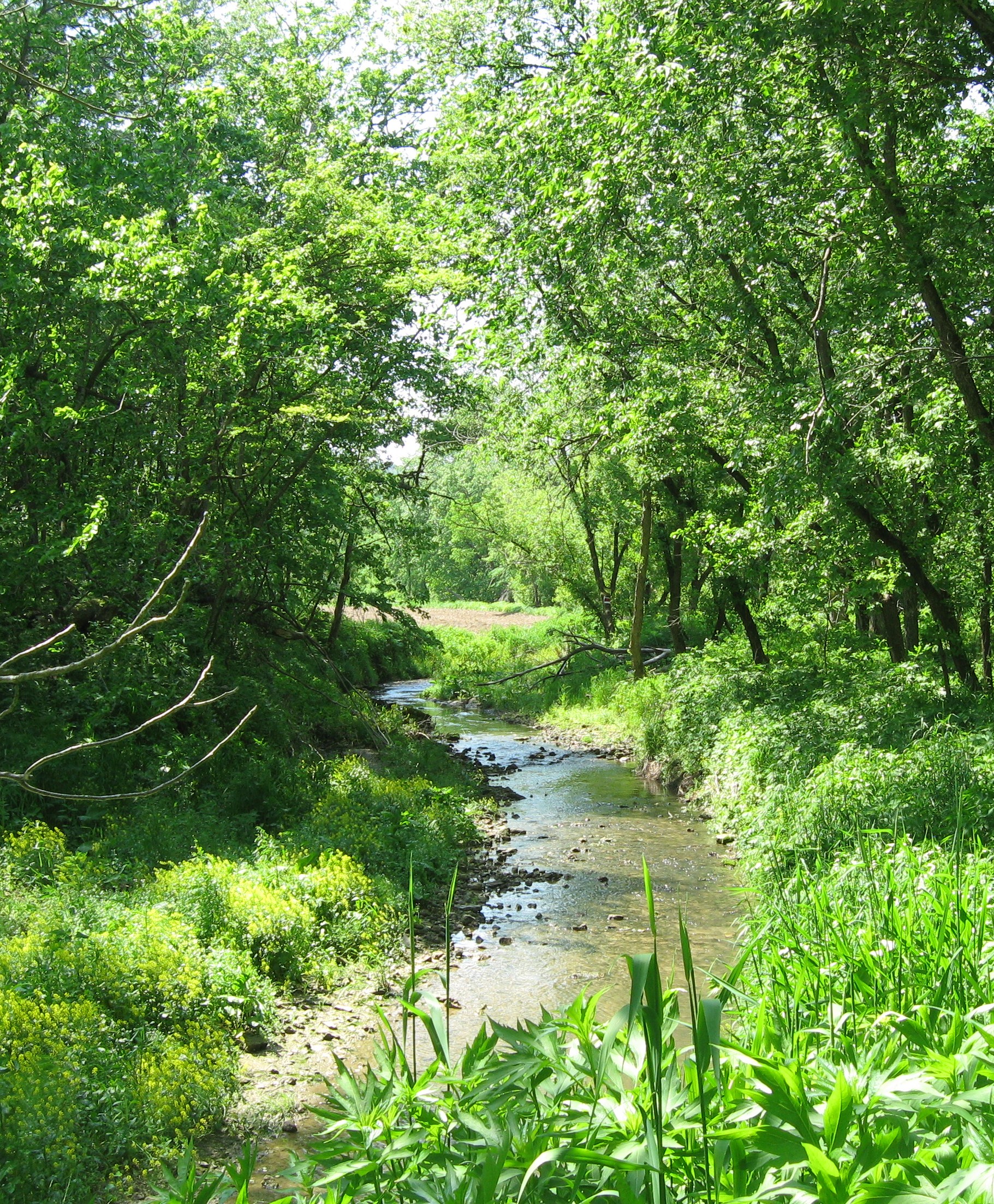
Wolf Creek--photo by Julie McCarty--Note: click on photo to enlarge

Flowing water fascinates me. When I was a little girl, my best friend had a house with a creek flowing near her house, and we would play for hours within and around the water.

Jesus tells us that he is the living water that satisfies all our deepest longings. The Spirit is flowing in Christ, flowing through him to everyone around him.

What surprises me when I read this passage today is the part about the water of the Spirit flowing out of those who believe in Christ. In all the times I heard this passage proclaimed at church, I never noticed that part. Here’s what the footnote in my bible says:

Jesus is the true water of life, who turns the symbol into reality. . . Believers become channels of life to others, through Christ’s Spirit given at Pentecost after he was glorified (crucified, risen, ascended).    –From the Oxford Annotated Bible, NRSV.

Not only was Christ both human and divine, his human side was a channel of the Holy Spirit–and we, too, are called to be channels of the Holy Spirit, flowing out to give to others in abundance.

Today I am offering you a gift that relates to this meditation: a 2 minute escape from your present work into the environment of a flowing, modern day stream named Wolf Creek. This is a very short video I took on a recent trip to our favorite country getaway in the rolling hills of northeastern Iowa, the “Morning Mist Cabin” owned by Larry and Jo Thein. (Thanks to them for letting us share it, and thanks to my husband Terry for his techie expertise in getting it setup on YouTube.)

As you watch this video, you might want to just enjoy the ability to getaway for a moment from the busyness of daily life, taking in the sights and sounds of God’s creation in nature. You might consider Jesus, the Living Water, and how the Spirit is the water that flows through you to others. Or maybe you just want to wait and see what the Spirit might inspire in you this day.

Note: You can enlarge the picture using the little box with four arrows in the bottom right of the picture to enhance the experience of “getting away from it all,” but just be aware that the picture won’t be as sharp. Move your mouse to see how to reduce it again. 

Until next time, Amen! 

Sumi Painting, Chi, Creativity and the Spirit


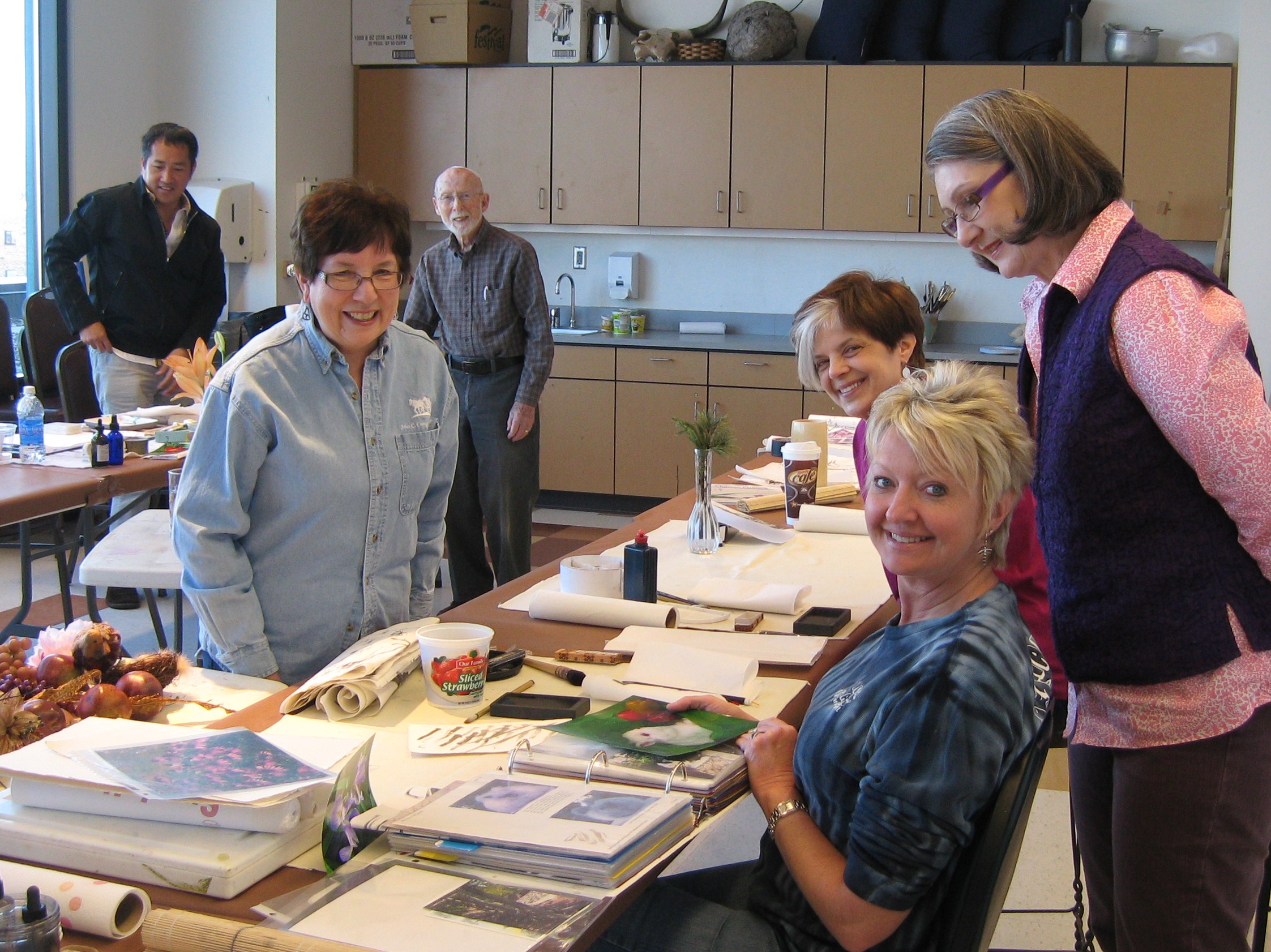
In the past year or two I have been digging into my artistic side by taking watercolor classes. Last fall, I signed up for a workshop called “Sumi and Soul” by Yuming Zhu, a professional artist who was born in China and currently lives in Seattle, Washington. I received so much from the experience that I signed up for another two-day workshop this spring with the same teacher.

Artist Yuming Zhu at Sumi painting workshop, 2011, Bloomington, MN--photo by Julie McCarty

Painting in the Chinese or Japanese way is quite different from the European style. In sumi painting, one holds the brush differently, and uses materials that more closely resemble ink and tissue paper than oils and canvas. Rather than painting with just your hand or arm, it is more as if your whole body is painting, from your own “center of gravity” someplace deep in your body. The philosophical or spiritual underpinnings are different as well, something the teacher mentioned in a gentle way, here and there, without harping or preaching.

Julie trying out Sumi painting at Yuming Zhu's workshop at the Bloomington Art Center in Minnesota--2011

My experience of the workshops with Yuming was very positive. As a writer, I am often too tense or perfectionist, which blocks the flow of words onto the paper. The Sumi workshop helped me to view my writing in a different way, to open up myself to letting the creativity flow more freely without fear of making “mistakes.” This fear is a real block to creativity, and “Mary Francis” (what I call the “good little Catholic girl” inside me) needs to let go of these fears.

 One of the many things I learned about in this workshop was the Chinese concept of chi, a word that means something like “energy” or “life force” in English. Here’s what About.com says about chi:

Ch’i (also spelled Chi or Qi) is a fundamental concept in Chinese philosophy and culture. Found in Chinese traditional religion but especially Taoism, Ch’i literally means “air” or “breath,” but as a concept it refers to the energy flow or life force that is said to pervade all things. (Read more here or also here.)

On the second day of Yuming Zhu's workshop, students arrived with energy--photo by Julie McCarty, 2011

The concept of chi intrigues me. Because I follow Christ, the idea of chi made me think of the Holy Spirit. God’s Spirit moves, creates, and breathes in us. In fact, in the original bible languages, the word “spirit” is the same is the word “breath.” It was “spirit” that God “breathed” into the first human in one biblical Creation story.

 
Too often, Christians think of God as rigid, stable, unchanging–and I’m sure there is certainly the element of stability and permanence in the best sense in the Divine Being we Westerners call “God.” I don’t deny that truth. However, on the other hand, the Spirit is called Creator Spiritus, the divine Spirit that Genesis tells us “hovered over the waters” during the creation of the cosmos. This Spirit of God is alive, dynamic, moving, active. Jesus compared the Spirit to the wind: you do not see it, or where it is going, but you know it it there.
Yuming Zhu's painting demo, Bloomington Art Center workshop, Spring, 2011--photo by Julie McCarty
I wonder what would happen if Christians of today took Creator Spirit seriously, that person of God known for movement, action, creativity, and breath. Would the Creative Spirit bring about something new? Something beautiful? Something prophetic, that is revealing truth and compassion?

I wonder, dear reader, what good things might the chi within you or me, our inner energy, want to create today? What newness of life might the Spirit of God want us to bring to birth this week, this year? How might we live the Resurrection of Christ, that image of energy, bursting out of the tomb, right here, right now in this moment?

Note: To view artwork by Yuming Zhu or find workshops, visit his website http://www.yumingfineart.com/about.htm  or on Facebook, http://www.facebook.com/mypainting

Jesus said, “Peace be with you.”

When it was evening on that day, the first day of the week, and the doors of the house where the disciples had met were locked for fear of the Jews [the leaders who handed Jesus over to the Romans] , Jesus came and stood among them and said, “Peace be with you.” (John 20:19)

After Jesus was crucified, his disciples were in hiding, afraid of what might happen next. If Jesus, their beloved rabbi and leader, the one with all those miraculous spiritual powers, had been tortured and killed, it could happen to them.  

I imagine they were confused, crushed with disappointment, and experiencing the intense emotions of grieving. How could this happen? All those miracles, their belief in Jesus as the Messiah, the Anointed one of God–all that goodness destroyed by the Romans who put him to death! And their own religious leaders, who had also condemned Jesus of blasphemy. Would they also turn on Jesus’ disciples?

Surely they had feelings of remorse and guilt. After all, they had run away when their friend needed them most. They had given in to fear, even though their Lord had told them repeatedly, “Do not be afraid.” What kind of followers were they, insisting to Jesus’ face that they would stand by him, even to the death, and then, instead, immediately fleeing when the going got tough? Peter, “first among equals” or the “prime” apostle, even lied when questioned about his association with Jesus.

When the Risen Lord appears to this disloyal group for the first time after his death, what does he say? If he were a married person, talking to his or her spouse, he might have said, “Told you so! I knew you would leave me when things got rough.”

If Jesus were a politician, he might have fired the disciples from their managerial posts. If Jesus were like certain religious leaders, he might have assigned the apostles a penance, banned them from teaching, or withheld communion. After all, most the apostles abandoned Jesus after he was arrested. (We only hear of John, Jesus’ mother, and other women followers standing by Jesus as he suffered on the cross.)

But the Lord Jesus is not like us sinners. He is not self-centered or self-righteous. In relationships, Jesus does not grab at power over others. He has no need to be a superstar, dictator, or spiritual bully.

When he reappears to them after his death, the first words Jesus says to them are “Peace be with you.” This peace is the inner peace that only God can give. It is not a peace based on owning a lot of material possessions, being wealthy, having a sexy appearance, belonging to the winning political group, or even forming the perfect liturgical translation. Christ’s peace is a gift of the Spirit, given freely with love.

The peace that Christ is offered them–and offers us–is not only peace within each soul, but also peace among people, creating spiritual networks of loving relationships. The Greek word in this passage of John’s gospel is not merely about the absence of disturbance or conflict. It is a word that probably is from the root word that means “to join.” Christ desires that we be joined together in relationships of love. The peace Christ wants is one of harmony among people, which is what he prayed for just prior to his death, that all may be one, not one in physical appearance, worship style, culture, or dogma, but one in the Spirit, one in the Lord.

When Christ wishes the disciples peace, he is offering it to them without strings  attached. The Risen Lord loves all people, sinners or so-called religious. If we would be his followers, we must do the same.

Until next time, Amen!


Note: Many thanks to my hubby, Terry McCarty, for the photographs in this post. He took them this past month at the Como Park Conservatory in Saint Paul, Minnesota. Copyright 2011, Terry McCarty. All rights reserved.

The Veil Torn in Two–Removing Obstacles in the Spiritual Life

After the long winter, it was good to see the ground again, even if the grass was flat and brown. One recent Saturday, when the only snow left was a couple of mountains near our driveway, my husband Terry spread the snow out across the lawn to speed up the melting. He said he wanted the exercise of shoveling and, after all, it felt good to get outside in the fresh spring air.

Secretly, I thought it wasn’t necessary, but I understood well the desire to be done with winter. Besides, I knew there were flower bulbs underneath that giant snow pile by the mailbox, and I thought perhaps we might see some blossoms a little bit sooner if the thick veil of snow was removed.

We were in for a big surprise: the very next morning, little shoots were peeking out of the soil. I still can’t get over it. How can a bulb that is several inches beneath the surface, and just the day before also beneath a couple feet of snow, push its way to the surface in less than 24 hours?

This experience made me think of the many obstacles, like mountains of snow, that sometimes block spiritual growth or the deepening of our relationship with God. We may have certain behaviors in our lives that are sinful, or bad habits that keep us from our maximum potential. Soft addictions (see my March 24 post) may keep us occupied in ways that prevent us from having the time for more productive activities or more attentive prayer lives.

But it is not God’s desire that anything keep us apart from the divine presence. In upcoming days, Christians throughout the world will be meditating on the suffering, death and resurrection of Jesus Christ. We read in Matthew’s gospel that at the moment when Jesus released his spirit and died upon the cross

 . . . the curtain of the temple was torn in two, from top to bottom. The earth shook, and the rocks were split. The tombs also were opened, and many bodies of the saints who had fallen asleep were raised(Matthew 27:51-52).

This curtain was the veil that hung between the general worship space of the temple and the Holy of Holies, the place where the Ark of the Covenant with the Ten Commandments was kept. The Holy of Holies was the place in which God dwelt in a special way–so special that only the High Priest could enter this sacred room, and then only on one day each year, on the Day of Atonement.

Some Scripture commentators write that the tearing of the veil of the temple at the time of Jesus’ death symbolizes the end of the Old Covenant and the beginning of the New Covenant. Another interpretation–the one I like best–is that Christ’s sacrificial death transformed the way we humans relate to God. Christ removes the obstacles between God and us.

Christ is our high priest whose own sacrifice “tears the veil away,” making it possible for us to approach God directly in prayer. Christ removes the many obstacles in our lives that keep us from growing in love and service.

The more these obstacles are removed, the more the light of God will shine on us, so that each of us will grow into creations as beautiful as the flowers that bloom in spring.

Until next time, Amen!

P.S. If you are receiving this in e-mail subscription, it is always allowable to forward it to a friend. –Julie McCarty, author of the Spiritual Drawing Board, https://spiritualdrawingboard.wordpress.com

No Man Is an Island: Praying for Japan


Cherry blossoms
In Japan, cherry blossoms symbolize many things, including beauty and the transitory nature of life. (Click once or twice on the picture to enlarge it.) Photo by Radu Razvan Gheorghe--Dreamstime.com


As I write this, Japan is dealing with the aftermath of the recent earthquake/tsunami and experiencing the agonizing wait-and-see regarding damaged nuclear power plants. All the world watches and prays with them.

 As it so happened, just after the disaster hit on the other side of the world, I was reading a book that quoted this famous passage written by English poet John Donne (1572-1631):

 No man is an Iland, intire of it selfe; everyman is a peece of the Continent, a part of the maine; if a Clod bee washed away by the Sea, Europe is the lesse, as well as if a Promontorie were, as well as if a Mannor of thy friends or of thine own were; any mans death diminishes me, because I am involved in Mankinde; And therefore never send to know for who the bell tolls; It tolls for thee.

 This reflection is but a portion of Meditation XVII, found in Donne’s book called Devotions Upon Emergent Occasions, written while John Donne was confined to bed with a long illness. He would listen to the church bells calling people to gather for prayer. Sometimes the bells signaled a funeral–whose funeral might it be? Would the person who lay dying know the bells were calling people for a funeral? John Donne even wonders if perchance the bells are tolling for his own funeral, but is too sick to comprehend that the bells are for him.

 While pondering the meaning of the bells and the human condition, he comes to the awareness that we are all interconnected by the fact of our human nature. When one suffers, we all suffer. The suffering is not identical, of course, but when one suffers, we all feel the effects. When one rejoices, we can rejoice with them. We are not isolated, unfeeling robots, but rather members of the one human family.

 In Donne’s meditation, England is the “island” that appears separate from continental Europe, but is not really alone. When I read the passage the other day, I thought of the islands that form Japan, seemingly separate from the rest of Asia, but now, in our day, an important culture and piece of the bigger global community. Here is a more modern version of the passage:

 No man is an island, entire of itself; every man is a piece of the continent, a part of the main; if a clod be washed away by the sea, Europe is the less, as well as if a promontory were, as well as if a manor of thy friends or of thine own were; any man’s death diminishes me, because I am involved in mankind; and therefore never send to know for whom the bell tolls; it tolls for thee.

Today, we remember the people of Japan in our thoughts and prayers: O God, be with all those who suffer pain, grief, confusion, and the exhaustion of natural catastrophes. Guide and strengthen the arms of those who rescue and minister to the needs of others. Give us the courage to do what we can to support and comfort all those in need. Amen.


 Note: Reuters News Service has a list of relief agencies serving in the crisis in Japan. To view this list and donate, click here.

 Selected sources consulted for this post:

 Link to the source of cherry blossom photo:

 http://www.dreamstime.com/free-stock-photo-flower-net-rimagefree84837-resi1238037


Waiting for Spring

Waiting for Spring 2 -- Photo by Julie McCarty 2011


I took this photo a couple of weeks ago in Lebanon Hills Regional Park, a place not far from my home in Eagan, Minnesota. We’ve had more snow than usual this year, and on this day, the sun was out (on and off!) and there was a temporary thaw underway.

It may be difficult for people in warmer climates to imagine the joy I felt walking outside in weather like this, but it was exhilarating. The milder temperatures of the day allowed me to take deep breaths and walk freely across the crunch, crunch, crunch under my feet. Lebanon Hills is such a huge area of woods, meadows and lakes that I felt the wonder and happiness I often feel when submerged in a nature walk.

The canoes in the picture, the little naked patch of land, and the water sitting on top of the frozen lake remind me that spring is coming–even if it seems like winter lasts forever. Little by little, the daylight hours are growing longer, something that gives me renewed energy.

Today is Ash Wednesday, the beginning of the church season called “Lent,” a word that comes from the English word for “spring,” the time of year when the days lengthen (Lent, lengthen). Just as the warmer temperatures melt the snow, we allow God to melt the places in our hearts that are harsh, icy, or cold. We focus more intentionally on spiritual things to make room for whatever growth the Spirit wants for us. We die to sin in order to be ready for the springtime of resurrection.

On this day, I wish you a good Ash Wednesday and a very blessed Lent. Until next time, Amen!

P.S. If you want to see a larger version of the photo for your own meditation, try clicking on the picture.

Grandma’s Quilt

A thing of beauty is a joy for ever . . .   

                                                –John Keats, 19th century

Amish Quilt from Minnesota

 The smallest things can make an impression on a child. I remember the first time I experienced the beauty of patchwork quilts. I was spending the night at Grandma’s house, and she covered me with one of her own quilt creations. As she explained the pieces, my eyes lit on fabric squares of the same cloth she had used to make my doll’s clothes. It seemed a kind of magic: the same fabric in both places? How did she do that?

 Quilts remind us that nature is not the only place that beauty can be found. People can use their God-given talents to co-create with God. One way this is expressed is in the way women arrange “little scraps” together to form something artistic, giving us a glimpse of spiritual beauty. When our eyes behold a striking pattern, we pause in delight, even if only for a second. This pause grants us a little rest from the busyness of life, an opportunity to whisper a prayer of thanks.

Juggling the many pieces of my life often feels helter-skelter and confused, but a quilt reminds me that God is sewing these elements together into a pattern. I just don’t see the bigger picture in the moment—a picture that is bigger and better than just I, me, mine. Continue reading “Grandma’s Quilt”