Holy Week: Meditating on Marc Chagall’s White Crucifixion

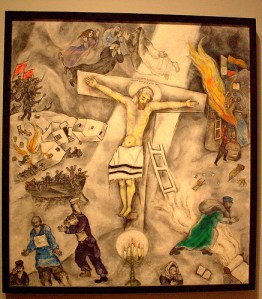
White Crucifixion–1938 oil painting by Marc Chagall (click on picture to enlarge)   (more details at end of post) 


 As you probably know, this week is the celebration of Jewish Passover and Christian Holy Week. Because of this, I wanted to do something special, so I hunted online for a work of art to use for visio divina (meditating with art, see Feb. 24, 2011 post). As a Christian, I was looking for an image of Christ on the cross, and ended up being drawn to a 20th century painting called White Crucifixion by the famous Russian and Jewish artist Marc Chagall.

People have highly individualized reactions to art and I want to state up front that this post is not a historic analysis, an art critic’s review, or even a theological examination of the White Crucifixion. This post is simply my own personal feelings, thoughts, and prayer reactions after spending several days pondering the work. I respect that there are many ways to view the White Crucifixion, and I believe the artist himself would be the first to acknowledge that.

Many of Chagall’s paintings could be described as lively, romantic, humorous, imaginative, and filled with brilliant colors, but the White Crucifixion is largely drained of color. Chagall painted it in 1938 while living in Paris, in response to the horrifying events of Kristallnacht,  the “Night of Broken Glass,” when Jewish homes, businesses, and synagogues throughout Germany were systematically vandalized or destroyed, and thousands of Jewish men were carted off to concentration camps.

In White Crucifixion, Chagall arranges various scenes of this Jewish suffering around the crucifix, much like an altar screen adorned with biblical scenes around the perimeter. In the upper left, Russian soldiers turn Jewish homes upside down and set them ablaze. In the upper right, Nazi soldiers throw sacred objects from a burning synagogue out into the streets.

Below, a Jewish man is fleeing with a bag of belongings on his back, while another stands ready to sprint away, the sacred Torah firmly clasped in his arms. A woman holds her child in a protective stance; an old bearded man stands with a sign around his neck, his hands open, as if to ask “Why?”; refugees on an overloaded boat look as if about to die of hunger; a sacred scroll in the lower left corner is rolling on the ground, about to disappear from our sight; and the ghosts of Jewish rabbis and ancestors float above the scene, some covering their eyes or looking away—the sight is too horrendous to behold.

In the middle of all this, a Jewish man hangs on a cross, his only clothes a simple head covering and a tallith, a Jewish prayer shawl, to hide his nakedness. The words above him identify him as “King of the Jews.” With his hands and feet nailed to the cross he cannot move to stop the chaos and suffering all around him. He, too, suffers with all those others suffering. He bows his head in silence, as if in prayer or mourning. A light shines from above, while silent candles (a menorah turned sideways?) hold vigil at the base of the cross.

If the picture makes you feel uncomfortable, as it did me, I suggest you stay with that feeling for awhile. I did. I pondered the many evil things people have done, supposedly in the name of Christianity or other religions. I thought of all the times we think of Jesus as a blue-eyed, blond-haired little baby in a manger and how wrong it is that so often Christians have stripped Jesus of his Jewish heritage—and, much worse, committed heinous crimes against his younger, modern-day nieces and nephews.

The White Crucifixion reminds me that the observance of Good Friday ought not only to be about remembering the sacrifice of Christ, but also of the suffering that is going on all around the world today. Even as you read this, someone somewhere is being tortured, unjustly imprisoned, raped, kidnapped, enslaved, or murdered. Do we pray for these unseen, silent victims?

This Good Friday, let those of us who dare to call ourselves Christians take a good hard look at how we treat people who are seemingly “different.” Let us meditate long on the words Jesus said: “. . . love your enemies, do good to those who hate you. . .” (Luke 6:27) May we respect life in all its forms, treating every human with the same dignity we would treat Christ.  After all, it was Jesus who said [in the words of the song based on Matt. 25:40], “Whatsoever you do to the least of my brothers, that you do unto me.”


Notes:  Image of the painting above was copied from Wikipedia under the creative commons agreement. To view a larger image, visit the Art Institute of Chicago website, http://www.artic.edu/aic/collections/artwork/59426.

Other resources consulted: Marc Chagall and the Lost Jewish World by Benjamin Harshav (Rizzoli); Chagall by Jacob Baal-Teshuva (Taschen); and Marc Chagall by Jonathon Wilson (Nextbook-Schoken).

The Veil Torn in Two–Removing Obstacles in the Spiritual Life

After the long winter, it was good to see the ground again, even if the grass was flat and brown. One recent Saturday, when the only snow left was a couple of mountains near our driveway, my husband Terry spread the snow out across the lawn to speed up the melting. He said he wanted the exercise of shoveling and, after all, it felt good to get outside in the fresh spring air.

Secretly, I thought it wasn’t necessary, but I understood well the desire to be done with winter. Besides, I knew there were flower bulbs underneath that giant snow pile by the mailbox, and I thought perhaps we might see some blossoms a little bit sooner if the thick veil of snow was removed.

We were in for a big surprise: the very next morning, little shoots were peeking out of the soil. I still can’t get over it. How can a bulb that is several inches beneath the surface, and just the day before also beneath a couple feet of snow, push its way to the surface in less than 24 hours?

This experience made me think of the many obstacles, like mountains of snow, that sometimes block spiritual growth or the deepening of our relationship with God. We may have certain behaviors in our lives that are sinful, or bad habits that keep us from our maximum potential. Soft addictions (see my March 24 post) may keep us occupied in ways that prevent us from having the time for more productive activities or more attentive prayer lives.

But it is not God’s desire that anything keep us apart from the divine presence. In upcoming days, Christians throughout the world will be meditating on the suffering, death and resurrection of Jesus Christ. We read in Matthew’s gospel that at the moment when Jesus released his spirit and died upon the cross

 . . . the curtain of the temple was torn in two, from top to bottom. The earth shook, and the rocks were split. The tombs also were opened, and many bodies of the saints who had fallen asleep were raised(Matthew 27:51-52).

This curtain was the veil that hung between the general worship space of the temple and the Holy of Holies, the place where the Ark of the Covenant with the Ten Commandments was kept. The Holy of Holies was the place in which God dwelt in a special way–so special that only the High Priest could enter this sacred room, and then only on one day each year, on the Day of Atonement.

Some Scripture commentators write that the tearing of the veil of the temple at the time of Jesus’ death symbolizes the end of the Old Covenant and the beginning of the New Covenant. Another interpretation–the one I like best–is that Christ’s sacrificial death transformed the way we humans relate to God. Christ removes the obstacles between God and us.

Christ is our high priest whose own sacrifice “tears the veil away,” making it possible for us to approach God directly in prayer. Christ removes the many obstacles in our lives that keep us from growing in love and service.

The more these obstacles are removed, the more the light of God will shine on us, so that each of us will grow into creations as beautiful as the flowers that bloom in spring.

Until next time, Amen!

P.S. If you are receiving this in e-mail subscription, it is always allowable to forward it to a friend. –Julie McCarty, author of the Spiritual Drawing Board, https://spiritualdrawingboard.wordpress.com

Behind the Boss’ Back: Prayer in the Workplace

Pray during the workday without disturbing others

Is there a way to pray in the workplace, without neglecting your job or infringing on the rights of others? A way to keep in touch with God while running a grocery store checkout, managing a daycare, answering phones, or meeting with clients? Or is prayer something restricted to that little Sunday box on your calendar?

A lot depends on how you define prayer. Praying the rosary while interviewing a new hire or meditating in a lotus position while running a backhoe certainly won’t work. Your boss won’t be a happy camper if you tell him or her that you missed a critical staff meeting because you were in a deep mystical ecstasy.

I suspect that few of us have ever thought about taking God with us to the workplace—but God is already there. After all, God is everywhere. Merely recalling God’s presence is itself one type of prayer. Simple? Yes, but difficult to remember to do. Here are some ways to prompt yourself to pray inwardly during your work day:

1. Place little reminders of God around your work area. If your office doesn’t allow religious symbols, use ordinary objects, like family photos, a personal book with a spiritual cover, or notes posted inside your briefcase to remind you of the spiritual dimension of your work, writes Gregory F. A. Pierce in  Spirituality at Work (Loyola Press). Writing a Scripture verse in your planner or selecting a gorgeous nature scene for your computer’s desktop wallpaper are other examples of unobtrusive ways to draw your heart to God without forcing your views on others.

2. Use your coffee break for a rendezvous with God. Reading little reflection booklets with lectionary readings or other devotions takes only a few minutes, but helps one enter into God’s presence.

3. Group with others for prayer time. In New York City, Muslims, committed to praying five times a day, meet in small groups during lunch or break times to recite the opening of the Koran and pray with bows, kneeling, and prostrations, writes Joseph Berger in the New York Times. He also reports that observant Jews similarly gather for minyan (prayer group of at least ten) in at least 180 places in busy Manhattan. People of other faiths might consider forming a small prayer group to meet at a nearby food court or coffee shop during a weekly lunch.

4. Set aside distracting thoughts. Just as you set aside distracting thoughts during prayer time, gently let go of distracting thoughts when a co-worker is speaking to you. Listen carefully to him or her—you might just hear the Spirit of God in something that is said.

5. Bring more silence into the work environment. God speaks to us in silence. You can invite a higher intelligence into your office meeting without saying it in so many words, suggests Dr. Deborah Savage, adjunct faculty of theology and business at the University of St. Thomas in St. Paul, Minnesota [now Clinical Faculty member at the Saint Paul Seminary at St. Thomas]. Prof. Savage says God’s grace is constantly present to us, but we need to slow down in order to notice it. For example, one business she heard about instituted a company-wide policy that allotted one specific hour each day for sacred work time: no meetings, no phoning, no interaction, just sitting at your desk to do your work.

6. Practice awareness of the present moment. Prof. Savage also observes that we often mistakenly imagine the soul as one little compartment of who we are, when really our soul is “larger” than our body and connects us to God. You can’t very well leave your soul at home when you drive to work in the morning—it’s the spiritual thread that runs through every moment of our lives, she says.

Prayer is really more about be-ing, than do-ing, Dr. Savage reminds us, so it’s good to practice being attune to everything in the present moment: our feelings, our sensory perceptions, our thoughts, etc. Everything we are actually exists within the presence of God. As chapter 17 of the Acts of the Apostles declares, in God “we live and move and have our being.” God is always with us—even in the busy workplace.

Note: This article is a slightly revised version of a column I wrote that appeared in several Catholic diocesan newspapers around the country a few years ago. It is reprinted here because it is one of the most requested articles on my author website.

Copyright 2011 — Julie McCarty, Eagan, Minnesota.

New Page about Spiritual Direction

Yesterday I learned how to add a whole new sticky page to the Spiritual Drawing Board. The page I created tells about the time-honored practice of spiritual direction, often called “spiritual companioning” today.

(You can access this new page by clicking on the tab labeled spiritual direction above the sunrise photo. If you are receiving this post via e-mail subscription, you can click to my blog or else just google “Spiritual Drawing Board.”)

If you are looking for a safe place to explore your own spiritual life, to wrestle with soul questions, to learn about prayer in a one-with-one setting, think about finding a spiritual director. If you live near Eagan, Minnesota, and feel you might like to work with me, my contact info is on the Spiritual Direction page. You can locate other spiritual directors by asking church staff, spirituality or retreat centers, or searching on the website of Spiritual Directors International.

By the way, Spiritual Directors International website has some great YouTube videos of people talking about their experience with spiritual direction.  

Hope your Lent is proving fruitful–and if not, it’s not too late to delve into a good spiritual book, take a soul walk,  or turn to prayer. 

Until next time, Amen! 

P.S. If you are receiving this in e-mail, feel free to pass it on to others who might be interested in spiritual direction. (It is always okay to forward my Spiritual Drawing Board posts!)


Lent, Soft Addictions, and Detachment

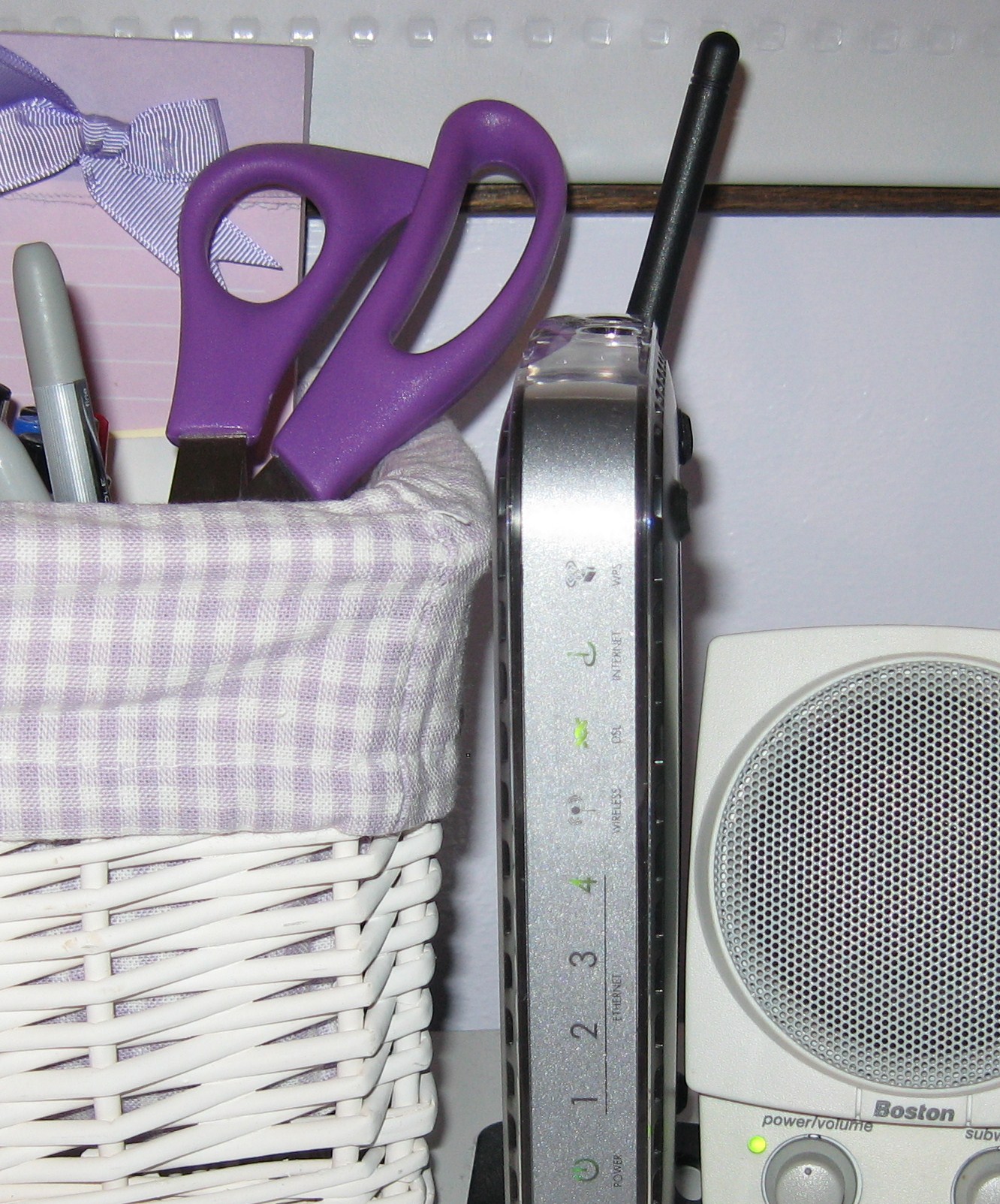
Router on Julie's desk--photo by Julie McCarty 2011I do not understand my own actions. For I do not do what I want, but do the very thing I hate.     –St. Paul in Romans 7:15

I was awakened the other day by a little scratchy sound in the next room. Was it a mouse? No…maybe my husband was hauling out spring clothes? No, it was taking too long for that… Was he cleaning the house? . . . REALLY? At five in the morning?! 

When I dragged myself out of bed, I discovered the internet wasn’t working and Terry was trying to get the web up and running by unplugging and resetting various cords. 

After he left for work, I kept trying to fix it, without success. Eventually, I told myself it didn’t matter–I’m a writer for goodness sake: get to work!

But, try as I might, I was restless and jittery. How could I work without checking e-mail and reading the morning news online? I kept looking at the little red light on the router, flashing at me.

I was like a little baby who has had her milk bottle wrenched away, mid-sip. I want! I want! I want e-mail! I want to blog! I want to revise my website! Waaaaaahhh!

(So far I don’t have Facebook or Twitter accounts, and you can see why these options may not be good for me.)

While I was sitting at my desk, having mental internet withdrawal symptoms, I remembered a phrase from old-time spirituality books:  “inordinate attachments.” These are things in life that we cling to in a way that is excessive or beyond what is spiritually healthy.

Attachments are not necessarily bad in and of themselves, but sometimes they keep us from focusing on the really important things in life. For example, using the internet to do scholarly research is a good thing, but it might be an attachment if I simply cannot pull myself away to fix my family dinner.

While few people today speak of “inordinate attachments,” modern author Judith Wright communicates a similar idea when she speaks of “soft addictions.” As she describes in an interview with WebMD, “Soft addictions are those seemingly harmless habits like watching too much television, over-shopping, surfing the Internet, gossiping — the things we overdo but we don’t realize it. . . It seems like normal behavior, but that’s simply because everyone is doing it, too.” (To read the full article, click here.)

Lent is a good time to step back from our busyness and take stock of our lives. Are we too attached to some things? Do soft addictions keep us from having any time for prayer? Are there relationships in our lives that push us into doing things we know are bad for us? Do we find our attachments growing into bad habits that may evolve into the type of sin that hurts others or ourselves?

In spirituality, the opposite of attachment is detachment, the ability to let go of things. This letting go is done for the sake of a greater good. A person might detach from her fondness for eating in restaurants during Lent so she can use the money saved to feed starving children. A student who finds his schoolwork is not getting done “lets go” of chatty texting in order to succeed in his studies.

Practicing detachment is one way to open ourselves more fully to the action of grace and the presence of the Holy Spirit. We find the ultimate detachment in Jesus, who, while on the cross, opened his hands wide and let go of his life with the words, “Father, into Your hands I entrust my spirit.”

No Man Is an Island: Praying for Japan


Cherry blossoms
In Japan, cherry blossoms symbolize many things, including beauty and the transitory nature of life. (Click once or twice on the picture to enlarge it.) Photo by Radu Razvan Gheorghe--Dreamstime.com


As I write this, Japan is dealing with the aftermath of the recent earthquake/tsunami and experiencing the agonizing wait-and-see regarding damaged nuclear power plants. All the world watches and prays with them.

 As it so happened, just after the disaster hit on the other side of the world, I was reading a book that quoted this famous passage written by English poet John Donne (1572-1631):

 No man is an Iland, intire of it selfe; everyman is a peece of the Continent, a part of the maine; if a Clod bee washed away by the Sea, Europe is the lesse, as well as if a Promontorie were, as well as if a Mannor of thy friends or of thine own were; any mans death diminishes me, because I am involved in Mankinde; And therefore never send to know for who the bell tolls; It tolls for thee.

 This reflection is but a portion of Meditation XVII, found in Donne’s book called Devotions Upon Emergent Occasions, written while John Donne was confined to bed with a long illness. He would listen to the church bells calling people to gather for prayer. Sometimes the bells signaled a funeral–whose funeral might it be? Would the person who lay dying know the bells were calling people for a funeral? John Donne even wonders if perchance the bells are tolling for his own funeral, but is too sick to comprehend that the bells are for him.

 While pondering the meaning of the bells and the human condition, he comes to the awareness that we are all interconnected by the fact of our human nature. When one suffers, we all suffer. The suffering is not identical, of course, but when one suffers, we all feel the effects. When one rejoices, we can rejoice with them. We are not isolated, unfeeling robots, but rather members of the one human family.

 In Donne’s meditation, England is the “island” that appears separate from continental Europe, but is not really alone. When I read the passage the other day, I thought of the islands that form Japan, seemingly separate from the rest of Asia, but now, in our day, an important culture and piece of the bigger global community. Here is a more modern version of the passage:

 No man is an island, entire of itself; every man is a piece of the continent, a part of the main; if a clod be washed away by the sea, Europe is the less, as well as if a promontory were, as well as if a manor of thy friends or of thine own were; any man’s death diminishes me, because I am involved in mankind; and therefore never send to know for whom the bell tolls; it tolls for thee.

Today, we remember the people of Japan in our thoughts and prayers: O God, be with all those who suffer pain, grief, confusion, and the exhaustion of natural catastrophes. Guide and strengthen the arms of those who rescue and minister to the needs of others. Give us the courage to do what we can to support and comfort all those in need. Amen.


 Note: Reuters News Service has a list of relief agencies serving in the crisis in Japan. To view this list and donate, click here.

 Selected sources consulted for this post:

 Link to the source of cherry blossom photo:

 http://www.dreamstime.com/free-stock-photo-flower-net-rimagefree84837-resi1238037


Waiting for Spring

Waiting for Spring 2 -- Photo by Julie McCarty 2011


I took this photo a couple of weeks ago in Lebanon Hills Regional Park, a place not far from my home in Eagan, Minnesota. We’ve had more snow than usual this year, and on this day, the sun was out (on and off!) and there was a temporary thaw underway.

It may be difficult for people in warmer climates to imagine the joy I felt walking outside in weather like this, but it was exhilarating. The milder temperatures of the day allowed me to take deep breaths and walk freely across the crunch, crunch, crunch under my feet. Lebanon Hills is such a huge area of woods, meadows and lakes that I felt the wonder and happiness I often feel when submerged in a nature walk.

The canoes in the picture, the little naked patch of land, and the water sitting on top of the frozen lake remind me that spring is coming–even if it seems like winter lasts forever. Little by little, the daylight hours are growing longer, something that gives me renewed energy.

Today is Ash Wednesday, the beginning of the church season called “Lent,” a word that comes from the English word for “spring,” the time of year when the days lengthen (Lent, lengthen). Just as the warmer temperatures melt the snow, we allow God to melt the places in our hearts that are harsh, icy, or cold. We focus more intentionally on spiritual things to make room for whatever growth the Spirit wants for us. We die to sin in order to be ready for the springtime of resurrection.

On this day, I wish you a good Ash Wednesday and a very blessed Lent. Until next time, Amen!

P.S. If you want to see a larger version of the photo for your own meditation, try clicking on the picture.

A Personal Focus for Lent

The Lord said to Moses, “Come up to me on the mountain, and wait there. . . . Moses was on the mountain for forty days and forty nights.  (Exodus 24:12, 18)

 Then Jesus was led up by the Spirit into the wilderness to be tempted by the devil. He fasted forty days and forty nights. . .     (Matthew 4:1-2)

Ash Wednesday is just around the corner, and I’m wondering what spiritual practice I might do for Lent. If you are like me, you have experienced various Lenten penances related to prayer, fasting, and almsgiving over the course of your life. Some of my experiences produced quality spiritual growth. Other times I failed to follow through or had results that were, um, a little “silly” (such as the time I gave up potato chips and ate so many chocolate chip cookies that I actually gained weight during Lent).

Waiting for Spring -- Photo by Julie McCarty 2011

One spiritual practice that has been meaningful for me is reflecting on a single word, phrase, or bible verse for the whole 40 days. For example, one year I focused on the virtue of patience. I read about patience and pondered what patience is and what patience is not (laziness or procrastination). I asked God in prayer to help me be patient. When life brought me annoying moments, I tried to be patient.

One possible pitfall of this theme approach is that I might forget to follow through for the entire 40 days, but I have found ways around that. I can post my theme in places I’ll see it, such as the bathroom mirror, refrigerator, computer screen saver or cell phone banner. I can find a book on the topic and spend a few minutes each day reading about it. I can make it a point to weave my theme into prayer time and the routine of daily living. On occasion, I’ve asked spiritual people what they think about the topic.

When making plans for Lent, it’s important—as always—to ask the Holy Spirit to inspire your choices. (Why do I always think of this tip last? It should be first!) The “theme approach” may not be for everyone.   Think about what will build your relationship with God, and what will deeper your love for others.      

May all we do glorify God and build bonds of love throughout the earth. Until next time, Amen!

Spiritual Aerobics for Lent

   If focusing on a theme doesn’t appeal to you, here are 13 other ideas:                 

  • Volunteer at a food pantry, homeless shelter, or other charitable organization.
  • Plan quality time with your children: eat together, use discussion starters, read together.
  • Organize recycling in your home in order to take care of God’s creation.
  • Visit a lonely or homebound person.
  • Reduce the amount of time spent with television, social networking, internet surfing, or video gaming.
  • Listen to inspiring, spiritual music while commuting to work.
  • Care for the body God gave you by increasing your sleep or exercise.
  • Read one book of the bible or other spiritual book slowly and reflectively. 
  • Sort out closets and donate clothing to those who need it. 
  • Teach your children a new prayer and pray it together when you gather for meals.
  • Be kind to someone you often ignore. Pray each day for him or her. Smile genuinely and listen respectfully to this person.
  • Fast from shopping for clothes (or books, electronic gadgets, makeup, etc.)
  • Visit a retreat center. If you cannot go away on a retreat just now, make arrangements to go on retreat later this year.

Praying with “Migrant Mother” using Visio Divina

On the website Patheos, Presbyterian minister Tim Mooney writes about a prayer form called Visio Divina, a way of praying with sacred art or other images. Visio divina (“divine seeing”) models itself after lectio divina (“divine reading”), that time-honored Christian way of thoughtfully meditating on Scripture. (Read more about visio divina here.)

 Artwork and religious symbols often draw me into a quiet, reflective zone, so I decided to give visio divina a try and share my experience here at the Spiritual Drawing Board. Just so I wouldn’t have too many preconceived ideas, I looked for an image not usually found in churches, and decided upon Dorothea Lange’s 1936 photograph called “Migrant Mother.”

 Experiencing Visio Divina

As the article on visio divina recommended, I set aside 20-30 minutes for the process. After asking the Holy Spirit to guide my prayer, I spent a little time just observing the various parts of the picture:

  • The woman’s sleeve is tattered. She has no make-up and there are wrinkles near her eyes.
  • Why do the children hide their faces? Are they ashamed to be seen?
  • The baby on her lap is wrapped in an oversize garment and has dirt on his or her face.

 The woman looks to be 40-something, but I know from my reading that her name is Florence Owens Thompson, 32, married mother of seven children. In this photo, taken during the Great Depression, she is sitting in a three-sided lean-to canvas tent. (View other pictures taken that day here. )

These facts make me think about the economy of today and people who suffer around the world, especially the homeless, many of whom are children. I imagine the faces of other migrant women of various races and ethnicities. Would I feel the same empathy for each of them as I feel for the woman in the picture?

 After praying for the grace to love all people with equal intensity, I focus my attention back on the picture once again. The woman’s expression haunts me. She may be worried, but she is determined. I think she is going to do whatever it takes to feed her children. With her hand placed under her chin, she reminds me of Rodin’s bronze sculpture The Thinker. Yes, I decide, she is indeed a strong woman, a brave woman, dead set on caring for her hungry children.

 I wonder, did Mary, the mother of Jesus, ever look so strong and determined? She, too, was a “migrant mother,” on the move with Joseph, first traveling as a pregnant woman to Bethlehem, then fleeing to Egypt to save her child from death, and some years later to Nazareth. Did the Holy Family ever experience hunger pangs? Surely Mary must have felt this same fierce love and deep resolve to do whatever was necessary to care for her Child.  

 Why have I never seen this look of strength and determination on the face of Mary in statues or paintings? Wouldn’t Mary have been radically committed to do all in her power to fulfill God’s will? Wouldn’t her love of God have been strong? Are these characteristics of Mary portrayed in sacred art but I just didn’t notice?

 Come to think of it, wouldn’t God have the same type of parental concern for us? Could we imagine the Divine Face looking something like this woman, in terms of her strength and determination? Doesn’t God love us as much—no even more—than the very best of mothers?

Observing the Results

Sometimes we think of Scripture as comforting, but the Word of God also challenges us to become more like Christ. I think the prayer form visio divina has the same potential. After the above prayer time, I observed myself feeling less whiney about my own inconveniences and more grateful. I found myself intentionally smiling at people who look “different” from me. And, when writing this post, I recalled that the Hosea 13:8 compares God to a mother bear, who expresses fierceness if her cubs are threatened or taken away. 

Spiritual Aerobics –Try visio divina yourself, using whatever image or artwork you like. Many musuems have artwork available online. For visio divina directions, click here.

Skillful Speech–Part 2: Insights from Buddhism

Aware of the suffering caused by unmindful speech and the inability to listen to others, I am committed to cultivating loving speech and deep listening in order to bring joy and happiness to others and relieve others of their suffering.                –Fourth Mindfulness Training*

In “Brutally Yours, Bob Hartley,” an old episode of The Bob Newhart Show, psychologist Bob Hartley urges clients Mr. Carlin and Michelle to be more honest and open with their feelings. During the conversation, Bob hides his true feelings about his secretary leaving work early and the clients challenge him to practice what he preaches. As the show progresses, Mr. Carlin and Michelle make a game out of hurling insults at other people, while at home Bob nearly ruins a budding friendship in his overzealous quest for total honesty. In the end, it is agreed by all that some things are better left unsaid.

The episode illustrates in a humorous manner just how difficult it can be to be truthful and yet do it in a way that does not unnecessarily hurt another. In my last post, I wrote a few things that Jesus had to say about the right use of speech. This week, I’ve been reading about the idea of Right Speech in Buddhism. (I’m not a Buddhist and I don’t know much about the Buddhist path, but I think that Buddhism offers some insights on the topic of how to speak and listen with compassion.)  

In his book, The Heart of the Buddha’s Teaching, Vietnamese Buddhist monk Thich Nhat Hanh devotes an entire chapter to Right Speech. Here are some of my notes from reading his explanation of Right Speech:   

  • Being truthful is basic to Right Speech.
  • Much suffering is caused in this world by people who are simply not paying attention to what they say and how they say it. Our words have the potential to add to the suffering of others, or to alleviate their pain. (The Buddhist practitioner seeks to alleviate the suffering of others.)
  • Right Speech means “not speaking with a forked tongue.” That is, do not tell one person one thing and another person a different thing. It is fine to use different words, examples, or images in explaining something to help others understand, but it is not truthful to invent different “truths” for various people.
  • Right Speech means not speaking cruelly. “We don’t shout, slander, curse, encourage suffering, or create hatred.” This can be challenging even for people of good will, he writes, but because words are powerful, we must avoid vicious speech.
  • Right Speech also means that we should not exaggerate or embellish what we have seen or heard. “We don’t dramatize unnecessarily, making things sound better, worse, or more extreme than they actually are. If someone is a little irritated, we don’t say that he is furious.”
  • Right speech involves deep listening, something very needed today. When we listen with an open heart, calmly and without judging others, we may actually reduce their suffering. (What a great gift to give another!)
  •  Hanh writes: “Letter writing is a form of speech. A letter can sometimes be safer than speaking, because there is time for you to read what you have written before sending it. . . If any phrase can be misunderstood or upsetting [to the other person], rewrite it.”  This can be adapted in our own time for the social media by using the “save the draft” feature and reviewing what we have written at a later time, when we aren’t angry or upset, before hitting “send.”

 When it comes to integrating Right Speech into our everyday lives, Thich Nhat Hanh offers a gatha (meditation verse):

Words can travel thousands of miles.
May my words create mutual understanding and love.
May they be as beautiful as gems,
as lovely as flowers.  (page 92)
 

The author suggests writing this saying on paper and placing it by the telephone, to recite just before making a phone call. Today, we can adapt this practice by putting this verse near our computer screens as a reminder of the ways of Right Speech.  

There is much more that could be explored about Right Speech, but I will leave you to ponder these ideas for now. If you are like me, there is plenty in just these few points to challenge my own ways of communicating with others.

One final thought: May someone shower you today with compassionate words and empathetic listening, and may you find a skillful way to do the same for someone else. Until next time, Amen!  

(Skillful Speech, Part One contains insights from Christ about right speech.)

_________

*Quoted in Thich Nhat Hanh’s The Heart of the Buddha’s Teaching (NY: Broadway Books, 1999), page 84.